Roquin-2 (EC 2.3.2.27) (Membrane-associated nucleic acid-binding protein) (RING finger and CCCH-type zinc finger domain-containing protein 2) (RING finger protein 164) (RING-type E3 ubiquitin transferase Roquin-2)
1_MPVQA 6_ AQWTE 11_ FLSCP 16_ ICYNE 21_ FDENV 26_ HKPIS 31_ LGCSH 36_ TVCKT 41_ CLNKL 46_ HRKAC 51_ PFDQT 56_ AINTD 61_ IDVLP 66_ VNFAL 71_ LQLVG 76_ AQVPD 81_ HQSIK 86_ LSNLG 91_ ENKHY 96_ EVAKK 101_ CVEDL 106_ ALYLK 111_ PLSGG 116_ KGVAS 121_ LNQSA 126_ LSRPM 131_ QRKLV 136_ TLVNC 141_ QLVEE 146_ EGRVR 151_ AMRAA 156_ RSLGE 161_ RTVTE 166_ LILQH 171_ QNPQQ 176_ LSANL 181_ WAAVR 186_ ARGCQ 191_ FLGPA 196_ MQEEA 201_ LKLVL 206_ LALED 211_ GSALS 216_ RKVLV 221_ LFVVQ 226_ RLEPR 231_ FPQAS 236_ KTSIG 241_ HVVQL 246_ LYRAS 251_ CFKVT 256_ KRDED 261_ SSLMQ 266_ LKEEF 271_ RSYEA 276_ LRREH 281_ DAQIV 286_ HIAME 291_ AGLRI 296_ SPEQW 301_ SSLLY 306_ GDLAH 311_ KSHMQ 316_ SIIDK 321_ LQSPE 326_ SFAKS 331_ VQELT 336_ IVLQR 341_ TGDPA 346_ NLNRL 351_ RPHLE 356_ LLANI 361_ DPNPD 366_ AVSPT 371_ WEQLE 376_ NAMVA 381_ VKTVV 386_ HGLVD 391_ FIQNY 396_ SRKGH 401_ ETPQP 406_ QPNSK 411_ YKTSM 416_ CRDLR 421_ QQGGC 426_ PRGTN 431_ CTFAH 436_ SQEEL 441_ EKYRL 446_ RNKKI 451_ NATVR 456_ TFPLL 461_ NKVGV 466_ NNTVT 471_ TTAGN 476_ VISVI 481_ GSTET 486_ TGKIV 491_ PSTNG 496_ ISNAE 501_ NSVSQ 506_ LISRS 511_ TDSTL 516_ RALET 521_ VKKVG 526_ KVGAN 531_ GQNAA 536_ GPSAD 541_ SVTEN 546_ KIGSP 551_ PKTPV 556_ SNVAA 561_ TSAGP 566_ SNVGT 571_ ELNSV 576_ PQKSS 581_ PFLTR 586_ VPVYP 591_ PHSEN 596_ IQYFQ 601_ DPRTQ 606_ IPFEV 611_ PQYPQ 616_ TGYYP 621_ PPPTV 626_ PAGVA 631_ PCVPR 636_ FVRSN 641_ NVPES 646_ SLPPA 651_ SMPYA 656_ DHYST 661_ FSPRD 666_ RMNSS 671_ PYQPP 676_ PPQPY 681_ GPVPP 686_ VPSGM 691_ YAPVY 696_ DSRRI 701_ WRPPM 706_ YQRDD 711_ IIRSN 716_ SLPPM 721_ DVMHS 726_ SVYQT 731_ SLRER 736_ YNSLD 741_ GYYSV 746_ ACQPP 751_ SEPRT 756_ TVPLP 761_ REPCG 766_ HLKTS 771_ CEEQI 776_ RRKPD 781_ QWAQY 786_ HTQKA 791_ PLVSS 796_ TLPVA 801_ TQSPT 806_ PPSPL 811_ FSVDF 816_ RADFS 821_ ESVSG 826_ TKFEE 831_ DHLSH 836_ YSPWS 841_ CGTIG 846_ SCINA 851_ IDSEP 856_ KDVIA 861_ NSNAV 866_ LMDLD 871_ SGDVK 876_ RRVHL 881_ FETQR 886_ RTKEE 891_ DPIIP 896_ FSDGP 901_ IISKW 906_ GAISR 911_ SSRTG 916_ YHTTD 921_ PVQAT 926_ ASQGS 931_ ATKPI 936_ SVSDY 941_ VPYVN 946_ AVDSR 951_ WSSYG 956_ NEATS 961_ SAHYV 966_ ERDRF 971_ IVTDL 976_ SGHRK 981_ HSSTG 986_ DLLSL 991_ ELQQA 996_ KSNSL 1001_ LLQRE 1006_ ANALA 1011_ MQQKW 1016_ NSLDE 1021_ GRHLT 1026_ LNLLS 1031_ KEIEL 1036_ RNGEL 1041_ QSDYT 1046_ EDATD 1051_ TKPDR 1056_ DIELE 1061_ LSALD 1066_ TDEPD 1071_ GQSEP 1076_ IEEIL 1081_ DIQLG 1086_ ISSQN 1091_ DQLLN 1096_ GMAVE 1101_ NGHPV 1106_ QQHQK 1111_ EPPKQ 1116_ KKQSL 1121_ GEDHV 1126_ ILEEQ 1131_ KTILP 1136_ VTSCF 1141_ SQPLP 1146_ VSISN 1151_ ASCLP 1156_ ITTSV 1161_ SAGNL 1166_ ILKTH 1171_ VMSED 1176_ KNDFL 1181_ KPVAN 1186_GKMVN
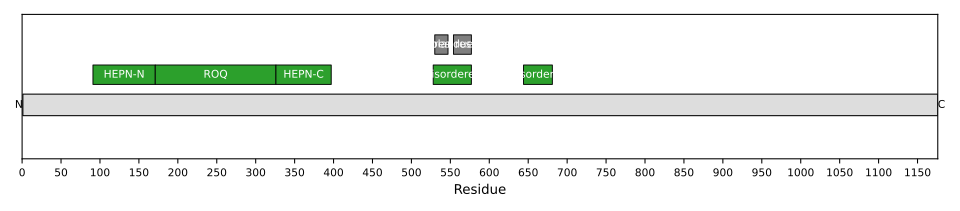
1: Post-transcriptional repressor of mRNAs containing a conserved stem loop motif, called constitutive decay element (CDE), which is often located in the 3'-UTR, as in HMGXB3, ICOS, IER3, NFKBID, NFKBIZ, PPP1R10, TNF and in many more mRNAs. Binds to CDE and promotes mRNA deadenylation and degradation. This process does not involve miRNAs. In follicular helper T (Tfh) cells, represses of ICOS and TNFRSF4 expression, thus preventing spontaneous Tfh cell differentiation, germinal center B-cell differentiation in the absence of immunization and autoimmunity. In resting or LPS-stimulated macrophages, controls inflammation by suppressing TNF expression. Also recognizes CDE in its own mRNA and in that of paralogous RC3H1, possibly leading to feedback loop regulation (By similarity). miRNA-binding protein that regulates microRNA homeostasis. Enhances DICER-mediated processing of pre-MIR146a but reduces mature MIR146a levels through an increase of 3' end uridylation. Both inhibits ICOS mRNA expression and they may act together to exert the suppression (PubMed:25697406). Acts as a ubiquitin E3 ligase. Pairs with E2 enzymes UBE2B, UBE2D2, UBE2E2, UBE2E3, UBE2G2, UBE2K and UBE2Q2 and produces polyubiquitin chains (PubMed:26489670). Shows the strongest activity when paired with UBE2N:UBE2V1 or UBE2N:UBE2V2 E2 complexes and generate both short and long polyubiquitin chains (PubMed:26489670). Involved in the ubiquitination of MAP3K5 (PubMed:24448648, PubMed:26489670, PubMed:29186683). Able to interact with double-stranded RNA (dsRNA) (PubMed:26489670)