T-lymphocyte surface antigen Ly-9 (Cell surface molecule Ly-9) (Lymphocyte antigen 9) (SLAM family member 3) (SLAMF3) (Signaling lymphocytic activation molecule 3) (CD antigen CD229)
1_MVAPK 6_ SHTDD 11_ WAPGP 16_ FSSKP 21_ QRSQL 26_ QIFSS 31_ VLQTS 36_ LLFLL 41_ MGLRA 46_ SGKDS 51_ APTVV 56_ SGILG 61_ GSVTL 66_ PLNIS 71_ VDTEI 76_ ENVIW 81_ IGPKN 86_ ALAFA 91_ RPKEN 96_ VTIMV 101_ KSYLG 106_ RLDIT 111_ KWSYS 116_ LCISN 121_ LTLND 126_ AGSYK 131_ AQINQ 136_ RNFEV 141_ TTEEE 146_ FTLFV 151_ YEQLQ 156_ EPQVT 161_ MKSVK 166_ VSENF 171_ SCNIT 176_ LMCSV 181_ KGAEK 186_ SVLYS 191_ WTPRE 196_ PHASE 201_ SNGGS 206_ ILTVS 211_ RTPCD 216_ PDLPY 221_ ICTAQ 226_ NPVSQ 231_ RSSLP 236_ VHVGQ 241_ FCTDP 246_ GASRG 251_ GTTGE 256_ TVVGV 261_ LGEPV 266_ TLPLA 271_ LPACR 276_ DTEKV 281_ VWLFN 286_ TSIIS 291_ KEREE 296_ AATAD 301_ PLIKS 306_ RDPYK 311_ NRVWV 316_ SSQDC 321_ SLKIS 326_ QLKIE 331_ DAGPY 336_ HAYVC 341_ SEASS 346_ VTSMT 351_ HVTLL 356_ IYRRL 361_ RKPKI 366_ TWSLR 371_ HSEDG 376_ ICRIS 381_ LTCSV 386_ EDGGN 391_ TVMYT 396_ WTPLQ 401_ KEAVV 406_ SQGES 411_ HLNVS 416_ WRSSE 421_ NHPNL 426_ TCTAS 431_ NPVSR 436_ SSHQF 441_ LSENI 446_ CSGPE 451_ RNTKL 456_ WIGLF 461_ LMVCL 466_ LCVGI 471_ FSWCI 476_ WKRKG 481_ RCSVP 486_ AFCSS 491_ QAEAP 496_ ADTPE 501_ PTAGH 506_ TLYSV 511_ LSQGY 516_ EKLDT 521_ PLRPA 526_ RQQPT 531_ PTSDS 536_ SSDSN 541_ LTTEE 546_ DEDRP 551_ EVHKP 556_ ISGRY 561_ EVFDQ 566_ VTQEG 571_ AGHDP 576_ APEGQ 581_ ADYDP 586_ VTPYV 591_ TEVES 596_ VVGEN 601_ TMYAQ 606_ VFNLQ 611_ GKTPV 616_ SQKEE 621_ SSATI 626_ YCSIR 631_ KPQVV 636_ PPPQQ 641_ NDLEI 646_PESPT
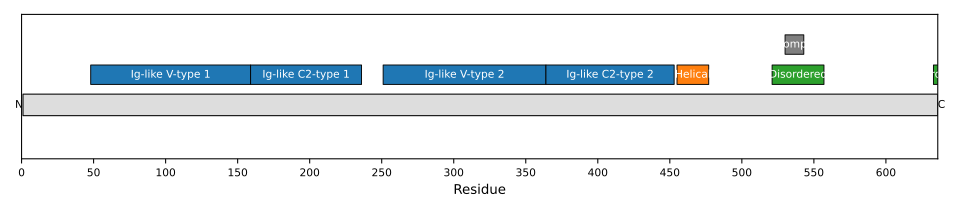
1: Self-ligand receptor of the signaling lymphocytic activation molecule (SLAM) family. SLAM receptors triggered by homo- or heterotypic cell-cell interactions are modulating the activation and differentiation of a wide variety of immune cells and thus are involved in the regulation and interconnection of both innate and adaptive immune response. Activities are controlled by presence or absence of small cytoplasmic adapter proteins, SH2D1A/SAP and/or SH2D1B/EAT-2. May participate in adhesion reactions between T lymphocytes and accessory cells by homophilic interaction. Promotes T-cell differentiation into a helper T-cell Th17 phenotype leading to increased IL-17 secretion; the costimulatory activity requires SH2D1A (PubMed:22184727). Promotes recruitment of RORC to the IL-17 promoter (PubMed:22989874). May be involved in the maintenance of peripheral cell tolerance by serving as a negative regulator of the immune response. May disable autoantibody responses and inhibit IFN-gamma secretion by CD4(+) T-cells. May negatively regulate the size of thymic innate CD8(+) T-cells and the development of invariant natural killer T (iNKT) cells (By similarity)