NmrA-like family domain-containing protein 1
1_MVDKK 6_ LVVVF 11_ GGTGA 16_ QGGSV 21_ ARTLL 26_ EDGTF 31_ KVRVV 36_ TRNPR 41_ KKAAK 46_ ELRLQ 51_ GAEVV 56_ QGDQD 61_ DQVIM 66_ ELALN 71_ GAYAT 76_ FIVTN 81_ YWESC 86_ SQEQE 91_ VKQGK 96_ LLADL 101_ ARRLG 106_ LHYVV 111_ YSGLE 116_ NIKKL 121_ TAGRL 126_ AAAHF 131_ DGKGE 136_ VEEYF 141_ RDIGV 146_ PMTSV 151_ RLPCY 156_ FENLL 161_ SHFLP 166_ QKAPD 171_ GKSYL 176_ LSLPT 181_ GDVPM 186_ DGMSV 191_ SDLGP 196_ VVLSL 201_ LKMPE 206_ KYVGQ 211_ NIGLS 216_ TCRHT 221_ AEEYA 226_ ALLTK 231_ HTRKV 236_ VHDAK 241_ MTPED 246_ YEKLG 251_ FPGAR 256_ DLANM 261_ FRFYA 266_ LRPDR 271_ DIELT 276_ LRLNP 281_ KALTL 286_ DQWLE 291_QHKGD
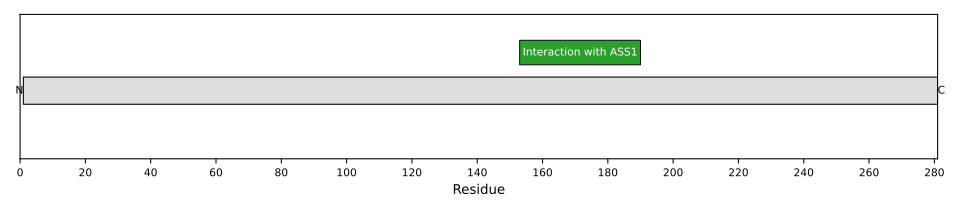
1: Redox sensor protein. Undergoes restructuring and subcellular redistribution in response to changes in intracellular NADPH/NADP(+) levels. At low NADPH concentrations the protein is found mainly as a monomer, and binds argininosuccinate synthase (ASS1), the enzyme involved in nitric oxide synthesis. Association with ASS1 impairs its activity and reduces the production of nitric oxide, which subsecuently prevents apoptosis. Under normal NADPH concentrations, the protein is found as a dimer and hides the binding site for ASS1. The homodimer binds one molecule of NADPH. Has higher affinity for NADPH than for NADP(+). Binding to NADPH is necessary to form a stable dimer