Nucleotide-binding oligomerization domain-containing protein 2 (Caspase recruitment domain-containing protein 15) (Inflammatory bowel disease protein 1)
1_MGEEG 6_ GSASH 11_ DEEER 16_ ASVLL 21_ GHSPG 26_ CEMCS 31_ QEAFQ 36_ AQRSQ 41_ LVELL 46_ VSGSL 51_ EGFES 56_ VLDWL 61_ LSWEV 66_ LSWED 71_ YEGFH 76_ LLGQP 81_ LSHLA 86_ RRLLD 91_ TVWNK 96_ GTWAC 101_ QKLIA 106_ AAQEA 111_ QADSQ 116_ SPKLH 121_ GCWDP 126_ HSLHP 131_ ARDLQ 136_ SHRPA 141_ IVRRL 146_ HSHVE 151_ NMLDL 156_ AWERG 161_ FVSQY 166_ ECDEI 171_ RLPIF 176_ TPSQR 181_ ARRLL 186_ DLATV 191_ KANGL 196_ AAFLL 201_ QHVQE 206_ LPVPL 211_ ALPLE 216_ AATCK 221_ KYMAK 226_ LRTTV 231_ SAQSR 236_ FLSTY 241_ DGAET 246_ LCLED 251_ IYTEN 256_ VLEVW 261_ ADVGM 266_ AGPPQ 271_ KSPAT 276_ LGLEE 281_ LFSTP 286_ GHLND 291_ DADTV 296_ LVVGE 301_ AGSGK 306_ STLLQ 311_ RLHLL 316_ WAAGQ 321_ DFQEF 326_ LFVFP 331_ FSCRQ 336_ LQCMA 341_ KPLSV 346_ RTLLF 351_ EHCCW 356_ PDVGQ 361_ EDIFQ 366_ LLLDH 371_ PDRVL 376_ LTFDG 381_ FDEFK 386_ FRFTD 391_ RERHC 396_ SPTDP 401_ TSVQT 406_ LLFNL 411_ LQGNL 416_ LKNAR 421_ KVVTS 426_ RPAAV 431_ SAFLR 436_ KYIRT 441_ EFNLK 446_ GFSEQ 451_ GIELY 456_ LRKRH 461_ HEPGV 466_ ADRLI 471_ RLLQE 476_ TSALH 481_ GLCHL 486_ PVFSW 491_ MVSKC 496_ HQELL 501_ LQEGG 506_ SPKTT 511_ TDMYL 516_ LILQH 521_ FLLHA 526_ TPPDS 531_ ASQGL 536_ GPSLL 541_ RGRLP 546_ TLLHL 551_ GRLAL 556_ WGLGM 561_ CCYVF 566_ SAQQL 571_ QAAQV 576_ SPDDI 581_ SLGFL 586_ VRAKG 591_ VVPGS 596_ TAPLE 601_ FLHIT 606_ FQCFF 611_ AAFYL 616_ ALSAD 621_ VPPAL 626_ LRHLF 631_ NCGRP 636_ GNSPM 641_ ARLLP 646_ TMCIQ 651_ ASEGK 656_ DSSVA 661_ ALLQK 666_ AEPHN 671_ LQITA 676_ AFLAG 681_ LLSRE 686_ HWGLL 691_ AECQT 696_ SEKAL 701_ LRRQA 706_ CARWC 711_ LARSL 716_ RKHFH 721_ SIPPA 726_ APGEA 731_ KSVHA 736_ MPGFI 741_ WLIRS 746_ LYEMQ 751_ EERLA 756_ RKAAR 761_ GLNVG 766_ HLKLT 771_ FCSVG 776_ PTECA 781_ ALAFV 786_ LQHLR 791_ RPVAL 796_ QLDYN 801_ SVGDI 806_ GVEQL 811_ LPCLG 816_ VCKAL 821_ YLRDN 826_ NISDR 831_ GICKL 836_ IECAL 841_ HCEQL 846_ QKLAL 851_ FNNKL 856_ TDGCA 861_ HSMAK 866_ LLACR 871_ QNFLA 876_ LRLGN 881_ NYITA 886_ AGAQV 891_ LAEGL 896_ RGNTS 901_ LQFLG 906_ FWGNR 911_ VGDEG 916_ AQALA 921_ EALGD 926_ HQSLR 931_ WLSLV 936_ GNNIG 941_ SVGAQ 946_ ALALM 951_ LAKNV 956_ MLEEL 961_ CLEEN 966_ HLQDE 971_ GVCSL 976_ AEGLK 981_ KNSSL 986_ KILKL 991_ SNNCI 996_ TYLGA 1001_ EALLQ 1006_ ALERN 1011_ DTILE 1016_ VWLRG 1021_ NTFSL 1026_ EEVDK 1031_LGCRD
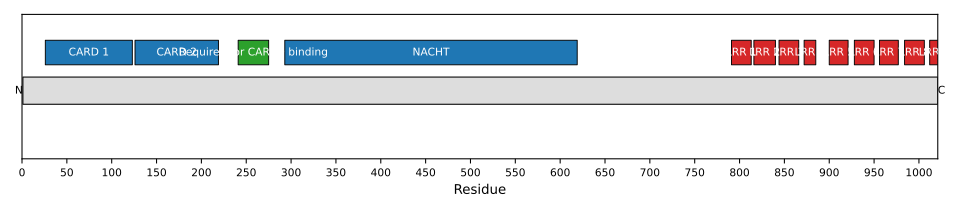
1: Pattern recognition receptor (PRR) that detects bacterial peptidoglycan fragments and other danger signals and plays an important role in gastrointestinal immunity (PubMed:12514169, PubMed:12527755, PubMed:12626759, PubMed:15044951, PubMed:15998797, PubMed:27283905, PubMed:27748583, PubMed:31649195). Specifically activated by muramyl dipeptide (MDP), a fragment of bacterial peptidoglycan found in every bacterial peptidoglycan type (PubMed:12514169, PubMed:12527755, PubMed:12626759, PubMed:12871942, PubMed:15044951, PubMed:15198989, PubMed:15998797, PubMed:22857257, PubMed:23322906, PubMed:27748583, PubMed:36002575). NOD2 specifically recognizes and binds 6-O-phospho-MDP, the phosphorylated form of MDP, which is generated by NAGK (PubMed:36002575). 6-O-phospho-MDP-binding triggers oligomerization that facilitates the binding and subsequent activation of the proximal adapter receptor-interacting RIPK2 (PubMed:11087742, PubMed:17355968, PubMed:21887730, PubMed:23806334, PubMed:28436939). Following recruitment, RIPK2 undergoes 'Met-1'- (linear) and 'Lys-63'-linked polyubiquitination by E3 ubiquitin-protein ligases XIAP, BIRC2, BIRC3 and the LUBAC complex, becoming a scaffolding protein for downstream effectors, triggering activation of the NF-kappa-B and MAP kinases signaling (PubMed:11087742, PubMed:12514169, PubMed:12626759, PubMed:15198989, PubMed:21887730, PubMed:23322906, PubMed:23806334, PubMed:28436939). This in turn leads to the transcriptional activation of hundreds of genes involved in immune response (PubMed:15198989). Its ability to detect bacterial MDP plays a central role in maintaining the equilibrium between intestinal microbiota and host immune responses to control inflammation (By similarity). An imbalance in this relationship results in dysbiosis, whereby pathogenic bacteria prevail on commensals, causing damage in the intestinal epithelial barrier as well as allowing bacterial invasion and inflammation (By similarity). Acts as a regulator of appetite by sensing MDP in a subset of brain neurons: microbiota-derived MDP reach the brain, where they bind and activate NOD2 in inhibitory hypothalamic neurons, decreasing neuronal activity, thereby regulating satiety and body temperature (By similarity). NOD2-dependent MDP-sensing of bacterial cell walls in the intestinal epithelial compartment contributes to sustained postnatal growth upon undernutrition (By similarity). Also plays a role in antiviral response by acting as a sensor of single-stranded RNA (ssRNA) from viruses: upon ssRNA-binding, interacts with MAVS, leading to activation of interferon regulatory factor-3/IRF3 and expression of type I interferon (PubMed:19701189). Also acts as a regulator of autophagy in dendritic cells via its interaction with ATG16L1, possibly by recruiting ATG16L1 at the site of bacterial entry (PubMed:20637199). NOD2 activation in the small intestine crypt also contributes to intestinal stem cells survival and function: acts by promoting mitophagy via its association with ATG16L1 (By similarity). In addition to its main role in innate immunity, also regulates the adaptive immune system by acting as regulator of helper T-cell and regulatory T-cells (Tregs) (By similarity). Besides recognizing pathogens, also involved in the endoplasmic reticulum stress response: acts by sensing and binding to the cytosolic metabolite sphingosine-1-phosphate generated in response to endoplasmic reticulum stress, initiating an inflammation process that leads to activation of the NF-kappa-B and MAP kinases signaling (PubMed:27007849, PubMed:33942347). May also be involved in NLRP1 activation following activation by MDP, leading to CASP1 activation and IL1B release in macrophages (PubMed:18511561)
2: Acts as a pattern recognition receptor (PRR); able to activate NF-kappa-B
3: Can activate NF-kappa-B in a muramyl dipeptide (MDP)-independent manner