CD209 antigen (C-type lectin domain family 4 member L) (Dendritic cell-specific ICAM-3-grabbing non-integrin 1) (DC-SIGN) (DC-SIGN1) (CD antigen CD209)
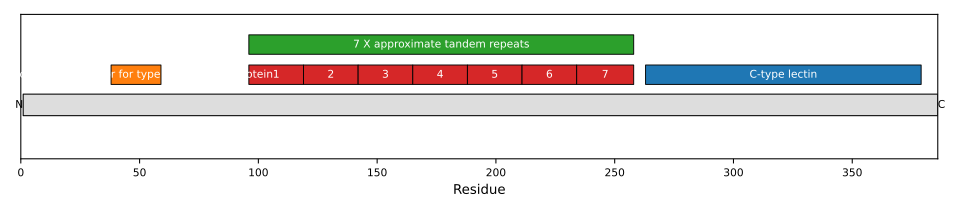
1_MSDSK 6_ EPRLQ 11_ QLGLL 16_ EEEQL 21_ RGLGF 26_ RQTRG 31_ YKSLA 36_ GCLGH 41_ GPLVL 46_ QLLSF 51_ TLLAG 56_ LLVQV 61_ SKVPS 66_ SISQE 71_ QSRQD 76_ AIYQN 81_ LTQLK 86_ AAVGE 91_ LSEKS 96_ KLQEI 101_ YQELT 106_ QLKAA 111_ VGELP 116_ EKSKL 121_ QEIYQ 126_ ELTRL 131_ KAAVG 136_ ELPEK 141_ SKLQE 146_ IYQEL 151_ TWLKA 156_ AVGEL 161_ PEKSK 166_ MQEIY 171_ QELTR 176_ LKAAV 181_ GELPE 186_ KSKQQ 191_ EIYQE 196_ LTRLK 201_ AAVGE 206_ LPEKS 211_ KQQEI 216_ YQELT 221_ RLKAA 226_ VGELP 231_ EKSKQ 236_ QEIYQ 241_ ELTQL 246_ KAAVE 251_ RLCHP 256_ CPWEW 261_ TFFQG 266_ NCYFM 271_ SNSQR 276_ NWHDS 281_ ITACK 286_ EVGAQ 291_ LVVIK 296_ SAEEQ 301_ NFLQL 306_ QSSRS 311_ NRFTW 316_ MGLSD 321_ LNQEG 326_ TWQWV 331_ DGSPL 336_ LPSFK 341_ QYWNR 346_ GEPNN 351_ VGEED 356_ CAEFS 361_ GNGWN 366_ DDKCN 371_ LAKFW 376_ ICKKS 381_ AASCS 386_ RDEEQ 391_ FLSPA 396_PATPN
1: Pathogen-recognition receptor expressed on the surface of immature dendritic cells (DCs) and involved in initiation of primary immune response. Thought to mediate the endocytosis of pathogens which are subsequently degraded in lysosomal compartments. The receptor returns to the cell membrane surface and the pathogen-derived antigens are presented to resting T-cells via MHC class II proteins to initiate the adaptive immune response
2: On DCs it is a high affinity receptor for ICAM2 and ICAM3 by binding to mannose-like carbohydrates. May act as a DC rolling receptor that mediates transendothelial migration of DC presursors from blood to tissues by binding endothelial ICAM2. Seems to regulate DC-induced T-cell proliferation by binding to ICAM3 on T-cells in the immunological synapse formed between DC and T-cells
3: (Microbial infection) Acts as an attachment receptor for HIV-1 and HIV-2
4: (Microbial infection) Acts as an attachment receptor for Ebolavirus
5: (Microbial infection) Acts as an attachment receptor for Cytomegalovirus
6: (Microbial infection) Acts as an attachment receptor for HCV
7: (Microbial infection) Acts as an attachment receptor for Dengue virus
8: (Microbial infection) Acts as an attachment receptor for Measles virus
9: (Microbial infection) Acts as an attachment receptor for Herpes simplex virus 1
10: (Microbial infection) Acts as an attachment receptor for Influenzavirus A
11: (Microbial infection) Acts as an attachment receptor for SARS-CoV
12: (Microbial infection) Acts as an attachment receptor for Japanese encephalitis virus
13: (Microbial infection) Acts as an attachment receptor for Lassa virus (PubMed:23966408). Acts as an attachment receptor for Marburg virusn
14: (Microbial infection) Acts as an attachment receptor for Respiratory syncytial virus
15: (Microbial infection) Acts as an attachment receptor for Rift valley fever virus and uukuniemi virus
16: (Microbial infection) Acts as an attachment receptor for West-nile virus
17: (Microbial infection) Probably recognizes in a calcium-dependent manner high mannose N-linked oligosaccharides in a variety of bacterial pathogen antigens, including Leishmania pifanoi LPG, Lewis-x antigen in Helicobacter pylori LPS, mannose in Klebsiella pneumonae LPS, di-mannose and tri-mannose in Mycobacterium tuberculosis ManLAM and Lewis-x antigen in Schistosoma mansoni SEA (PubMed:16379498). Recognition of M.tuberculosis by dendritic cells occurs partially via this molecule (PubMed:16092920, PubMed:21203928)