Partitioning defective 6 homolog alpha (PAR-6) (PAR-6 alpha) (PAR-6A) (PAR6C) (Tax interaction protein 40) (TIP-40)
1_MARPQ 6_ RTPAR 11_ SPDSI 16_ VEVKS 21_ KFDAE 26_ FRRFA 31_ LPRAS 36_ VSGFQ 41_ EFSRL 46_ LRAVH 51_ QIPGL 56_ DVLLG 61_ YTDAH 66_ GDLLP 71_ LTNDD 76_ SLHRA 81_ LASGP 86_ PPLRL 91_ LVQKR 96_ AEADS 101_ SGLAF 106_ ASNSL 111_ QRRKK 116_ GLLLR 121_ PVAPL 126_ RTRPP 131_ LLISL 136_ PQDFR 141_ QVSSV 146_ IDVDL 151_ LPETH 156_ RRVRL 161_ HKHGS 166_ DRPLG 171_ FYIRD 176_ GMSVR 181_ VAPQG 186_ LERVP 191_ GIFIS 196_ RLVRG 201_ GLAES 206_ TGLLA 211_ VSDEI 216_ LEVNG 221_ IEVAG 226_ KTLDQ 231_ VTDMM 236_ VANSH 241_ NLIVT 246_ VKPAN 251_ QRNNV 256_ VRGAS 261_ GRLTG 266_ PPSAG 271_ PGPAE 276_ PDSDD 281_ DSSDL 286_ VIENR 291_ QPPSS 296_ NGLSQ 301_ GPPCW 306_ DLHPG 311_ CRHPG 316_ TRSSL 321_ PSLDD 326_ QEQAS 331_ SGWGS 336_ RIRGD 341_GSGFS
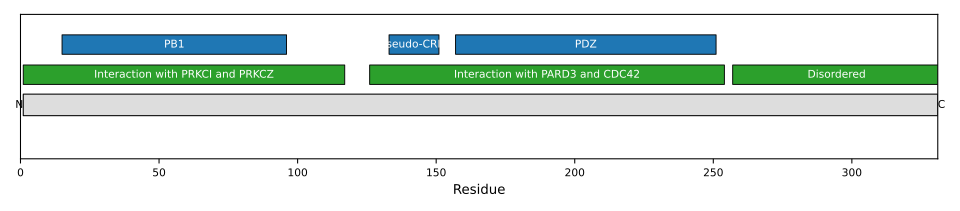
1: Adapter protein involved in asymmetrical cell division and cell polarization processes. Probably involved in the formation of epithelial tight junctions. Association with PARD3 may prevent the interaction of PARD3 with F11R/JAM1, thereby preventing tight junction assembly. The PARD6-PARD3 complex links GTP-bound Rho small GTPases to atypical protein kinase C proteins (PubMed:10873802). Regulates centrosome organization and function. Essential for the centrosomal recruitment of key proteins that control centrosomal microtubule organization (PubMed:20719959)