Potassium channel subfamily K member 9 (Acid-sensitive potassium channel protein TASK-3) (TWIK-related acid-sensitive K(+) channel 3) (Two pore potassium channel KT3.2) (Two pore K(+) channel KT3.2)
1_MKRQN 6_ VRTLS 11_ LIVCT 16_ FTYLL 21_ VGAAV 26_ FDALE 31_ SDHEM 36_ REEEK 41_ LKAEE 46_ IRIKG 51_ KYNIS 56_ SEDYR 61_ QLELV 66_ ILQSE 71_ PHRAG 76_ VQWKF 81_ AGSFY 86_ FAITV 91_ ITTIG 96_ YGHAA 101_ PGTDA 106_ GKAFC 111_ MFYAV 116_ LGIPL 121_ TLVMF 126_ QSLGE 131_ RMNTF 136_ VRYLL 141_ KRIKK 146_ CCGMR 151_ NTDVS 156_ MENMV 161_ TVGFF 166_ SCMGT 171_ LCIGA 176_ AAFSQ 181_ CEEWS 186_ FFHAY 191_ YYCFI 196_ TLTTI 201_ GFGDY 206_ VALQT 211_ KGALQ 216_ KKPLY 221_ VAFSF 226_ MYILV 231_ GLTVI 236_ GAFLN 241_ LVVLR 246_ FLTMN 251_ SEDER 256_ RDAEE 261_ RASLA 266_ GNRNS 271_ MVIHI 276_ PEEPR 281_ PSRPR 286_ YKADV 291_ PDLQS 296_ VCSCT 301_ CYRSQ 306_ DYGGR 311_ SVAPQ 316_ NSFSA 321_ KLAPH 326_ YFHSI 331_ SYKIE 336_ EISPS 341_ TLKNS 346_ LFPSP 351_ ISSIS 356_ PGLHS 361_ FTDHQ 366_RLMKR
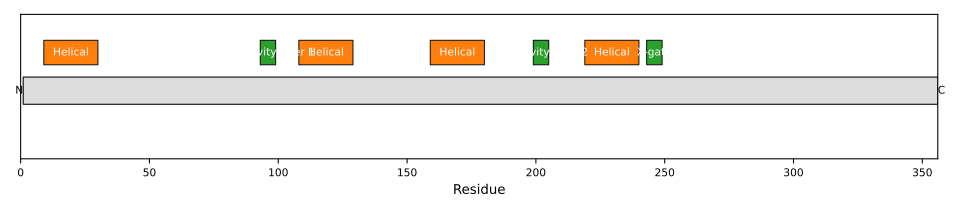
1: K(+) channel that conducts voltage-dependent outward rectifying currents upon membrane depolarization. Voltage sensing is coupled to K(+) electrochemical gradient in an 'ion flux gating' mode where outward but not inward ion flow opens the gate (PubMed:11042359, PubMed:11431495, PubMed:26919430, PubMed:38630723). Changes ion selectivity and becomes permeable to Na(+) ions in response to extracellular acidification. Protonation of the pH sensor His-98 stabilizes C-type inactivation conformation likely converting the channel from outward K(+)-conducting, to inward Na(+)-conducting to nonconductive state (PubMed:22948150, PubMed:38630723). Homo- and heterodimerizes to form functional channels with distinct regulatory and gating properties (By similarity) (PubMed:23169818, PubMed:38630723). Allows K(+) currents with fast-gating kinetics important for the repolarization and hyperpolarization phases of action potentials (By similarity). In granule neurons, hyperpolarizes the resting membrane potential to limit intrinsic neuronal excitability, but once the action potential threshold is reached, supports high-frequency action potential firing and increased neuronal excitability. Homomeric and/or heteromeric KCNK3:KCNK9 channels operate in cerebellar granule cells, whereas heteromeric KCNK1:KCNK9 enables currents in hippocampal dentate gyrus granule neurons (By similarity). Dispensable for central chemosensory respiration i.e. breathing controlled by brainstem CO2/pH, it rather conducts pH-sensitive currents and controls the firing rate of serotonergic raphe neurons involved in potentiation of the respiratory chemoreflex (By similarity). In retinal ganglion cells, mediates outward currents that regulate action potentials in response to acidification of the synaptic cleft. Involved in transmission of image-forming and nonimage-forming visual information in the retina (By similarity). In adrenal gland, contributes to the maintenance of a hyperpolarized resting membrane potential of aldosterone-producing cells at zona glomerulosa and limits aldosterone release as part of a regulatory mechanism that controls arterial blood pressure and electrolyte homeostasis (By similarity)