Homeobox protein SIX2 (Sine oculis homeobox homolog 2)
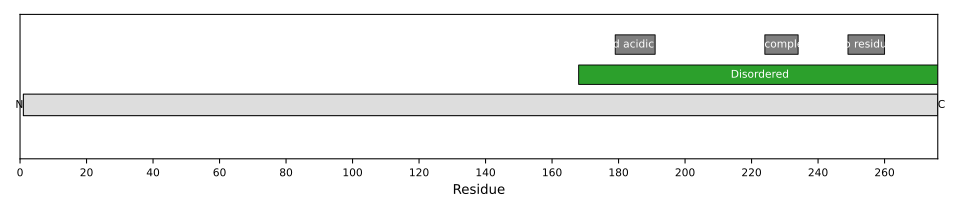
1_MSMLP 6_ TFGFT 11_ QEQVA 16_ CVCEV 21_ LQQGG 26_ NIERL 31_ GRFLW 36_ SLPAC 41_ EHLHK 46_ NESVL 51_ KAKAV 56_ VAFHR 61_ GNFRE 66_ LYKIL 71_ ESHQF 76_ SPHNH 81_ AKLQQ 86_ LWLKA 91_ HYIEA 96_ EKLRG 101_ RPLGA 106_ VGKYR 111_ VRRKF 116_ PLPRS 121_ IWDGE 126_ ETSYC 131_ FKEKS 136_ RSVLR 141_ EWYAH 146_ NPYPS 151_ PREKR 156_ ELAEA 161_ TGLTT 166_ TQVSN 171_ WFKNR 176_ RQRDR 181_ AAEAK 186_ ERENN 191_ ENSNS 196_ NSHNP 201_ LNGSG 206_ KSVLG 211_ SSEDE 216_ KTPSG 221_ TPDHS 226_ SSSPA 231_ LLLSP 236_ PPPGL 241_ PSLHS 246_ LGHPP 251_ GPSAV 256_ PVPVP 261_ GGGGA 266_ DPLQH 271_ HHGLQ 276_ DSILN 281_ PMSAN 286_LVDLG
1: Transcription factor that plays an important role in the development of several organs, including kidney, skull and stomach. During kidney development, maintains cap mesenchyme multipotent nephron progenitor cells in an undifferentiated state by opposing the inductive signals emanating from the ureteric bud and cooperates with WNT9B to promote renewing progenitor cells proliferation. Acts through its interaction with TCF7L2 and OSR1 in a canonical Wnt signaling independent manner preventing transcription of differentiation genes in cap mesenchyme such as WNT4. Also acts independently of OSR1 to activate expression of many cap mesenchyme genes, including itself, GDNF and OSR1. During craniofacial development plays a role in growth and elongation of the cranial base through regulation of chondrocyte differentiation. During stomach organogenesis, controls pyloric sphincter formation and mucosal growth through regulation of a gene network including NKX2-5, BMPR1B, BMP4, SOX9 and GREM1. During branchial arch development, acts to mediate HOXA2 control over the insulin-like growth factor pathway. May also be involved in limb tendon and ligament development (By similarity). Plays a role in cell proliferation and migration