Frizzled-3 (Fz-3) (hFz3)
1_MAMTW 6_ IVFSL 11_ WPLTV 16_ FMGHI 21_ GGHSL 26_ FSCEP 31_ ITLRM 36_ CQDLP 41_ YNTTF 46_ MPNLL 51_ NHYDQ 56_ QTAAL 61_ AMEPF 66_ HPMVN 71_ LDCSR 76_ DFRPF 81_ LCALY 86_ APICM 91_ EYGRV 96_ TLPCR 101_ RLCQR 106_ AYSEC 111_ SKLME 116_ MFGVP 121_ WPEDM 126_ ECSRF 131_ PDCDE 136_ PYPRL 141_ VDLNL 146_ AGEPT 151_ EGAPV 156_ AVQRD 161_ YGFWC 166_ PRELK 171_ IDPDL 176_ GYSFL 181_ HVRDC 186_ SPPCP 191_ NMYFR 196_ REELS 201_ FARYF 206_ IGLIS 211_ IICLS 216_ ATLFT 221_ FLTFL 226_ IDVTR 231_ FRYPE 236_ RPIIF 241_ YAVCY 246_ MMVSL 251_ IFFIG 256_ FLLED 261_ RVACN 266_ ASIPA 271_ QYKAS 276_ TVTQG 281_ SHNKA 286_ CTMLF 291_ MILYF 296_ FTMAG 301_ SVWWV 306_ ILTIT 311_ WFLAA 316_ VPKWG 321_ SEAIE 326_ KKALL 331_ FHASA 336_ WGIPG 341_ TLTII 346_ LLAMN 351_ KIEGD 356_ NISGV 361_ CFVGL 366_ YDVDA 371_ LRYFV 376_ LAPLC 381_ LYVVV 386_ GVSLL 391_ LAGII 396_ SLNRV 401_ RIEIP 406_ LEKEN 411_ QDKLV 416_ KFMIR 421_ IGVFS 426_ ILYLV 431_ PLLVV 436_ IGCYF 441_ YEQAY 446_ RGIWE 451_ TTWIQ 456_ ERCRE 461_ YHIPC 466_ PYQVT 471_ QMSRP 476_ DLILF 481_ LMKYL 486_ MALIV 491_ GIPSV 496_ FWVGS 501_ KKTCF 506_ EWASF 511_ FHGRR 516_ KKEIV 521_ NESRQ 526_ VLQEP 531_ DFAQS 536_ LLRDP 541_ NTPII 546_ RKSRG 551_ TSTQG 556_ TSTHA 561_ SSTQL 566_ AMVDD 571_ QRSKA 576_ GSIHS 581_ KVSSY 586_ HGSLH 591_ RSRDG 596_ RYTPC 601_ SYRGM 606_ EERLP 611_ HGSMS 616_ RLTDH 621_ SRHSS 626_ SHRLN 631_ EQSRH 636_ SSIRD 641_ LSNNP 646_ MTHIT 651_ HGTSM 656_ NRVIE 661_EDGTS
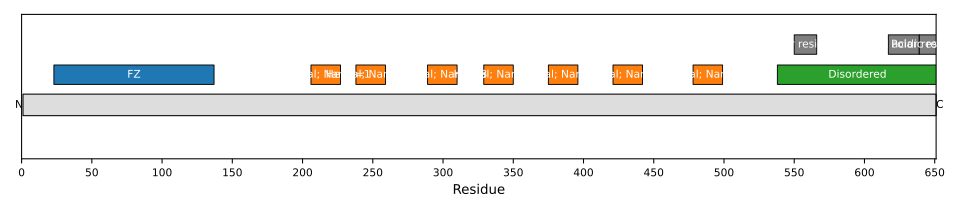
1: Receptor for Wnt proteins. Most of frizzled receptors are coupled to the beta-catenin canonical signaling pathway, which leads to the activation of disheveled proteins, inhibition of GSK-3 kinase, nuclear accumulation of beta-catenin and activation of Wnt target genes. A second signaling pathway involving PKC and calcium fluxes has been seen for some family members, but it is not yet clear if it represents a distinct pathway or if it can be integrated in the canonical pathway, as PKC seems to be required for Wnt-mediated inactivation of GSK-3 kinase. Both pathways seem to involve interactions with G-proteins. Activation by Wnt5A stimulates PKC activity via a G-protein-dependent mechanism. Involved in transduction and intercellular transmission of polarity information during tissue morphogenesis and/or in differentiated tissues. Plays a role in controlling early axon growth and guidance processes necessary for the formation of a subset of central and peripheral major fiber tracts. Required for the development of major fiber tracts in the central nervous system, including: the anterior commissure, the corpus callosum, the thalamocortical, corticothalamic and nigrostriatal tracts, the corticospinal tract, the fasciculus retroflexus, the mammillothalamic tract, the medial lemniscus, and ascending fiber tracts from the spinal cord to the brain. In the peripheral nervous system, controls axon growth in distinct populations of cranial and spinal motor neurons, including the facial branchimotor nerve, the hypoglossal nerve, the phrenic nerve, and motor nerves innervating dorsal limbs. Involved in the migration of cranial neural crest cells. May also be implicated in the transmission of sensory information from the trunk and limbs to the brain. Controls commissural sensory axons guidance after midline crossing along the anterior-posterior axis in the developing spinal cord in a Wnt-dependent signaling pathway. Together with FZD6, is involved in the neural tube closure and plays a role in the regulation of the establishment of planar cell polarity (PCP), particularly in the orientation of asymmetric bundles of stereocilia on the apical faces of a subset of auditory and vestibular sensory cells located in the inner ear. Promotes neurogenesis by maintaining sympathetic neuroblasts within the cell cycle in a beta-catenin-dependent manner (By similarity)