Exosome complex component RRP46 (Chronic myelogenous leukemia tumor antigen 28) (Exosome component 5) (Ribosomal RNA-processing protein 46) (p12B)
1_MEEET 6_ HTDAK 11_ IRAEN 16_ GTGSS 21_ PRGPG 26_ CSLRH 31_ FACEQ 36_ NLLSR 41_ PDGSA 46_ SFLQG 51_ DTSVL 56_ AGVYG 61_ PAEVK 66_ VSKEI 71_ FNKAT 76_ LEVIL 81_ RPKIG 86_ LPGVA 91_ EKSRE 96_ RLIRN 101_ TCEAV 106_ VLGTL 111_ HPRTS 116_ ITVVL 121_ QVVSD 126_ AGSLL 131_ ACCLN 136_ AACMA 141_ LVDAG 146_ VPMRA 151_ LFCGV 156_ ACALD 161_ SDGTL 166_ VLDPT 171_ SKQEK 176_ EARAV 181_ LTFAL 186_ DSVER 191_ KLLMS 196_ STKGL 201_ YSDTE 206_ LQQCL 211_ AAAQA 216_ ASQHV 221_ FRFYR 226_ESLQR
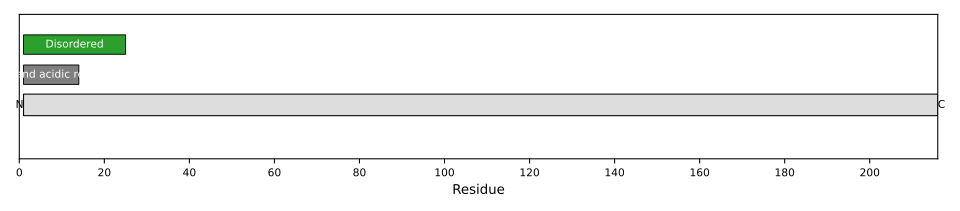
1: Non-catalytic component of the RNA exosome complex which has 3'->5' exoribonuclease activity and participates in a multitude of cellular RNA processing and degradation events. In the nucleus, the RNA exosome complex is involved in proper maturation of stable RNA species such as rRNA, snRNA and snoRNA, in the elimination of RNA processing by-products and non-coding 'pervasive' transcripts, such as antisense RNA species and promoter-upstream transcripts (PROMPTs), and of mRNAs with processing defects, thereby limiting or excluding their export to the cytoplasm. The RNA exosome may be involved in Ig class switch recombination (CSR) and/or Ig variable region somatic hypermutation (SHM) by targeting AICDA deamination activity to transcribed dsDNA substrates. In the cytoplasm, the RNA exosome complex is involved in general mRNA turnover and specifically degrades inherently unstable mRNAs containing AU-rich elements (AREs) within their 3' untranslated regions, and in RNA surveillance pathways, preventing translation of aberrant mRNAs. It seems to be involved in degradation of histone mRNA. The catalytic inactive RNA exosome core complex of 9 subunits (Exo-9) is proposed to play a pivotal role in the binding and presentation of RNA for ribonucleolysis, and to serve as a scaffold for the association with catalytic subunits and accessory proteins or complexes (PubMed:11782436, PubMed:21269460). In vitro, EXOSC5 does not bind or digest single-stranded RNA and binds to double-stranded DNA without detectable DNase activity (PubMed:20660080)