Histone-lysine N-methyltransferase PRDM9 (PR domain zinc finger protein 9) (PR domain-containing protein 9) (Protein-lysine N-methyltransferase PRDM9) (EC 2.1.1.-) ([histone H3]-lysine36 N-trimethyltransferase PRDM9) (EC 2.1.1.359) ([histone H3]-lysine4 N-trimethyltransferase PRDM9) (EC 2.1.1.354) ([histone H3]-lysine9 N-trimethyltransferase PRDM9) (EC 2.1.1.355) ([histone H4]-N-methyl-L-lysine20 N-methyltransferase PRDM9) (EC 2.1.1.362) ([histone H4]-lysine20 N-methyltransferase PRDM9) (EC 2.1.1.361)
1_MSPEK 6_ SQEES 11_ PEEDT 16_ ERTER 21_ KPMVK 26_ DAFKD 31_ ISIYF 36_ TKEEW 41_ AEMGD 46_ WEKTR 51_ YRNVK 56_ RNYNA 61_ LITIG 66_ LRATR 71_ PAFMC 76_ HRRQA 81_ IKLQV 86_ DDTED 91_ SDEEW 96_ TPRQQ 101_ VKPPW 106_ MALRV 111_ EQRKH 116_ QKGMP 121_ KASFS 126_ NESSL 131_ KELSR 136_ TANLL 141_ NASGS 146_ EQAQK 151_ PVSPS 156_ GEAST 161_ SGQHS 166_ RLKLE 171_ LRKKE 176_ TERKM 181_ YSLRE 186_ RKGHA 191_ YKEVS 196_ EPQDD 201_ DYLYC 206_ EMCQN 211_ FFIDS 216_ CAAHG 221_ PPTFV 226_ KDSAV 231_ DKGHP 236_ NRSAL 241_ SLPPG 246_ LRIGP 251_ SGIPQ 256_ AGLGV 261_ WNEAS 266_ DLPLG 271_ LHFGP 276_ YEGRI 281_ TEDEE 286_ AANNG 291_ YSWLI 296_ TKGRN 301_ CYEYV 306_ DGKDK 311_ SWANW 316_ MRYVN 321_ CARDD 326_ EEQNL 331_ VAFQY 336_ HRQIF 341_ YRTCR 346_ VIRPG 351_ CELLV 356_ WYGDE 361_ YGQEL 366_ GIKWG 371_ SKWKK 376_ ELMAG 381_ REPKP 386_ EIHPC 391_ PSCCL 396_ AFSSQ 401_ KFLSQ 406_ HVERN 411_ HSSQN 416_ FPGPS 421_ ARKLL 426_ QPENP 431_ CPGDQ 436_ NQEQQ 441_ YPDPH 446_ SRNDK 451_ TKGQE 456_ IKERS 461_ KLLNK 466_ RTWQR 471_ EISRA 476_ FSSPP 481_ KGQMG 486_ SCRVG 491_ KRIME 496_ EESRT 501_ GQKVN 506_ PGNTG 511_ KLFVG 516_ VGISR 521_ IAKVK 526_ YGECG 531_ QGFSV 536_ KSDVI 541_ THQRT 546_ HTGEK 551_ LYVCR 556_ ECGRG 561_ FSWKS 566_ HLLIH 571_ QRIHT 576_ GEKPY 581_ VCREC 586_ GRGFS 591_ WQSVL 596_ LTHQR 601_ THTGE 606_ KPYVC 611_ RECGR 616_ GFSRQ 621_ SVLLT 626_ HQRRH 631_ TGEKP 636_ YVCRE 641_ CGRGF 646_ SRQSV 651_ LLTHQ 656_ RRHTG 661_ EKPYV 666_ CRECG 671_ RGFSW 676_ QSVLL 681_ THQRT 686_ HTGEK 691_ PYVCR 696_ ECGRG 701_ FSWQS 706_ VLLTH 711_ QRTHT 716_ GEKPY 721_ VCREC 726_ GRGFS 731_ NKSHL 736_ LRHQR 741_ THTGE 746_ KPYVC 751_ RECGR 756_ GFRDK 761_ SHLLR 766_ HQRTH 771_ TGEKP 776_ YVCRE 781_ CGRGF 786_ RDKSN 791_ LLSHQ 796_ RTHTG 801_ EKPYV 806_ CRECG 811_ RGFSN 816_ KSHLL 821_ RHQRT 826_ HTGEK 831_ PYVCR 836_ ECGRG 841_ FRNKS 846_ HLLRH 851_ QRTHT 856_ GEKPY 861_ VCREC 866_ GRGFS 871_ DRSSL 876_ CYHQR 881_ THTGE 886_KPYVC
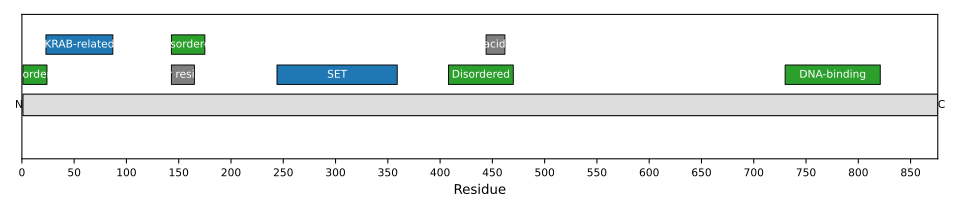
1: Histone methyltransferase that sequentially mono-, di-, and tri-methylates both 'Lys-4' (H3K4) and 'Lys-36' (H3K36) of histone H3 to produce respectively trimethylated 'Lys-4' (H3K4me3) and trimethylated 'Lys-36' (H3K36me3) histone H3 and plays a key role in meiotic prophase by determining hotspot localization thereby promoting meiotic recombination (PubMed:24095733, PubMed:24634223, PubMed:26833727, PubMed:27129774). Can also methylate all four core histones with H3 being the best substrate and the most highly modified (PubMed:24095733, PubMed:24634223, PubMed:26833727). Is also able, on one hand, to mono and di-methylate H4K20 and on other hand to trimethylate H3K9 with the di-methylated H3K9 as the best substrate (By similarity). During meiotic prophase, binds specific DNA sequences through its zinc finger domains thereby determining hotspot localization where it promotes local H3K4me3 and H3K36me3 enrichment on the same nucleosomes through its histone methyltransferase activity (PubMed:26833727). Thereby promotes double-stranded breaks (DSB) formation, at this subset of PRDM9-binding sites, that initiates meiotic recombination for the proper meiotic progression (By similarity). During meiotic progression hotspot-bound PRDM9 interacts with several complexes; in early leptonema binds CDYL and EHMT2 followed by EWSR1 and CXXC1 by the end of leptonema. EWSR1 joins PRDM9 with the chromosomal axis through REC8 (By similarity). In this way, controls the DSB repair pathway, pairing of homologous chromosomes and sex body formation (By similarity). Moreover plays a central role in the transcriptional activation of genes during early meiotic prophase thanks to H3K4me3 and H3K36me3 enrichment that represents a specific tag for epigenetic transcriptional activation (By similarity). In addition performs automethylation (By similarity). Acetylation and phosphorylation of histone H3 attenuate or prevent histone H3 methylation (By similarity)