Acetyl-coenzyme A synthetase, cytoplasmic (EC 6.2.1.1) (Acetate--CoA ligase) (Acetyl-CoA synthetase) (ACS) (AceCS) (Acetyl-CoA synthetase 1) (AceCS1) (Acyl-CoA synthetase short-chain family member 2) (Acyl-activating enzyme) (Propionate--CoA ligase) (EC 6.2.1.17)
1_MGLPE 6_ ERVRS 11_ GSGSR 16_ GQEEA 21_ GAGGR 26_ ARSWS 31_ PPPEV 36_ SRSAH 41_ VPSLQ 46_ RYREL 51_ HRRSV 56_ EEPRE 61_ FWGDI 66_ AKEFY 71_ WKTPC 76_ PGPFL 81_ RYNFD 86_ VTKGK 91_ IFIEW 96_ MKGAT 101_ TNICY 106_ NVLDR 111_ NVHEK 116_ KLGDK 121_ VAFYW 126_ EGNEP 131_ GETTQ 136_ ITYHQ 141_ LLVQV 146_ CQFSN 151_ VLRKQ 156_ GIQKG 161_ DRVAI 166_ YMPMI 171_ PELVV 176_ AMLAC 181_ ARIGA 186_ LHSIV 191_ FAGFS 196_ SESLC 201_ ERILD 206_ SSCSL 211_ LITTD 216_ AFYRG 221_ EKLVN 226_ LKELA 231_ DEALQ 236_ KCQEK 241_ GFPVR 246_ CCIVV 251_ KHLGR 256_ AELGM 261_ GDSTS 266_ QSPPI 271_ KRSCP 276_ DVQIS 281_ WNQGI 286_ DLWWH 291_ ELMQE 296_ AGDEC 301_ EPEWC 306_ DAEDP 311_ LFILY 316_ TSGST 321_ GKPKG 326_ VVHTV 331_ GGYML 336_ YVATT 341_ FKYVF 346_ DFHAE 351_ DVFWC 356_ TADIG 361_ WITGH 366_ SYVTY 371_ GPLAN 376_ GATSV 381_ LFEGI 386_ PTYPD 391_ VNRLW 396_ SIVDK 401_ YKVTK 406_ FYTAP 411_ TAIRL 416_ LMKFG 421_ DEPVT 426_ KHSRA 431_ SLQVL 436_ GTVGE 441_ PINPE 446_ AWLWY 451_ HRVVG 456_ AQRCP 461_ IVDTF 466_ WQTET 471_ GGHML 476_ TPLPG 481_ ATPMK 486_ PGSAT 491_ FPFFG 496_ VAPAI 501_ LNESG 506_ EELEG 511_ EAEGY 516_ LVFKQ 521_ PWPGI 526_ MRTVY 531_ GNHER 536_ FETTY 541_ FKKFP 546_ GYYVT 551_ GDGCQ 556_ RDQDG 561_ YYWIT 566_ GRIDD 571_ MLNVS 576_ GHLLS 581_ TAEVE 586_ SALVE 591_ HEAVA 596_ EAAVV 601_ GHPHP 606_ VKGEC 611_ LYCFV 616_ TLCDG 621_ HTFSP 626_ KLTEE 631_ LKKQI 636_ REKIG 641_ PIATP 646_ DYIQN 651_ APGLP 656_ KTRSG 661_ KIMRR 666_ VLRKI 671_ AQNDH 676_ DLGDM 681_ STVAD 686_ PSVIS 691_ HLFSH 696_RCLTI
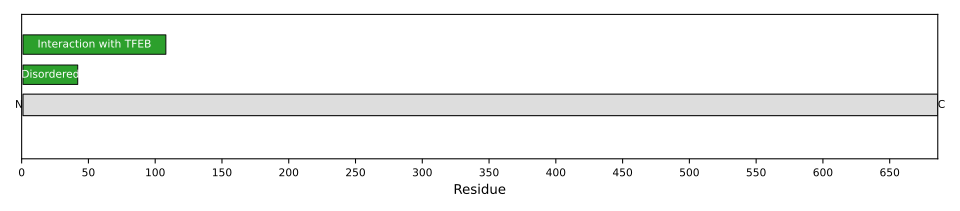
1: Catalyzes the synthesis of acetyl-CoA from short-chain fatty acids (PubMed:10843999, PubMed:28003429, PubMed:28552616). Acetate is the preferred substrate (PubMed:10843999, PubMed:28003429). Can also utilize propionate with a much lower affinity (By similarity). Nuclear ACSS2 promotes glucose deprivation-induced lysosomal biogenesis and autophagy, tumor cell survival and brain tumorigenesis (PubMed:28552616). Glucose deprivation results in AMPK-mediated phosphorylation of ACSS2 leading to its translocation to the nucleus where it binds to TFEB and locally produces acetyl-CoA for histone acetylation in the promoter regions of TFEB target genes thereby activating their transcription (PubMed:28552616). The regulation of genes associated with autophagy and lysosomal activity through ACSS2 is important for brain tumorigenesis and tumor survival (PubMed:28552616). Acts as a chromatin-bound transcriptional coactivator that up-regulates histone acetylation and expression of neuronal genes (By similarity). Can be recruited to the loci of memory-related neuronal genes to maintain a local acetyl-CoA pool, providing the substrate for histone acetylation and promoting the expression of specific genes, which is essential for maintaining long-term spatial memory (By similarity)