F-box only protein 6 (F-box protein that recognizes sugar chains 2) (F-box/G-domain protein 2)
1_MDAPH 6_ SKAAL 11_ DSINE 16_ LPENI 21_ LLELF 26_ THVPA 31_ RQLLL 36_ NCRLV 41_ CSLWR 46_ DLIDL 51_ MTLWK 56_ RKCLR 61_ EGFIT 66_ KDWDQ 71_ PVADW 76_ KIFYF 81_ LRSLH 86_ RNLLR 91_ NPCAE 96_ EDMFA 101_ WQIDF 106_ NGGDR 111_ WKVES 116_ LPGAH 121_ GTDFP 126_ DPKVK 131_ KYFVT 136_ SYEMC 141_ LKSQL 146_ VDLVA 151_ EGYWE 156_ ELLDT 161_ FRPDI 166_ VVKDW 171_ FAARA 176_ DCGCT 181_ YQLKV 186_ QLASA 191_ DYFVL 196_ ASFEP 201_ PPVTI 206_ QQWNN 211_ ATWTE 216_ VSYTF 221_ SDYPR 226_ GVRYI 231_ LFQHG 236_ GRDTQ 241_ YWAGW 246_ YGPRV 251_ TNSSI 256_ VVSPK 261_ MTRNQ 266_ ASSEA 271_ QPGQK 276_ HGQEE 281_ AAQSP 286_YRAVV
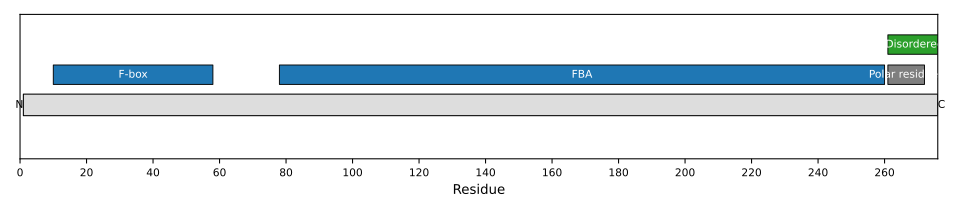
1: Substrate-recognition component of some SCF (SKP1-CUL1-F-box protein)-type E3 ubiquitin ligase complexes. Involved in endoplasmic reticulum-associated degradation pathway (ERAD) for misfolded lumenal proteins by recognizing and binding sugar chains on unfolded glycoproteins that are retrotranslocated into the cytosol and promoting their ubiquitination and subsequent degradation. Able to recognize and bind denatured glycoproteins, which are modified with not only high-mannose but also complex-type oligosaccharides. Also recognizes sulfated glycans. Also involved in DNA damage response by specifically recognizing activated CHEK1 (phosphorylated on 'Ser-345'), promoting its ubiquitination and degradation. Ubiquitination of CHEK1 is required to ensure that activated CHEK1 does not accumulate as cells progress through S phase, or when replication forks encounter transient impediments during normal DNA replication