Transmembrane protein 106B
1_MGKSL 6_ SHLPL 11_ HSSKE 16_ DAYDG 21_ VTSEN 26_ MRNGL 31_ VNSEV 36_ HNEDG 41_ RNGDV 46_ SQFPY 51_ VEFTG 56_ RDSVT 61_ CPTCQ 66_ GTGRI 71_ PRGQE 76_ NQLVA 81_ LIPYS 86_ DQRLR 91_ PRRTK 96_ LYVMA 101_ SVFVC 106_ LLLSG 111_ LAVFF 116_ LFPRS 121_ IDVKY 126_ IGVKS 131_ AYVSY 136_ DVQKR 141_ TIYLN 146_ ITNTL 151_ NITNN 156_ NYYSV 161_ EVENI 166_ TAQVQ 171_ FSKTV 176_ IGKAR 181_ LNNIT 186_ IIGPL 191_ DMKQI 196_ DYTVP 201_ TVIAE 206_ EMSYM 211_ YDFCT 216_ LISIK 221_ VHNIV 226_ LMMQV 231_ TVTTT 236_ YFGHS 241_ EQISQ 246_ ERYQY 251_ VDCGR 256_ NTTYQ 261_ LGQSE 266_YLNVL
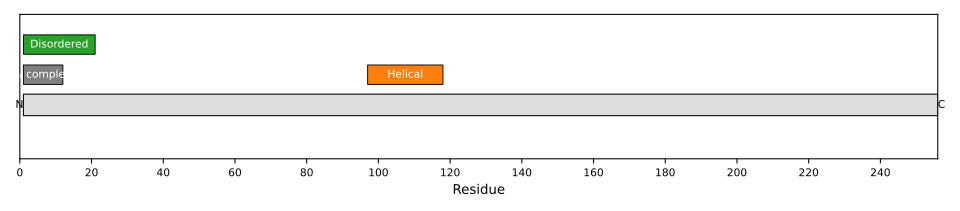
1: In neurons, involved in the transport of late endosomes/lysosomes (PubMed:25066864). May be involved in dendrite morphogenesis and maintenance by regulating lysosomal trafficking (PubMed:25066864). May act as a molecular brake for retrograde transport of late endosomes/lysosomes, possibly via its interaction with MAP6 (By similarity). In motoneurons, may mediate the axonal transport of lysosomes and axonal sorting at the initial segment (By similarity). It remains unclear whether TMEM106B affects the transport of moving lysosomes in the anterograde or retrograde direction in neurites and whether it is important in the sorting of lysosomes in axons or in dendrites (By similarity). In neurons, may also play a role in the regulation of lysosomal size and responsiveness to stress (PubMed:25066864). Required for proper lysosomal acidification (By similarity)
2: (Microbial infection) Plays a role in human coronavirus SARS-CoV-2 infection, but not in common cold coronaviruses HCoV-229E and HCoV-OC43 infections. Involved in ACE2-independent SARS-CoV-2 cell entry. Required for post-endocytic stage of virus entry, facilitates spike-mediated membrane fusion. Virus attachment and endocytosis can also be mediated by other cell surface receptors