Protein lin-7 homolog C (Lin-7C) (Mammalian lin-seven protein 3) (MALS-3) (Vertebrate lin-7 homolog 3) (Veli-3)
1_MAALG 6_ EPVRL 11_ ERDIC 16_ RAIEL 21_ LEKLQ 26_ RSGEV 31_ PPQKL 36_ QALQR 41_ VLQSE 46_ FCNAV 51_ REVYE 56_ HVYET 61_ VDISS 66_ SPEVR 71_ ANATA 76_ KATVA 81_ AFAAS 86_ EGHSH 91_ PRVVE 96_ LPKTE 101_ EGLGF 106_ NIMGG 111_ KEQNS 116_ PIYIS 121_ RIIPG 126_ GIADR 131_ HGGLK 136_ RGDQL 141_ LSVNG 146_ VSVEG 151_ EHHEK 156_ AVELL 161_ KAAQG 166_ KVKLV 171_ VRYTP 176_ KVLEE 181_ MESRF 186_ EKMRS 191_AKRRQ
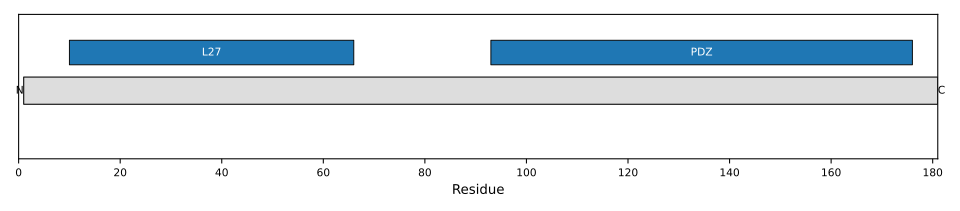
1: Plays a role in establishing and maintaining the asymmetric distribution of channels and receptors at the plasma membrane of polarized cells. Forms membrane-associated multiprotein complexes that may regulate delivery and recycling of proteins to the correct membrane domains. The tripartite complex composed of LIN7 (LIN7A, LIN7B or LIN7C), CASK and APBA1 associates with the motor protein KIF17 to transport vesicles containing N-methyl-D-aspartate (NMDA) receptor subunit NR2B along microtubules (By similarity). This complex may have the potential to couple synaptic vesicle exocytosis to cell adhesion in brain. Ensures the proper localization of GRIN2B (subunit 2B of the NMDA receptor) to neuronal postsynaptic density and may function in localizing synaptic vesicles at synapses where it is recruited by beta-catenin and cadherin. Required to localize Kir2 channels, GABA transporter (SLC6A12) and EGFR/ERBB1, ERBB2, ERBB3 and ERBB4 to the basolateral membrane of epithelial cells