BRISC and BRCA1-A complex member 1 (Mediator of RAP80 interactions and targeting subunit of 40 kDa) (New component of the BRCA1-A complex)
1_MEVAE 6_ PSSPT 11_ EEEEE 16_ EEEHS 21_ AEPRP 26_ RTRSN 31_ PEGAE 36_ DRAVG 41_ AQASV 46_ GSRSE 51_ GEGEA 56_ ASADD 61_ GSLNT 66_ SGAGP 71_ KSWQV 76_ PPPAP 81_ EVQIR 86_ TPRVN 91_ CPEKV 96_ IICLD 101_ LSEEM 106_ SLPKL 111_ ESFNG 116_ SKTNA 121_ LNVSQ 126_ KMIEM 131_ FVRTK 136_ HKIDK 141_ SHEFA 146_ LVVVN 151_ DDTAW 156_ LSGLT 161_ SDPRE 166_ LCSCL 171_ YDLET 176_ ASCST 181_ FNLEG 186_ LFSLI 191_ QQKTE 196_ LPVTE 201_ NVQTI 206_ PPPYV 211_ VRTIL 216_ VYSRP 221_ PCQPQ 226_ FSLTE 231_ PMKKM 236_ FQCPY 241_ FFFDV 246_ VYIHN 251_ GTEEK 256_ EEEMS 261_ WKDMF 266_ AFMGS 271_ LDTKG 276_ TSYKY 281_ EVALA 286_ GPALE 291_ LHNCM 296_ AKLLA 301_ HPLQR 306_ PCQSH 311_ ASYSL 316_ LEEED 321_EAIEV
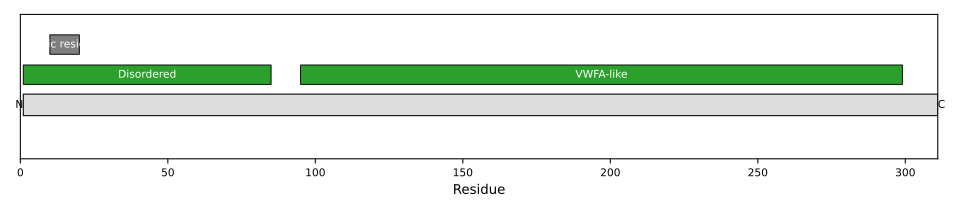
1: Component of the BRCA1-A complex, a complex that specifically recognizes 'Lys-63'-linked ubiquitinated histones H2A and H2AX at DNA lesions sites, leading to target the BRCA1-BARD1 heterodimer to sites of DNA damage at double-strand breaks (DSBs). The BRCA1-A complex also possesses deubiquitinase activity that specifically removes 'Lys-63'-linked ubiquitin on histones H2A and H2AX. In the BRCA1-A complex, it is required for the complex integrity and its localization at DSBs. Component of the BRISC complex, a multiprotein complex that specifically cleaves 'Lys-63'-linked ubiquitin in various substrates (PubMed:24075985, PubMed:26195665). In these 2 complexes, it is probably required to maintain the stability of BABAM2 and help the 'Lys-63'-linked deubiquitinase activity mediated by BRCC3/BRCC36 component. The BRISC complex is required for normal mitotic spindle assembly and microtubule attachment to kinetochores via its role in deubiquitinating NUMA1 (PubMed:26195665). Plays a role in interferon signaling via its role in the deubiquitination of the interferon receptor IFNAR1; deubiquitination increases IFNAR1 activity by enhancing its stability and cell surface expression (PubMed:24075985). Down-regulates the response to bacterial lipopolysaccharide (LPS) via its role in IFNAR1 deubiquitination (PubMed:24075985)