Interleukin-1 receptor-associated kinase 4 (IRAK-4) (EC 2.7.11.1) (Renal carcinoma antigen NY-REN-64)
1_MNKPI 6_ TPSTY 11_ VRCLN 16_ VGLIR 21_ KLSDF 26_ IDPQE 31_ GWKKL 36_ AVAIK 41_ KPSGD 46_ DRYNQ 51_ FHIRR 56_ FEALL 61_ QTGKS 66_ PTSEL 71_ LFDWG 76_ TTNCT 81_ VGDLV 86_ DLLIQ 91_ NEFFA 96_ PASLL 101_ LPDAV 106_ PKTAN 111_ TLPSK 116_ EAITV 121_ QQKQM 126_ PFCDK 131_ DRTLM 136_ TPVQN 141_ LEQSY 146_ MPPDS 151_ SSPEN 156_ KSLEV 161_ SDTRF 166_ HSFSF 171_ YELKN 176_ VTNNF 181_ DERPI 186_ SVGGN 191_ KMGEG 196_ GFGVV 201_ YKGYV 206_ NNTTV 211_ AVKKL 216_ AAMVD 221_ ITTEE 226_ LKQQF 231_ DQEIK 236_ VMAKC 241_ QHENL 246_ VELLG 251_ FSSDG 256_ DDLCL 261_ VYVYM 266_ PNGSL 271_ LDRLS 276_ CLDGT 281_ PPLSW 286_ HMRCK 291_ IAQGA 296_ ANGIN 301_ FLHEN 306_ HHIHR 311_ DIKSA 316_ NILLD 321_ EAFTA 326_ KISDF 331_ GLARA 336_ SEKFA 341_ QTVMT 346_ SRIVG 351_ TTAYM 356_ APEAL 361_ RGEIT 366_ PKSDI 371_ YSFGV 376_ VLLEI 381_ ITGLP 386_ AVDEH 391_ REPQL 396_ LLDIK 401_ EEIED 406_ EEKTI 411_ EDYID 416_ KKMND 421_ ADSTS 426_ VEAMY 431_ SVASQ 436_ CLHEK 441_ KNKRP 446_ DIKKV 451_QQLLQ
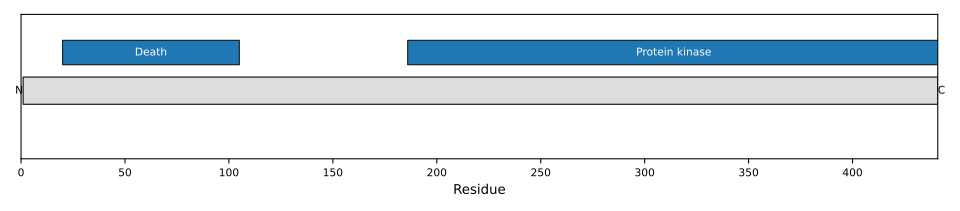
1: Serine/threonine-protein kinase that plays a critical role in initiating innate immune response against foreign pathogens. Involved in Toll-like receptor (TLR) and IL-1R signaling pathways (PubMed:17878374). Is rapidly recruited by MYD88 to the receptor-signaling complex upon TLR activation to form the Myddosome together with IRAK2. Phosphorylates initially IRAK1, thus stimulating the kinase activity and intensive autophosphorylation of IRAK1. Phosphorylates E3 ubiquitin ligases Pellino proteins (PELI1, PELI2 and PELI3) to promote pellino-mediated polyubiquitination of IRAK1. Then, the ubiquitin-binding domain of IKBKG/NEMO binds to polyubiquitinated IRAK1 bringing together the IRAK1-MAP3K7/TAK1-TRAF6 complex and the NEMO-IKKA-IKKB complex. In turn, MAP3K7/TAK1 activates IKKs (CHUK/IKKA and IKBKB/IKKB) leading to NF-kappa-B nuclear translocation and activation. Alternatively, phosphorylates TIRAP to promote its ubiquitination and subsequent degradation. Phosphorylates NCF1 and regulates NADPH oxidase activation after LPS stimulation suggesting a similar mechanism during microbial infections