DnaJ homolog subfamily B member 12
1_MESNK 6_ DEAER 11_ CISIA 16_ LKAIQ 21_ SNQPD 26_ RALRF 31_ LEKAQ 36_ RLYPT 41_ PRVRA 46_ LIESL 51_ NQKPQ 56_ TAGDQ 61_ PPPTD 66_ TTHAT 71_ HRKAG 76_ GTDAP 81_ SANGE 86_ AGGES 91_ TKGYT 96_ AEQVA 101_ AVKRV 106_ KQCKD 111_ YYEIL 116_ GVSRG 121_ ASDED 126_ LKKAY 131_ RRLAL 136_ KFHPD 141_ KNHAP 146_ GATEA 151_ FKAIG 156_ TAYAV 161_ LSNPE 166_ KRKQY 171_ DQFGD 176_ DKSQA 181_ ARHGH 186_ GHGDF 191_ HRGFE 196_ ADISP 201_ EDLFN 206_ MFFGG 211_ GFPSS 216_ NVHVY 221_ SNGRM 226_ RYTYQ 231_ QRQDR 236_ RDNQG 241_ DGGLG 246_ VFVQL 251_ MPILI 256_ LILVS 261_ ALSQL 266_ MVSSP 271_ PYSLS 276_ PRPSV 281_ GHIHR 286_ RVTDH 291_ LGVVY 296_ YVGDT 301_ FSEEY 306_ TGSSL 311_ KTVER 316_ NVEDD 321_ YIANL 326_ RNNCW 331_ KEKQQ 336_ KEGLL 341_ YRARY 346_ FGDTD 351_ MYHRA 356_ QKMGT 361_ PSCSR 366_LSEVQ
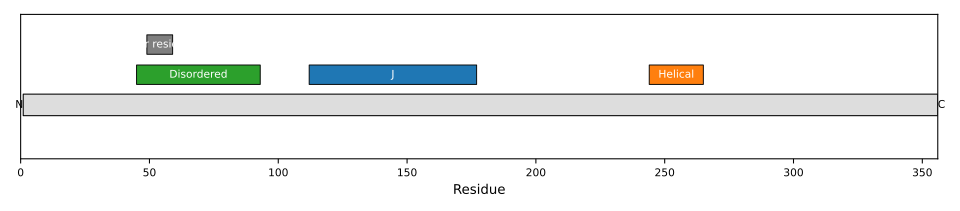
1: Acts as a co-chaperone with HSPA8/Hsc70; required to promote protein folding and trafficking, prevent aggregation of client proteins, and promote unfolded proteins to endoplasmic reticulum-associated degradation (ERAD) pathway (PubMed:21148293, PubMed:21150129). Acts by determining HSPA8/Hsc70's ATPase and polypeptide-binding activities (PubMed:21148293). Can also act independently of HSPA8/Hsc70: together with DNAJB14, acts as a chaperone that promotes maturation of potassium channels KCND2 and KCNH2 by stabilizing nascent channel subunits and assembling them into tetramers (PubMed:27916661). While stabilization of nascent channel proteins is dependent on HSPA8/Hsc70, the process of oligomerization of channel subunits is independent of HSPA8/Hsc70 (PubMed:27916661). When overexpressed, forms membranous structures together with DNAJB14 and HSPA8/Hsc70 within the nucleus; the role of these structures, named DJANGOs, is still unclear (PubMed:24732912)
2: (Microbial infection) In case of infection by polyomavirus, involved in the virus endoplasmic reticulum membrane penetration and infection (PubMed:21673190, PubMed:24675744)