Potassium channel subfamily K member 4 (TWIK-related arachidonic acid-stimulated potassium channel protein) (TRAAK) (Two pore potassium channel KT4.1) (Two pore K(+) channel KT4.1)
1_MRSTT 6_ LLALL 11_ ALVLL 16_ YLVSG 21_ ALVFR 26_ ALEQP 31_ HEQQA 36_ QRELG 41_ EVREK 46_ FLRAH 51_ PCVSD 56_ QELGL 61_ LIKEV 66_ ADALG 71_ GGADP 76_ ETNST 81_ SNSSH 86_ SAWDL 91_ GSAFF 96_ FSGTI 101_ ITTIG 106_ YGNVA 111_ LRTDA 116_ GRLFC 121_ IFYAL 126_ VGIPL 131_ FGILL 136_ AGVGD 141_ RLGSS 146_ LRHGI 151_ GHIEA 156_ IFLKW 161_ HVPPE 166_ LVRVL 171_ SAMLF 176_ LLIGC 181_ LLFVL 186_ TPTFV 191_ FCYME 196_ DWSKL 201_ EAIYF 206_ VIVTL 211_ TTVGF 216_ GDYVA 221_ GADPR 226_ QDSPA 231_ YQPLV 236_ WFWIL 241_ LGLAY 246_ FASVL 251_ TTIGN 256_ WLRVV 261_ SRRTR 266_ AEMGG 271_ LTAQA 276_ ASWTG 281_ TVTAR 286_ VTQRA 291_ GPAAP 296_ PPEKE 301_ QPLLP 306_ PPPCP 311_ AQPLG 316_ RPRSP 321_ SPPEK 326_ AQPPS 331_ PPTAS 336_ ALDYP 341_ SENLA 346_ FIDES 351_ SDTQS 356_ ERGCP 361_ LPRAP 366_ RGRRR 371_ PNPPR 376_ KPVRP 381_ RGPGR 386_PRDKG
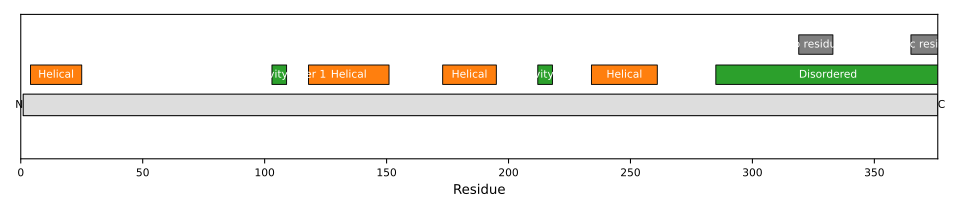
1: K(+) channel that conducts voltage-dependent outward rectifying currents upon membrane depolarization. Voltage sensing is coupled to K(+) electrochemical gradient in an 'ion flux gating' mode where outward but not inward ion flow opens the gate. Converts to voltage-independent 'leak' conductance mode upon stimulation by various stimuli including mechanical membrane stretch, basic pH, heat and lipids (PubMed:22282805, PubMed:25471887, PubMed:25500157, PubMed:26919430, PubMed:30290154, PubMed:38605031). Homo- and heterodimerizes to form functional channels with distinct regulatory and gating properties (PubMed:26919430). At trigeminal A-beta afferent nerves, the heterodimer of KCNK2/TREK-1 and KCNK4/TRAAK is mostly coexpressed at nodes of Ranvier where it conducts voltage-independent mechanosensitive and thermosensitive currents, allowing rapid action potential repolarization, high speed and high frequence saltatory conduction on myelinated nerves to ensure prompt sensory responses (By similarity). Permeable to other monovalent cations such as Rb(+) and Cs(+) (PubMed:26919430)