Mitogen-activated protein kinase kinase kinase 20 (EC 2.7.11.25) (Human cervical cancer suppressor gene 4 protein) (HCCS-4) (Leucine zipper- and sterile alpha motif-containing kinase) (MLK-like mitogen-activated protein triple kinase) (Mitogen-activated protein kinase kinase kinase MLT) (Mixed lineage kinase-related kinase) (MLK-related kinase) (MRK) (Sterile alpha motif- and leucine zipper-containing kinase AZK)
1_MSSLG 6_ ASFVQ 11_ IKFDD 16_ LQFFE 21_ NCGGG 26_ SFGSV 31_ YRAKW 36_ ISQDK 41_ EVAVK 46_ KLLKI 51_ EKEAE 56_ ILSVL 61_ SHRNI 66_ IQFYG 71_ VILEP 76_ PNYGI 81_ VTEYA 86_ SLGSL 91_ YDYIN 96_ SNRSE 101_ EMDMD 106_ HIMTW 111_ ATDVA 116_ KGMHY 121_ LHMEA 126_ PVKVI 131_ HRDLK 136_ SRNVV 141_ IAADG 146_ VLKIC 151_ DFGAS 156_ RFHNH 161_ TTHMS 166_ LVGTF 171_ PWMAP 176_ EVIQS 181_ LPVSE 186_ TCDTY 191_ SYGVV 196_ LWEML 201_ TREVP 206_ FKGLE 211_ GLQVA 216_ WLVVE 221_ KNERL 226_ TIPSS 231_ CPRSF 236_ AELLH 241_ QCWEA 246_ DAKKR 251_ PSFKQ 256_ IISIL 261_ ESMSN 266_ DTSLP 271_ DKCNS 276_ FLHNK 281_ AEWRC 286_ EIEAT 291_ LERLK 296_ KLERD 301_ LSFKE 306_ QELKE 311_ RERRL 316_ KMWEQ 321_ KLTEQ 326_ SNTPL 331_ LPSFE 336_ IGAWT 341_ EDDVY 346_ CWVQQ 351_ LVRKG 356_ DSSAE 361_ MSVYA 366_ SLFKE 371_ NNITG 376_ KRLLL 381_ LEEED 386_ LKDMG 391_ IVSKG 396_ HIIHF 401_ KSAIE 406_ KLTHD 411_ YINLF 416_ HFPPL 421_ IKDSG 426_ GEPEE 431_ NEEKI 436_ VNLEL 441_ VFGFH 446_ LKPGT 451_ GPQDC 456_ KWKMY 461_ MEMDG 466_ DEIAI 471_ TYIKD 476_ VTFNT 481_ NLPDA 486_ EILKM 491_ TKPPF 496_ VMEKW 501_ IVGIA 506_ KSQTV 511_ ECTVT 516_ YESDV 521_ RTPKS 526_ TKHVH 531_ SIQWS 536_ RTKPQ 541_ DEVKA 546_ VQLAI 551_ QTLFT 556_ NSDGN 561_ PGSRS 566_ DSSAD 571_ CQWLD 576_ TLRMR 581_ QIASN 586_ TSLQR 591_ SQSNP 596_ ILGSP 601_ FFSHF 606_ DGQDS 611_ YAAAV 616_ RRPQV 621_ PIKYQ 626_ QITPV 631_ NQSRS 636_ SSPTQ 641_ YGLTK 646_ NFSSL 651_ HLNSR 656_ DSGFS 661_ SGNTD 666_ TSSER 671_ GRYSD 676_ RSRNK 681_ YGRGS 686_ ISLNS 691_ SPRGR 696_ YSGKS 701_ QHSTP 706_ SRGRY 711_ PGKFY 716_ RVSQS 721_ ALNPH 726_ QSPDF 731_ KRSPR 736_ DLHQP 741_ NTIPG 746_ MPLHP 751_ ETDSR 756_ ASEED 761_ SKVSE 766_ GGWTK 771_ VEYRK 776_ KPHRP 781_ SPAKT 786_ NKERA 791_RGDHR
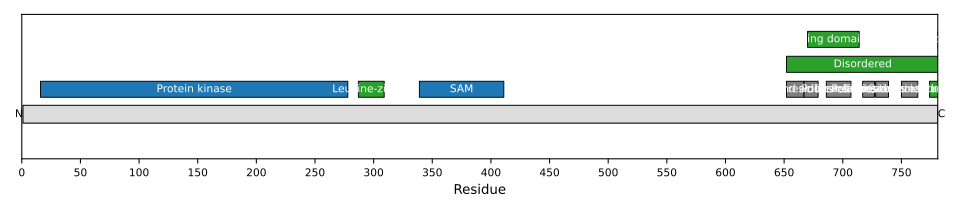
1: Stress-activated component of a protein kinase signal transduction cascade that promotes programmed cell death in response to various stress, such as ribosomal stress, osmotic shock and ionizing radiation (PubMed:10924358, PubMed:11836244, PubMed:12220515, PubMed:14521931, PubMed:15350844, PubMed:15737997, PubMed:18331592, PubMed:20559024, PubMed:26999302, PubMed:32289254, PubMed:32610081, PubMed:35857590). Acts by catalyzing phosphorylation of MAP kinase kinases, leading to activation of the JNK (MAPK8/JNK1, MAPK9/JNK2 and/or MAPK10/JNK3) and MAP kinase p38 (MAPK11, MAPK12, MAPK13 and/or MAPK14) pathways (PubMed:11042189, PubMed:11836244, PubMed:12220515, PubMed:14521931, PubMed:15172994, PubMed:15737997, PubMed:32289254, PubMed:32610081, PubMed:35857590). Activates JNK through phosphorylation of MAP2K4/MKK4 and MAP2K7/MKK7, and MAP kinase p38 gamma (MAPK12) via phosphorylation of MAP2K3/MKK3 and MAP2K6/MKK6 (PubMed:11836244, PubMed:12220515). Involved in stress associated with adrenergic stimulation: contributes to cardiac decompensation during periods of acute cardiac stress (PubMed:15350844, PubMed:21224381, PubMed:27859413). May be involved in regulation of S and G2 cell cycle checkpoint by mediating phosphorylation of CHEK2 (PubMed:15342622)
2: Key component of the stress-activated protein kinase signaling cascade in response to ribotoxic stress or UV-B irradiation (PubMed:32289254, PubMed:32610081, PubMed:35857590). Acts as the proximal sensor of ribosome collisions during the ribotoxic stress response (RSR): directly binds to the ribosome by inserting its flexible C-terminus into the ribosomal intersubunit space, thereby acting as a sentinel for colliding ribosomes (PubMed:32289254, PubMed:32610081). Upon ribosome collisions, activates either the stress-activated protein kinase signal transduction cascade or the integrated stress response (ISR), leading to programmed cell death or cell survival, respectively (PubMed:32610081). Dangerous levels of ribosome collisions trigger the autophosphorylation and activation of MAP3K20, which dissociates from colliding ribosomes and phosphorylates MAP kinase kinases, leading to activation of the JNK and MAP kinase p38 pathways that promote programmed cell death (PubMed:32289254, PubMed:32610081). Less dangerous levels of ribosome collisions trigger the integrated stress response (ISR): MAP3K20 activates EIF2AK4/GCN2 independently of its protein-kinase activity, promoting EIF2AK4/GCN2-mediated phosphorylation of EIF2S1/eIF-2-alpha (PubMed:32610081). Also part of the stress-activated protein kinase signaling cascade triggering the NLRP1 inflammasome in response to UV-B irradiation: ribosome collisions activate MAP3K20, which directly phosphorylates NLRP1, leading to activation of the NLRP1 inflammasome and subsequent pyroptosis (PubMed:35857590). NLRP1 is also phosphorylated by MAP kinase p38 downstream of MAP3K20 (PubMed:35857590). Also acts as a histone kinase by phosphorylating histone H3 at 'Ser-28' (H3S28ph) (PubMed:15684425)
3: Isoform that lacks the C-terminal region that mediates ribosome-binding: does not act as a sensor of ribosome collisions in response to ribotoxic stress (PubMed:32289254, PubMed:32610081, PubMed:35857590). May act as an antagonist of isoform ZAKalpha: interacts with isoform ZAKalpha, leading to decrease the expression of isoform ZAKalpha (PubMed:27859413)