Serine/threonine-protein kinase PLK2 (EC 2.7.11.21) (Polo-like kinase 2) (PLK-2) (hPlk2) (Serine/threonine-protein kinase SNK) (hSNK) (Serum-inducible kinase)
1_MELLR 6_ TITYQ 11_ PAAST 16_ KMCEQ 21_ ALGKG 26_ CGADS 31_ KKKRP 36_ PQPPE 41_ ESQPP 46_ QSQAQ 51_ VPPAA 56_ PHHHH 61_ HHSHS 66_ GPEIS 71_ RIIVD 76_ PTTGK 81_ RYCRG 86_ KVLGK 91_ GGFAK 96_ CYEMT 101_ DLTNN 106_ KVYAA 111_ KIIPH 116_ SRVAK 121_ PHQRE 126_ KIDKE 131_ IELHR 136_ ILHHK 141_ HVVQF 146_ YHYFE 151_ DKENI 156_ YILLE 161_ YCSRR 166_ SMAHI 171_ LKARK 176_ VLTEP 181_ EVRYY 186_ LRQIV 191_ SGLKY 196_ LHEQE 201_ ILHRD 206_ LKLGN 211_ FFINE 216_ AMELK 221_ VGDFG 226_ LAARL 231_ EPLEH 236_ RRRTI 241_ CGTPN 246_ YLSPE 251_ VLNKQ 256_ GHGCE 261_ SDIWA 266_ LGCVM 271_ YTMLL 276_ GRPPF 281_ ETTNL 286_ KETYR 291_ CIREA 296_ RYTMP 301_ SSLLA 306_ PAKHL 311_ IASML 316_ SKNPE 321_ DRPSL 326_ DDIIR 331_ HDFFL 336_ QGFTP 341_ DRLSS 346_ SCCHT 351_ VPDFH 356_ LSSPA 361_ KNFFK 366_ KAAAA 371_ LFGGK 376_ KDKAR 381_ YIDTH 386_ NRVSK 391_ EDEDI 396_ YKLRH 401_ DLKKT 406_ SITQQ 411_ PSKHR 416_ TDEEL 421_ QPPTT 426_ TVARS 431_ GTPAV 436_ ENKQQ 441_ IGDAI 446_ RMIVR 451_ GTLGS 456_ CSSSS 461_ ECLED 466_ STMGS 471_ VADTV 476_ ARVLR 481_ GCLEN 486_ MPEAD 491_ CIPKE 496_ QLSTS 501_ FQWVT 506_ KWVDY 511_ SNKYG 516_ FGYQL 521_ SDHTV 526_ GVLFN 531_ NGAHM 536_ SLLPD 541_ KKTVH 546_ YYAEL 551_ GQCSV 556_ FPATD 561_ APEQF 566_ ISQVT 571_ VLKYF 576_ SHYME 581_ ENLMD 586_ GGDLP 591_ SVTDI 596_ RRPRL 601_ YLLQW 606_ LKSDK 611_ ALMML 616_ FNDGT 621_ FQVNF 626_ YHDHT 631_ KIIIC 636_ SQNEE 641_ YLLTY 646_ INEDR 651_ ISTTF 656_ RLTTL 661_ LMSGC 666_ SSELK 671_ NRMEY 676_ALNML
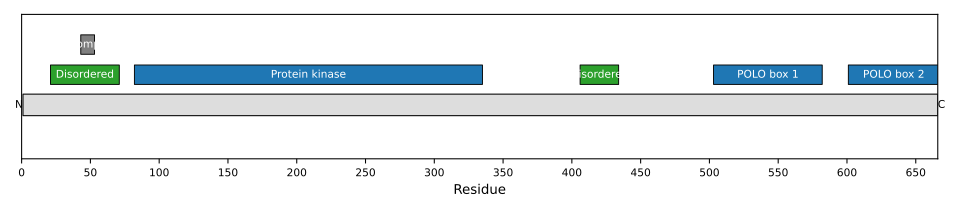
1: Tumor suppressor serine/threonine-protein kinase involved in synaptic plasticity, centriole duplication and G1/S phase transition. Polo-like kinases act by binding and phosphorylating proteins that are already phosphorylated on a specific motif recognized by the POLO box domains. Phosphorylates CPAP, NPM1, RAPGEF2, RASGRF1, SNCA, SIPA1L1 and SYNGAP1. Plays a key role in synaptic plasticity and memory by regulating the Ras and Rap protein signaling: required for overactivity-dependent spine remodeling by phosphorylating the Ras activator RASGRF1 and the Rap inhibitor SIPA1L1 leading to their degradation by the proteasome. Conversely, phosphorylates the Rap activator RAPGEF2 and the Ras inhibitor SYNGAP1, promoting their activity. Also regulates synaptic plasticity independently of kinase activity, via its interaction with NSF that disrupts the interaction between NSF and the GRIA2 subunit of AMPARs, leading to a rapid rundown of AMPAR-mediated current that occludes long term depression. Required for procentriole formation and centriole duplication by phosphorylating CPAP and NPM1, respectively. Its induction by p53/TP53 suggests that it may participate in the mitotic checkpoint following stress