Insulin-like growth factor 2 mRNA-binding protein 1 (IGF2 mRNA-binding protein 1) (IMP-1) (IMP1) (Coding region determinant-binding protein) (CRD-BP) (IGF-II mRNA-binding protein 1) (VICKZ family member 1) (Zipcode-binding protein 1) (ZBP-1)
1_MNKLY 6_ IGNLN 11_ ESVTP 16_ ADLEK 21_ VFAEH 26_ KISYS 31_ GQFLV 36_ KSGYA 41_ FVDCP 46_ DEHWA 51_ MKAIE 56_ TFSGK 61_ VELQG 66_ KRLEI 71_ EHSVP 76_ KKQRS 81_ RKIQI 86_ RNIPP 91_ QLRWE 96_ VLDSL 101_ LAQYG 106_ TVENC 111_ EQVNT 116_ ESETA 121_ VVNVT 126_ YSNRE 131_ QTRQA 136_ IMKLN 141_ GHQLE 146_ NHALK 151_ VSYIP 156_ DEQIA 161_ QGPEN 166_ GRRGG 171_ FGSRG 176_ QPRQG 181_ SPVAA 186_ GAPAK 191_ QQQVD 196_ IPLRL 201_ LVPTQ 206_ YVGAI 211_ IGKEG 216_ ATIRN 221_ ITKQT 226_ QSKID 231_ VHRKE 236_ NAGAA 241_ EKAIS 246_ VHSTP 251_ EGCSS 256_ ACKMI 261_ LEIMH 266_ KEAKD 271_ TKTAD 276_ EVPLK 281_ ILAHN 286_ NFVGR 291_ LIGKE 296_ GRNLK 301_ KVEQD 306_ TETKI 311_ TISSL 316_ QDLTL 321_ YNPER 326_ TITVK 331_ GAIEN 336_ CCRAE 341_ QEIMK 346_ KVREA 351_ YENDV 356_ AAMSL 361_ QSHLI 366_ PGLNL 371_ AAVGL 376_ FPASS 381_ SAVPP 386_ PPSSV 391_ TGAAP 396_ YSSFM 401_ QAPEQ 406_ EMVQV 411_ FIPAQ 416_ AVGAI 421_ IGKKG 426_ QHIKQ 431_ LSRFA 436_ SASIK 441_ IAPPE 446_ TPDSK 451_ VRMVI 456_ ITGPP 461_ EAQFK 466_ AQGRI 471_ YGKLK 476_ EENFF 481_ GPKEE 486_ VKLET 491_ HIRVP 496_ ASAAG 501_ RVIGK 506_ GGKTV 511_ NELQN 516_ LTAAE 521_ VVVPR 526_ DQTPD 531_ ENDQV 536_ IVKII 541_ GHFYA 546_ SQMAQ 551_ RKIRD 556_ ILAQV 561_ KQQHQ 566_ KGQSN 571_QAQAR
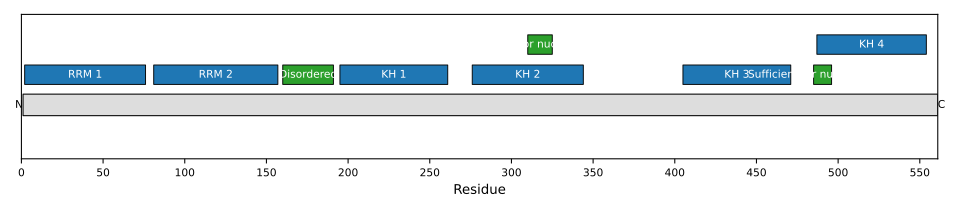
1: RNA-binding factor that recruits target transcripts to cytoplasmic protein-RNA complexes (mRNPs). This transcript 'caging' into mRNPs allows mRNA transport and transient storage. It also modulates the rate and location at which target transcripts encounter the translational apparatus and shields them from endonuclease attacks or microRNA-mediated degradation. Preferentially binds to N6-methyladenosine (m6A)-containing mRNAs and increases their stability (PubMed:29476152, PubMed:32245947). Plays a direct role in the transport and translation of transcripts required for axonal regeneration in adult sensory neurons (By similarity). Regulates localized beta-actin/ACTB mRNA translation, a crucial process for cell polarity, cell migration and neurite outgrowth. Co-transcriptionally associates with the ACTB mRNA in the nucleus. This binding involves a conserved 54-nucleotide element in the ACTB mRNA 3'-UTR, known as the 'zipcode'. The RNP thus formed is exported to the cytoplasm, binds to a motor protein and is transported along the cytoskeleton to the cell periphery. During transport, prevents ACTB mRNA from being translated into protein. When the RNP complex reaches its destination near the plasma membrane, IGF2BP1 is phosphorylated. This releases the mRNA, allowing ribosomal 40S and 60S subunits to assemble and initiate ACTB protein synthesis. Monomeric ACTB then assembles into the subcortical actin cytoskeleton (By similarity). During neuronal development, key regulator of neurite outgrowth, growth cone guidance and neuronal cell migration, presumably through the spatiotemporal fine tuning of protein synthesis, such as that of ACTB (By similarity). May regulate mRNA transport to activated synapses (By similarity). Binds to and stabilizes ABCB1/MDR-1 mRNA (By similarity). During interstinal wound repair, interacts with and stabilizes PTGS2 transcript. PTGS2 mRNA stabilization may be crucial for colonic mucosal wound healing (By similarity). Binds to the 3'-UTR of IGF2 mRNA by a mechanism of cooperative and sequential dimerization and regulates IGF2 mRNA subcellular localization and translation. Binds to MYC mRNA, in the coding region instability determinant (CRD) of the open reading frame (ORF), hence preventing MYC cleavage by endonucleases and possibly microRNA targeting to MYC-CRD (PubMed:29476152). Binding to MYC mRNA is enhanced by m6A-modification of the CRD (PubMed:29476152). Binds to the 3'-UTR of CD44 mRNA and stabilizes it, hence promotes cell adhesion and invadopodia formation in cancer cells. Binds to the oncofetal H19 transcript and to the neuron-specific TAU mRNA and regulates their localizations. Binds to and stabilizes BTRC/FBW1A mRNA. Binds to the adenine-rich autoregulatory sequence (ARS) located in PABPC1 mRNA and represses its translation. PABPC1 mRNA-binding is stimulated by PABPC1 protein. Prevents BTRC/FBW1A mRNA degradation by disrupting microRNA-dependent interaction with AGO2. Promotes the directed movement of tumor-derived cells by fine-tuning intracellular signaling networks. Binds to MAPK4 3'-UTR and inhibits its translation. Interacts with PTEN transcript open reading frame (ORF) and prevents mRNA decay. This combined action on MAPK4 (down-regulation) and PTEN (up-regulation) antagonizes HSPB1 phosphorylation, consequently it prevents G-actin sequestration by phosphorylated HSPB1, allowing F-actin polymerization. Hence enhances the velocity of cell migration and stimulates directed cell migration by PTEN-modulated polarization. Interacts with Hepatitis C virus (HCV) 5'-UTR and 3'-UTR and specifically enhances translation at the HCV IRES, but not 5'-cap-dependent translation, possibly by recruiting eIF3. Interacts with HIV-1 GAG protein and blocks the formation of infectious HIV-1 particles. Reduces HIV-1 assembly by inhibiting viral RNA packaging, as well as assembly and processing of GAG protein on cellular membranes. During cellular stress, such as oxidative stress or heat shock, stabilizes target mRNAs that are recruited to stress granules, including CD44, IGF2, MAPK4, MYC, PTEN, RAPGEF2 and RPS6KA5 transcripts