Denticleless protein homolog (DDB1- and CUL4-associated factor 2) (Lethal(2) denticleless protein homolog) (Retinoic acid-regulated nuclear matrix-associated protein)
1_MLFNS 6_ VLRQP 11_ QLGVL 16_ RNGWS 21_ SQYPL 26_ QSLLT 31_ GYQCS 36_ GNDEH 41_ TSYGE 46_ TGVPV 51_ PPFGC 56_ TFSSA 61_ PNMEH 66_ VLAVA 71_ NEEGF 76_ VRLYN 81_ TESQS 86_ FRKKC 91_ FKEWM 96_ AHWNA 101_ VFDLA 106_ WVPGE 111_ LKLVT 116_ AAGDQ 121_ TAKFW 126_ DVKAG 131_ ELIGT 136_ CKGHQ 141_ CSLKS 146_ VAFSK 151_ FEKAV 156_ FCTGG 161_ RDGNI 166_ MVWDT 171_ RCNKK 176_ DGFYR 181_ QVNQI 186_ SGAHN 191_ TSDKQ 196_ TPSKP 201_ KKKQN 206_ SKGLA 211_ PSVDF 216_ QQSVT 221_ VVLFQ 226_ DENTL 231_ VSAGA 236_ VDGII 241_ KVWDL 246_ RKNYT 251_ AYRQE 256_ PIASK 261_ SFLYP 266_ GSSTR 271_ KLGYS 276_ SLILD 281_ STGST 286_ LFANC 291_ TDDNI 296_ YMFNM 301_ TGLKT 306_ SPVAI 311_ FNGHQ 316_ NSTFY 321_ VKSSL 326_ SPDDQ 331_ FLVSG 336_ SSDEA 341_ AYIWK 346_ VSTPW 351_ QPPTV 356_ LLGHS 361_ QEVTS 366_ VCWCP 371_ SDFTK 376_ IATCS 381_ DDNTL 386_ KIWRL 391_ NRGLE 396_ EKPGG 401_ DKLST 406_ VGWAS 411_ QKKKE 416_ SRPGL 421_ VTVTS 426_ SQSTP 431_ AKAPR 436_ AKCNP 441_ SNSSP 446_ SSAAC 451_ APSCA 456_ GDLPL 461_ PSNTP 466_ TFSIK 471_ TSPAK 476_ ARSPI 481_ NRRGS 486_ VSSVS 491_ PKPPS 496_ SFKMS 501_ IRNWV 506_ TRTPS 511_ SSPPI 516_ TPPAS 521_ ETKIM 526_ SPRKA 531_ LIPVS 536_ QKSSQ 541_ AEACS 546_ ESRNR 551_ VKRRL 556_ DSSCL 561_ ESVKQ 566_ KCVKS 571_ CNCVT 576_ ELDGQ 581_ VENLH 586_ LDLCC 591_ LAGNQ 596_ EDLSK 601_ DSLGP 606_ TKSSK 611_ IEGAG 616_ TSISE 621_ PPSPI 626_ SPYAS 631_ ESCGT 636_ LPLPL 641_ RPCGE 646_ GSEMV 651_ GKENS 656_ SPENK 661_ NWLLA 666_ MAAKR 671_ KAENP 676_ SPRSP 681_ SSQTP 686_ NSRRQ 691_ SGKKL 696_ PSPVT 701_ ITPSS 706_ MRKIC 711_ TYFHR 716_ KSQED 721_FCGPE
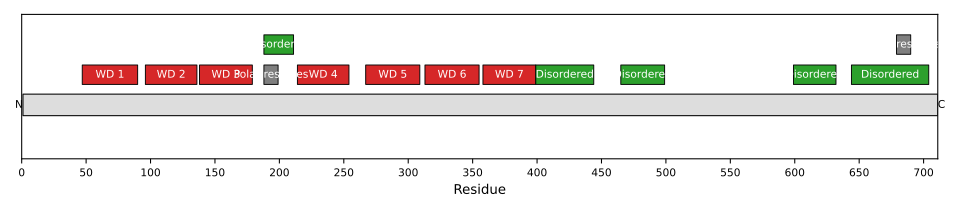
1: Substrate-specific adapter of a DCX (DDB1-CUL4-X-box) E3 ubiquitin-protein ligase complex required for cell cycle control, DNA damage response and translesion DNA synthesis. The DCX(DTL) complex, also named CRL4(CDT2) complex, mediates the polyubiquitination and subsequent degradation of CDT1, CDKN1A/p21(CIP1), FBH1, KMT5A and SDE2 (PubMed:16861906, PubMed:16949367, PubMed:16964240, PubMed:17085480, PubMed:18703516, PubMed:18794347, PubMed:18794348, PubMed:19332548, PubMed:20129063, PubMed:23478441, PubMed:23478445, PubMed:23677613, PubMed:27906959). CDT1 degradation in response to DNA damage is necessary to ensure proper cell cycle regulation of DNA replication (PubMed:16861906, PubMed:16949367, PubMed:17085480). CDKN1A/p21(CIP1) degradation during S phase or following UV irradiation is essential to control replication licensing (PubMed:18794348, PubMed:19332548). KMT5A degradation is also important for a proper regulation of mechanisms such as TGF-beta signaling, cell cycle progression, DNA repair and cell migration (PubMed:23478445). Most substrates require their interaction with PCNA for their polyubiquitination: substrates interact with PCNA via their PIP-box, and those containing the 'K+4' motif in the PIP box, recruit the DCX(DTL) complex, leading to their degradation. In undamaged proliferating cells, the DCX(DTL) complex also promotes the 'Lys-164' monoubiquitination of PCNA, thereby being involved in PCNA-dependent translesion DNA synthesis (PubMed:20129063, PubMed:23478441, PubMed:23478445, PubMed:23677613). The DDB1-CUL4A-DTL E3 ligase complex regulates the circadian clock function by mediating the ubiquitination and degradation of CRY1 (PubMed:26431207)