Programmed cell death 1 ligand 1 (PD-L1) (PDCD1 ligand 1) (Programmed death ligand 1) (hPD-L1) (B7 homolog 1) (B7-H1) (CD antigen CD274)
1_MRIFA 6_ VFIFM 11_ TYWHL 16_ LNAFT 21_ VTVPK 26_ DLYVV 31_ EYGSN 36_ MTIEC 41_ KFPVE 46_ KQLDL 51_ AALIV 56_ YWEME 61_ DKNII 66_ QFVHG 71_ EEDLK 76_ VQHSS 81_ YRQRA 86_ RLLKD 91_ QLSLG 96_ NAALQ 101_ ITDVK 106_ LQDAG 111_ VYRCM 116_ ISYGG 121_ ADYKR 126_ ITVKV 131_ NAPYN 136_ KINQR 141_ ILVVD 146_ PVTSE 151_ HELTC 156_ QAEGY 161_ PKAEV 166_ IWTSS 171_ DHQVL 176_ SGKTT 181_ TTNSK 186_ REEKL 191_ FNVTS 196_ TLRIN 201_ TTTNE 206_ IFYCT 211_ FRRLD 216_ PEENH 221_ TAELV 226_ IPELP 231_ LAHPP 236_ NERTH 241_ LVILG 246_ AILLC 251_ LGVAL 256_ TFIFR 261_ LRKGR 266_ MMDVK 271_ KCGIQ 276_ DTNSK 281_KQSDT
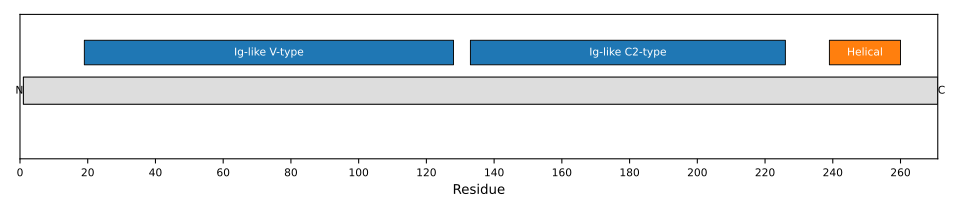
1: Plays a critical role in induction and maintenance of immune tolerance to self (PubMed:11015443, PubMed:28813410, PubMed:28813417, PubMed:31399419). As a ligand for the inhibitory receptor PDCD1/PD-1, modulates the activation threshold of T-cells and limits T-cell effector response (PubMed:11015443, PubMed:28813410, PubMed:28813417, PubMed:36727298). Through a yet unknown activating receptor, may costimulate T-cell subsets that predominantly produce interleukin-10 (IL10) (PubMed:10581077). Can also act as a transcription coactivator: in response to hypoxia, translocates into the nucleus via its interaction with phosphorylated STAT3 and promotes transcription of GSDMC, leading to pyroptosis (PubMed:32929201)
2: The PDCD1-mediated inhibitory pathway is exploited by tumors to attenuate anti-tumor immunity and escape destruction by the immune system, thereby facilitating tumor survival (PubMed:28813410, PubMed:28813417). The interaction with PDCD1/PD-1 inhibits cytotoxic T lymphocytes (CTLs) effector function (By similarity). The blockage of the PDCD1-mediated pathway results in the reversal of the exhausted T-cell phenotype and the normalization of the anti-tumor response, providing a rationale for cancer immunotherapy (By similarity)