Polycystic kidney disease 2-like 1 protein (Polycystin-2 homolog) (Polycystin-2L1) (Polycystin-L) (Polycystin-L1)
1_MNAVG 6_ SPEGQ 11_ ELQKL 16_ GSGAW 21_ DNPAY 26_ SGPPS 31_ PHGTL 36_ RVCTI 41_ SSTGP 46_ LQPQP 51_ KKPED 56_ EPQET 61_ AYRTQ 66_ VSSCC 71_ LHICQ 76_ GIRGL 81_ WGTTL 86_ TENTA 91_ ENREL 96_ YIKTT 101_ LRELL 106_ VYIVF 111_ LVDIC 116_ LLTYG 121_ MTSSS 126_ AYYYT 131_ KVMSE 136_ LFLHT 141_ PSDTG 146_ VSFQA 151_ ISSMA 156_ DFWDF 161_ AQGPL 166_ LDSLY 171_ WTKWY 176_ NNQSL 181_ GHGSH 186_ SFIYY 191_ ENMLL 196_ GVPRL 201_ RQLKV 206_ RNDSC 211_ VVHED 216_ FREDI 221_ LSCYD 226_ VYSPD 231_ KEEQL 236_ PFGPF 241_ NGTAW 246_ TYHSQ 251_ DELGG 256_ FSHWG 261_ RLTSY 266_ SGGGY 271_ YLDLP 276_ GSRQG 281_ SAEAL 286_ RALQE 291_ GLWLD 296_ RGTRV 301_ VFIDF 306_ SVYNA 311_ NINLF 316_ CVLRL 321_ VVEFP 326_ ATGGA 331_ IPSWQ 336_ IRTVK 341_ LIRYV 346_ SNWDF 351_ FIVGC 356_ EVIFC 361_ VFIFY 366_ YVVEE 371_ ILELH 376_ IHRLR 381_ YLSSI 386_ WNILD 391_ LVVIL 396_ LSIVA 401_ VGFHI 406_ FRTLE 411_ VNRLM 416_ GKLLQ 421_ QPNTY 426_ ADFEF 431_ LAFWQ 436_ TQYNN 441_ MNAVN 446_ LFFAW 451_ IKIFK 456_ YISFN 461_ KTMTQ 466_ LSSTL 471_ ARCAK 476_ DILGF 481_ AVMFF 486_ IVFFA 491_ YAQLG 496_ YLLFG 501_ TQVEN 506_ FSTFI 511_ KCIFT 516_ QFRII 521_ LGDFD 526_ YNAID 531_ NANRI 536_ LGPAY 541_ FVTYV 546_ FFVFF 551_ VLLNM 556_ FLAII 561_ NDTYS 566_ EVKEE 571_ LAGQK 576_ DELQL 581_ SDLLK 586_ QGYNK 591_ TLLRL 596_ RLRKE 601_ RVSDV 606_ QKVLQ 611_ GGEQE 616_ IQFED 621_ FTNTL 626_ RELGH 631_ AEHEI 636_ TELTA 641_ TFTKF 646_ DRDGN 651_ RILDE 656_ KEQEK 661_ MRQDL 666_ EEERV 671_ ALNTE 676_ IEKLG 681_ RSIVS 686_ SPQGK 691_ SGPEA 696_ ARAGG 701_ WVSGE 706_ EFYML 711_ TRRVL 716_ QLETV 721_ LEGVV 726_ SQIDA 731_ VGSKL 736_ KMLER 741_ KGWLA 746_ PSPGV 751_ KEQAI 756_ WKHPQ 761_ PAPAV 766_ TPDPW 771_ GVQGG 776_ QESEV 781_ PYKRE 786_ EEALE 791_ ERRLS 796_RGEIP
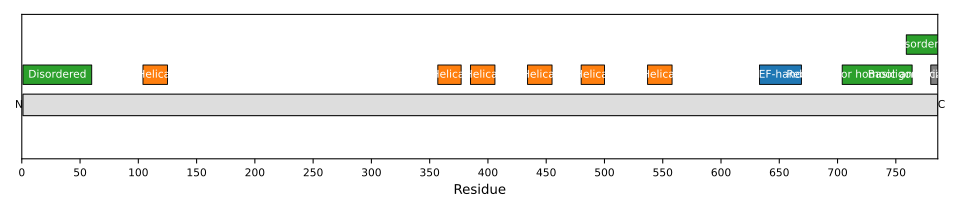
1: Homotetrameric, non-selective cation channel that is permeable to sodium, potassium, magnesium and calcium (PubMed:10517637, PubMed:11959145, PubMed:25820328, PubMed:27754867, PubMed:29425510, PubMed:30004384). Also forms functionnal heteromeric channels with PKD1, PKD1L1 and PKD1L3 (PubMed:23212381, PubMed:24336289). Pore-forming subunit of a heterotetrameric, non-selective cation channel, formed by PKD1L2 and PKD1L3, that is permeable to sodium, potassium, magnesium and calcium and which may act as a sour taste receptor in gustatory cells; however, its contribution to sour taste perception is unclear in vivo and may be indirect (PubMed:19812697, PubMed:23212381). The homomeric and heteromeric channels formed by PKD1L2 and PKD1L3 are activated by low pH and Ca(2+), but opens only when the extracellular pH rises again and after the removal of acid stimulus (PubMed:23212381). Pore-forming subunit of a calcium-permeant ion channel formed by PKD1L2 and PKD1L1 in primary cilia, where it controls cilium calcium concentration, without affecting cytoplasmic calcium concentration, and regulates sonic hedgehog/SHH signaling and GLI2 transcription (PubMed:24336289). The PKD1L1:PKD2L1 complex channel is mechanosensitive only at high pressures and is highly temperature sensitive (PubMed:24336289). Pore-forming subunit of a calcium-permeant ion channel formed by PKD1L2 and PKD1 that produces a transient increase in intracellular calcium concentration upon hypo-osmotic stimulation (200 mOsm) (By similarity). May play a role in the perception of carbonation taste (By similarity). May play a role in the sensory perception of water, via a mechanism that activates the channel in response to dilution of salivary bicarbonate and changes in salivary pH (By similarity)