Serine/threonine-protein kinase pim-2 (EC 2.7.11.1) (Pim-2h)
1_MLTKP 6_ LQGPP 11_ APPGT 16_ PTPPP 21_ GGKDR 26_ EAFEA 31_ EYRLG 36_ PLLGK 41_ GGFGT 46_ VFAGH 51_ RLTDR 56_ LQVAI 61_ KVIPR 66_ NRVLG 71_ WSPLS 76_ DSVTC 81_ PLEVA 86_ LLWKV 91_ GAGGG 96_ HPGVI 101_ RLLDW 106_ FETQE 111_ GFMLV 116_ LERPL 121_ PAQDL 126_ FDYIT 131_ EKGPL 136_ GEGPS 141_ RCFFG 146_ QVVAA 151_ IQHCH 156_ SRGVV 161_ HRDIK 166_ DENIL 171_ IDLRR 176_ GCAKL 181_ IDFGS 186_ GALLH 191_ DEPYT 196_ DFDGT 201_ RVYSP 206_ PEWIS 211_ RHQYH 216_ ALPAT 221_ VWSLG 226_ ILLYD 231_ MVCGD 236_ IPFER 241_ DQEIL 246_ EAELH 251_ FPAHV 256_ SPDCC 261_ ALIRR 266_ CLAPK 271_ PSSRP 276_ SLEEI 281_ LLDPW 286_ MQTPA 291_ EDVPL 296_ NPSKG 301_ GPAPL 306_AWSLL
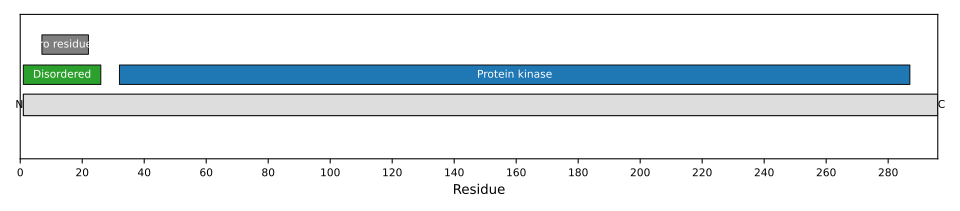
1: Proto-oncogene with serine/threonine kinase activity involved in cell survival and cell proliferation. Exerts its oncogenic activity through: the regulation of MYC transcriptional activity, the regulation of cell cycle progression, the regulation of cap-dependent protein translation and through survival signaling by phosphorylation of a pro-apoptotic protein, BAD. Phosphorylation of MYC leads to an increase of MYC protein stability and thereby an increase transcriptional activity. The stabilization of MYC exerted by PIM2 might explain partly the strong synergism between these 2 oncogenes in tumorigenesis. Regulates cap-dependent protein translation in a mammalian target of rapamycin complex 1 (mTORC1)-independent manner and in parallel to the PI3K-Akt pathway. Mediates survival signaling through phosphorylation of BAD, which induces release of the anti-apoptotic protein Bcl-X(L)/BCL2L1. Promotes cell survival in response to a variety of proliferative signals via positive regulation of the I-kappa-B kinase/NF-kappa-B cascade; this process requires phosphorylation of MAP3K8/COT. Promotes growth factor-independent proliferation by phosphorylation of cell cycle factors such as CDKN1A and CDKN1B. Involved in the positive regulation of chondrocyte survival and autophagy in the epiphyseal growth plate