Eukaryotic translation initiation factor 3 subunit K (eIF3k) (Eukaryotic translation initiation factor 3 subunit 12) (Muscle-specific gene M9 protein) (PLAC-24) (eIF-3 p25) (eIF-3 p28)
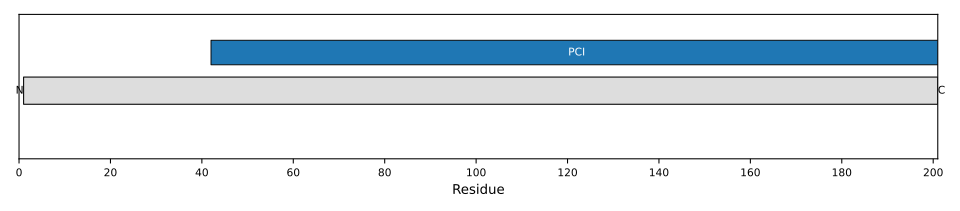
1_MAMFE 6_ QMRAN 11_ VGKLL 16_ KGIDR 21_ YNPEN 26_ LATLE 31_ RYVET 36_ QAKEN 41_ AYDLE 46_ ANLAV 51_ LKLYQ 56_ FNPAF 61_ FQTTV 66_ TAQIL 71_ LKALT 76_ NLPHT 81_ DFTLC 86_ KCMID 91_ QAHQE 96_ ERPIR 101_ QILYL 106_ GDLLE 111_ TCHFQ 116_ AFWQA 121_ LDENM 126_ DLLEG 131_ ITGFE 136_ DSVRK 141_ FICHV 146_ VGITY 151_ QHIDR 156_ WLLAE 161_ MLGDL 166_ SDSQL 171_ KVWMS 176_ KYGWS 181_ ADESG 186_ QIFIC 191_ SQEES 196_ IKPKN 201_ IVEKI 206_ DFDSV 211_SSIMA
1: Component of the eukaryotic translation initiation factor 3 (eIF-3) complex, which is required for several steps in the initiation of protein synthesis (PubMed:17581632, PubMed:25849773, PubMed:27462815). The eIF-3 complex associates with the 40S ribosome and facilitates the recruitment of eIF-1, eIF-1A, eIF-2:GTP:methionyl-tRNAi and eIF-5 to form the 43S pre-initiation complex (43S PIC). The eIF-3 complex stimulates mRNA recruitment to the 43S PIC and scanning of the mRNA for AUG recognition. The eIF-3 complex is also required for disassembly and recycling of post-termination ribosomal complexes and subsequently prevents premature joining of the 40S and 60S ribosomal subunits prior to initiation (PubMed:17581632). The eIF-3 complex specifically targets and initiates translation of a subset of mRNAs involved in cell proliferation, including cell cycling, differentiation and apoptosis, and uses different modes of RNA stem-loop binding to exert either translational activation or repression (PubMed:25849773)