Death domain-associated protein 6 (Daxx) (hDaxx) (ETS1-associated protein 1) (EAP1) (Fas death domain-associated protein)
1_MATAN 6_ SIIVL 11_ DDDDE 16_ DEAAA 21_ QPGPS 26_ HPLPN 31_ AASPG 36_ AEAPS 41_ SSEPH 46_ GARGS 51_ SSSGG 56_ KKCYK 61_ LENEK 66_ LFEEF 71_ LELCK 76_ MQTAD 81_ HPEVV 86_ PFLYN 91_ RQQRA 96_ HSLFL 101_ ASAEF 106_ CNILS 111_ RVLSR 116_ ARSRP 121_ AKLYV 126_ YINEL 131_ CTVLK 136_ AHSAK 141_ KKLNL 146_ APAAT 151_ TSNEP 156_ SGNNP 161_ PTHLS 166_ LDPTN 171_ AENTA 176_ SQSPR 181_ TRGSR 186_ RQIQR 191_ LEQLL 196_ ALYVA 201_ EIRRL 206_ QEKEL 211_ DLSEL 216_ DDPDS 221_ AYLQE 226_ ARLKR 231_ KLIRL 236_ FGRLC 241_ ELKDC 246_ SSLTG 251_ RVIEQ 256_ RIPYR 261_ GTRYP 266_ EVNRR 271_ IERLI 276_ NKPGP 281_ DTFPD 286_ YGDVL 291_ RAVEK 296_ AAARH 301_ SLGLP 306_ RQQLQ 311_ LMAQD 316_ AFRDV 321_ GIRLQ 326_ ERRHL 331_ DLIYN 336_ FGCHL 341_ TDDYR 346_ PGVDP 351_ ALSDP 356_ VLARR 361_ LRENR 366_ SLAMS 371_ RLDEV 376_ ISKYA 381_ MLQDK 386_ SEEGE 391_ RKKRR 396_ ARLQG 401_ TSSHS 406_ ADTPE 411_ ASLDS 416_ GEGPS 421_ GMASQ 426_ GCPSA 431_ SRAET 436_ DDEDD 441_ EESDE 446_ EEEEE 451_ EEEEE 456_ EEATD 461_ SEEEE 466_ DLEQM 471_ QEGQE 476_ DDEEE 481_ DEEEE 486_ AAAGK 491_ DGDKS 496_ PMSSL 501_ QISNE 506_ KNLEP 511_ GKQIS 516_ RSSGE 521_ QQNKG 526_ RIVSP 531_ SLLSE 536_ EPLAP 541_ SSIDA 546_ ESNGE 551_ QPEEL 556_ TLEEE 561_ SPVSQ 566_ LFELE 571_ IEALP 576_ LDTPS 581_ SVETD 586_ ISSSR 591_ KQSEE 596_ PFTTV 601_ LENGA 606_ GMVSS 611_ TSFNG 616_ GVSPH 621_ NWGDS 626_ GPPCK 631_ KSRKE 636_ KKQTG 641_ SGPLG 646_ NSYVE 651_ RQRSV 656_ HEKNG 661_ KKICT 666_ LPSPP 671_ SPLAS 676_ LAPVA 681_ DSSTR 686_ VDSPS 691_ HGLVT 696_ SSLCI 701_ PSPAR 706_ LSQTP 711_ HSQPP 716_ RPGTC 721_ KTSVA 726_ TQCDP 731_EEIIV
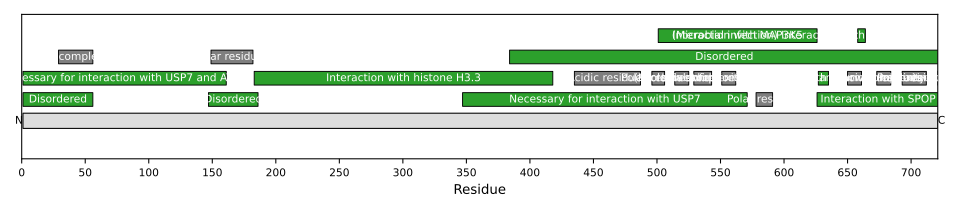
1: Transcription corepressor known to repress transcriptional potential of several sumoylated transcription factors. Down-regulates basal and activated transcription. Its transcription repressor activity is modulated by recruiting it to subnuclear compartments like the nucleolus or PML/POD/ND10 nuclear bodies through interactions with MCSR1 and PML, respectively. Seems to regulate transcription in PML/POD/ND10 nuclear bodies together with PML and may influence TNFRSF6-dependent apoptosis thereby. Inhibits transcriptional activation of PAX3 and ETS1 through direct protein-protein interactions. Modulates PAX5 activity; the function seems to involve CREBBP. Acts as an adapter protein in a MDM2-DAXX-USP7 complex by regulating the RING-finger E3 ligase MDM2 ubiquitination activity. Under non-stress condition, in association with the deubiquitinating USP7, prevents MDM2 self-ubiquitination and enhances the intrinsic E3 ligase activity of MDM2 towards TP53, thereby promoting TP53 ubiquitination and subsequent proteasomal degradation. Upon DNA damage, its association with MDM2 and USP7 is disrupted, resulting in increased MDM2 autoubiquitination and consequently, MDM2 degradation, which leads to TP53 stabilization. Acts as a histone chaperone that facilitates deposition of histone H3.3. Acts as a targeting component of the chromatin remodeling complex ATRX:DAXX which has ATP-dependent DNA translocase activity and catalyzes the replication-independent deposition of histone H3.3 in pericentric DNA repeats outside S-phase and telomeres, and the in vitro remodeling of H3.3-containing nucleosomes. Does not affect the ATPase activity of ATRX but alleviates its transcription repression activity. Upon neuronal activation associates with regulatory elements of selected immediate early genes where it promotes deposition of histone H3.3 which may be linked to transcriptional induction of these genes. Required for the recruitment of histone H3.3:H4 dimers to PML-nuclear bodies (PML-NBs); the process is independent of ATRX and facilitated by ASF1A; PML-NBs are suggested to function as regulatory sites for the incorporation of newly synthesized histone H3.3 into chromatin. In case of overexpression of centromeric histone variant CENPA (as found in various tumors) is involved in its mislocalization to chromosomes; the ectopic localization involves a heterotypic tetramer containing CENPA, and histones H3.3 and H4 and decreases binding of CTCF to chromatin. Proposed to mediate activation of the JNK pathway and apoptosis via MAP3K5 in response to signaling from TNFRSF6 and TGFBR2. Interaction with HSPB1/HSP27 may prevent interaction with TNFRSF6 and MAP3K5 and block DAXX-mediated apoptosis. In contrast, in lymphoid cells JNC activation and TNFRSF6-mediated apoptosis may not involve DAXX. Shows restriction activity towards human cytomegalovirus (HCMV). Plays a role as a positive regulator of the heat shock transcription factor HSF1 activity during the stress protein response (PubMed:15016915)