Small conductance calcium-activated potassium channel protein 3 (SK3) (SKCa 3) (SKCa3) (KCa2.3)
1_MDTSG 6_ HFHDS 11_ GVGDL 16_ DEDPK 21_ CPCPS 26_ SGDEQ 31_ QQQQQ 36_ QQQQQ 41_ QPPPP 46_ APPAA 51_ PQQPL 56_ GPSLQ 61_ PQPPQ 66_ LQQQQ 71_ QQQQQ 76_ QQQQQ 81_ PPHPL 86_ SQLAQ 91_ LQSQP 96_ VHPGL 101_ LHSSP 106_ TAFRA 111_ PPSSN 116_ STAIL 121_ HPSSR 126_ QGSQL 131_ NLNDH 136_ LLGHS 141_ PSSTA 146_ TSGPG 151_ GGSRH 156_ RQASP 161_ LVHRR 166_ DSNPF 171_ TEIAM 176_ SSCKY 181_ SGGVM 186_ KPLSR 191_ LSASR 196_ RNLIE 201_ AETEG 206_ QPLQL 211_ FSPSN 216_ PPEIV 221_ ISSRE 226_ DNHAH 231_ QTLLH 236_ HPNAT 241_ HNHQH 246_ AGTTA 251_ SSTTF 256_ PKANK 261_ RKNQN 266_ IGYKL 271_ GHRRA 276_ LFEKR 281_ KRLSD 286_ YALIF 291_ GMFGI 296_ VVMVI 301_ ETELS 306_ WGLYS 311_ KDSMF 316_ SLALK 321_ CLISL 326_ STIIL 331_ LGLII 336_ AYHTR 341_ EVQLF 346_ VIDNG 351_ ADDWR 356_ IAMTY 361_ ERILY 366_ ISLEM 371_ LVCAI 376_ HPIPG 381_ EYKFF 386_ WTARL 391_ AFSYT 396_ PSRAE 401_ ADVDI 406_ ILSIP 411_ MFLRL 416_ YLIAR 421_ VMLLH 426_ SKLFT 431_ DASSR 436_ SIGAL 441_ NKINF 446_ NTRFV 451_ MKTLM 456_ TICPG 461_ TVLLV 466_ FSISL 471_ WIIAA 476_ WTVRV 481_ CERYH 486_ DQQDV 491_ TSNFL 496_ GAMWL 501_ ISITF 506_ LSIGY 511_ GDMVP 516_ HTYCG 521_ KGVCL 526_ LTGIM 531_ GAGCT 536_ ALVVA 541_ VVARK 546_ LELTK 551_ AEKHV 556_ HNFMM 561_ DTQLT 566_ KRIKN 571_ AAANV 576_ LRETW 581_ LIYKH 586_ TKLLK 591_ KIDHA 596_ KVRKH 601_ QRKFL 606_ QAIHQ 611_ LRSVK 616_ MEQRK 621_ LSDQA 626_ NTLVD 631_ LSKMQ 636_ NVMYD 641_ LITEL 646_ NDRSE 651_ DLEKQ 656_ IGSLE 661_ SKLEH 666_ LTASF 671_ NSLPL 676_ LIADT 681_ LRQQQ 686_ QQLLS 691_ AIIEA 696_ RGVSV 701_ AVGTT 706_ HTPIS 711_ DSPIG 716_ VSSTS 721_ FPTPY 726_TSSSS
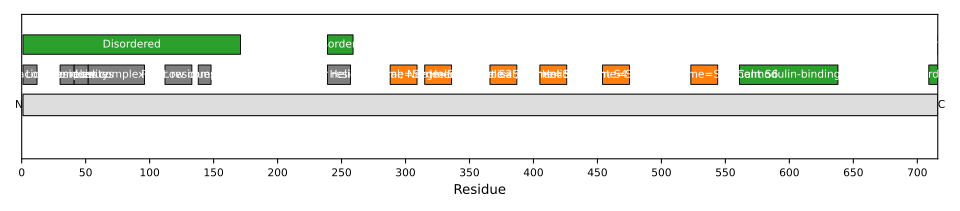
1: Small conductance calcium-activated potassium channel that mediates the voltage-independent transmembrane transfer of potassium across the cell membrane through a constitutive interaction with calmodulin which binds the intracellular calcium allowing its opening (PubMed:12808432, PubMed:20562108, PubMed:31155282, PubMed:36502918). The current is characterized by a voltage-independent activation, an intracellular calcium concentration increase-dependent activation and a single-channel conductance of 10 picosiemens (PubMed:12808432, PubMed:20562108, PubMed:31155282, PubMed:36502918). Also presents an inwardly rectifying current, thus reducing its already small outward conductance of potassium ions, which is particularly the case when the membrane potential displays positive values, above + 20 mV (PubMed:12808432). Activation is followed by membrane hyperpolarization. Thought to regulate neuronal excitability by contributing to the slow component of synaptic afterhyperpolarization (By similarity)
2: Does not function as a small conductance calcium-activated potassium channel (Probable). Selectively suppresses endogenous KCNN3 currents, in a dominant-negative fashion by decreasing the abundance of functional channels in the plasma membrane, possibly by selectively coassembling with and sequestering native KCNN3 protein in intracellular compartments (PubMed:12808432). This dominant inhibitory effect extends to other members of the SK subfamily (PubMed:12808432)