Poly [ADP-ribose] polymerase 2 (PARP-2) (hPARP-2) (EC 2.4.2.30) (ADP-ribosyltransferase diphtheria toxin-like 2) (ARTD2) (DNA ADP-ribosyltransferase PARP2) (EC 2.4.2.-) (NAD(+) ADP-ribosyltransferase 2) (ADPRT-2) (Poly[ADP-ribose] synthase 2) (pADPRT-2) (Protein poly-ADP-ribosyltransferase PARP2) (EC 2.4.2.-)
1_MAARR 6_ RRSTG 11_ GGRAR 16_ ALNES 21_ KRVNN 26_ GNTAP 31_ EDSSP 36_ AKKTR 41_ RCQRQ 46_ ESKKM 51_ PVAGG 56_ KANKD 61_ RTEDK 66_ QDGMP 71_ GRSWA 76_ SKRVS 81_ ESVKA 86_ LLLKG 91_ KAPVD 96_ PECTA 101_ KVGKA 106_ HVYCE 111_ GNDVY 116_ DVMLN 121_ QTNLQ 126_ FNNNK 131_ YYLIQ 136_ LLEDD 141_ AQRNF 146_ SVWMR 151_ WGRVG 156_ KMGQH 161_ SLVAC 166_ SGNLN 171_ KAKEI 176_ FQKKF 181_ LDKTK 186_ NNWED 191_ REKFE 196_ KVPGK 201_ YDMLQ 206_ MDYAT 211_ NTQDE 216_ EETKK 221_ EESLK 226_ SPLKP 231_ ESQLD 236_ LRVQE 241_ LIKLI 246_ CNVQA 251_ MEEMM 256_ MEMKY 261_ NTKKA 266_ PLGKL 271_ TVAQI 276_ KAGYQ 281_ SLKKI 286_ EDCIR 291_ AGQHG 296_ RALME 301_ ACNEF 306_ YTRIP 311_ HDFGL 316_ RTPPL 321_ IRTQK 326_ ELSEK 331_ IQLLE 336_ ALGDI 341_ EIAIK 346_ LVKTE 351_ LQSPE 356_ HPLDQ 361_ HYRNL 366_ HCALR 371_ PLDHE 376_ SYEFK 381_ VISQY 386_ LQSTH 391_ APTHS 396_ DYTMT 401_ LLDLF 406_ EVEKD 411_ GEKEA 416_ FREDL 421_ HNRML 426_ LWHGS 431_ RMSNW 436_ VGILS 441_ HGLRI 446_ APPEA 451_ PITGY 456_ MFGKG 461_ IYFAD 466_ MSSKS 471_ ANYCF 476_ ASRLK 481_ NTGLL 486_ LLSEV 491_ ALGQC 496_ NELLE 501_ ANPKA 506_ EGLLQ 511_ GKHST 516_ KGLGK 521_ MAPSS 526_ AHFVT 531_ LNGST 536_ VPLGP 541_ ASDTG 546_ ILNPD 551_ GYTLN 556_ YNEYI 561_ VYNPN 566_ QVRMR 571_ YLLKV 576_QFNFL
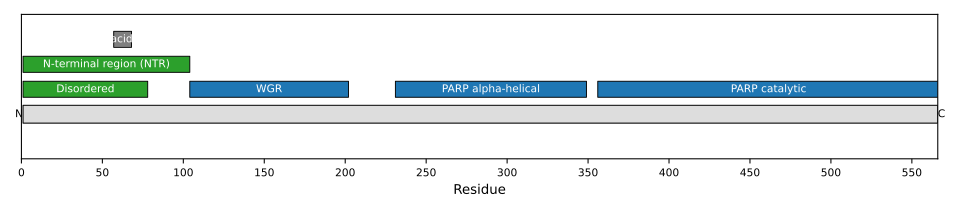
1: Poly-ADP-ribosyltransferase that mediates poly-ADP-ribosylation of proteins and plays a key role in DNA repair (PubMed:10364231, PubMed:25043379, PubMed:27471034, PubMed:30104678, PubMed:32028527, PubMed:32939087, PubMed:34108479, PubMed:34486521, PubMed:34874266). Mediates glutamate, aspartate or serine ADP-ribosylation of proteins: the ADP-D-ribosyl group of NAD(+) is transferred to the acceptor carboxyl group of target residues and further ADP-ribosyl groups are transferred to the 2'-position of the terminal adenosine moiety, building up a polymer with an average chain length of 20-30 units (PubMed:25043379, PubMed:30104678, PubMed:30321391). Serine ADP-ribosylation of proteins constitutes the primary form of ADP-ribosylation of proteins in response to DNA damage (PubMed:32939087). Mediates glutamate and aspartate ADP-ribosylation of target proteins in absence of HPF1 (PubMed:25043379). Following interaction with HPF1, catalyzes serine ADP-ribosylation of target proteins; HPF1 conferring serine specificity by completing the PARP2 active site (PubMed:28190768, PubMed:32028527, PubMed:34108479, PubMed:34486521, PubMed:34874266). PARP2 initiates the repair of double-strand DNA breaks: recognizes and binds DNA breaks within chromatin and recruits HPF1, licensing serine ADP-ribosylation of target proteins, such as histones, thereby promoting decompaction of chromatin and the recruitment of repair factors leading to the reparation of DNA strand breaks (PubMed:10364231, PubMed:32939087, PubMed:34108479). HPF1 initiates serine ADP-ribosylation but restricts the polymerase activity of PARP2 in order to limit the length of poly-ADP-ribose chains (PubMed:34732825, PubMed:34795260). Specifically mediates formation of branched poly-ADP-ribosylation (PubMed:30104678). Branched poly-ADP-ribose chains are specifically recognized by some factors, such as APLF (PubMed:30104678). In addition to proteins, also able to ADP-ribosylate DNA: preferentially acts on 5'-terminal phosphates at DNA strand breaks termini in nicked duplex (PubMed:27471034, PubMed:29361132)