Interleukin-36 alpha (FIL1 epsilon) (Interleukin-1 epsilon) (IL-1 epsilon) (Interleukin-1 family member 6) (IL-1F6)
1_MEKAL 6_ KIDTP 11_ QQGSI 16_ QDINH 21_ RVWVL 26_ QDQTL 31_ IAVPR 36_ KDRMS 41_ PVTIA 46_ LISCR 51_ HVETL 56_ EKDRG 61_ NPIYL 66_ GLNGL 71_ NLCLM 76_ CAKVG 81_ DQPTL 86_ QLKEK 91_ DIMDL 96_ YNQPE 101_ PVKSF 106_ LFYHS 111_ QSGRN 116_ STFES 121_ VAFPG 126_ WFIAV 131_ SSEGG 136_ CPLIL 141_ TQELG 146_ KANTT 151_DFGLT
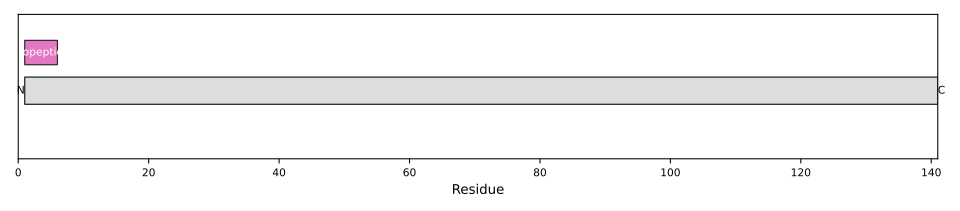
1: Cytokine that binds to and signals through the IL1RL2/IL-36R receptor which in turn activates NF-kappa-B and MAPK signaling pathways in target cells linked to a pro-inflammatory response. Part of the IL-36 signaling system that is thought to be present in epithelial barriers and to take part in local inflammatory response; similar to the IL-1 system with which it shares the coreceptor IL1RAP. Seems to be involved in skin inflammatory response by acting on keratinocytes, dendritic cells and indirectly on T-cells to drive tissue infiltration, cell maturation and cell proliferation. In cultured keratinocytes induces the expression of macrophage, T-cell, and neutrophil chemokines, such as CCL3, CCL4, CCL5, CCL2, CCL17, CCL22, CL20, CCL5, CCL2, CCL17, CCL22, CXCL8, CCL20 and CXCL1, and the production of pro-inflammatory cytokines such as TNF-alpha, IL-8 and IL-6. In cultured monocytes up-regulates expression of IL-1A, IL-1B and IL-6. In myeloid dendritic cells involved in cell maturation by up-regulating surface expression of CD83, CD86 and HLA-DR. In monocyte-derived dendritic cells facilitates dendritic cell maturation and drives T-cell proliferation. May play a role in pro-inflammatory effects in the lung