Serine/threonine-protein kinase TBK1 (EC 2.7.11.1) (NF-kappa-B-activating kinase) (T2K) (TANK-binding kinase 1)
1_MQSTS 6_ NHLWL 11_ LSDIL 16_ GQGAT 21_ ANVFR 26_ GRHKK 31_ TGDLF 36_ AIKVF 41_ NNISF 46_ LRPVD 51_ VQMRE 56_ FEVLK 61_ KLNHK 66_ NIVKL 71_ FAIEE 76_ ETTTR 81_ HKVLI 86_ MEFCP 91_ CGSLY 96_ TVLEE 101_ PSNAY 106_ GLPES 111_ EFLIV 116_ LRDVV 121_ GGMNH 126_ LRENG 131_ IVHRD 136_ IKPGN 141_ IMRVI 146_ GEDGQ 151_ SVYKL 156_ TDFGA 161_ ARELE 166_ DDEQF 171_ VSLYG 176_ TEEYL 181_ HPDMY 186_ ERAVL 191_ RKDHQ 196_ KKYGA 201_ TVDLW 206_ SIGVT 211_ FYHAA 216_ TGSLP 221_ FRPFE 226_ GPRRN 231_ KEVMY 236_ KIITG 241_ KPSGA 246_ ISGVQ 251_ KAENG 256_ PIDWS 261_ GDMPV 266_ SCSLS 271_ RGLQV 276_ LLTPV 281_ LANIL 286_ EADQE 291_ KCWGF 296_ DQFFA 301_ ETSDI 306_ LHRMV 311_ IHVFS 316_ LQQMT 321_ AHKIY 326_ IHSYN 331_ TATIF 336_ HELVY 341_ KQTKI 346_ ISSNQ 351_ ELIYE 356_ GRRLV 361_ LEPGR 366_ LAQHF 371_ PKTTE 376_ ENPIF 381_ VVSRE 386_ PLNTI 391_ GLIYE 396_ KISLP 401_ KVHPR 406_ YDLDG 411_ DASMA 416_ KAITG 421_ VVCYA 426_ CRIAS 431_ TLLLY 436_ QELMR 441_ KGIRW 446_ LIELI 451_ KDDYN 456_ ETVHK 461_ KTEVV 466_ ITLDF 471_ CIRNI 476_ EKTVK 481_ VYEKL 486_ MKINL 491_ EAAEL 496_ GEISD 501_ IHTKL 506_ LRLSS 511_ SQGTI 516_ ETSLQ 521_ DIDSR 526_ LSPGG 531_ SLADA 536_ WAHQE 541_ GTHPK 546_ DRNVE 551_ KLQVL 556_ LNCMT 561_ EIYYQ 566_ FKKDK 571_ AERRL 576_ AYNEE 581_ QIHKF 586_ DKQKL 591_ YYHAT 596_ KAMTH 601_ FTDEC 606_ VKKYE 611_ AFLNK 616_ SEEWI 621_ RKMLH 626_ LRKQL 631_ LSLTN 636_ QCFDI 641_ EEEVS 646_ KYQEY 651_ TNELQ 656_ ETLPQ 661_ KMFTA 666_ SSGIK 671_ HTMTP 676_ IYPSS 681_ NTLVE 686_ MTLGM 691_ KKLKE 696_ EMEGV 701_ VKELA 706_ ENNHI 711_ LERFG 716_ SLTMD 721_GGLRN
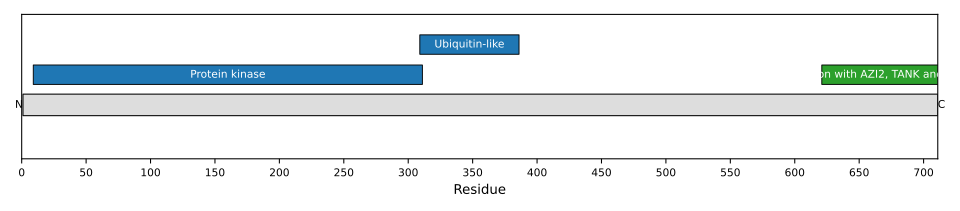
1: Serine/threonine kinase that plays an essential role in regulating inflammatory responses to foreign agents (PubMed:10581243, PubMed:11839743, PubMed:12692549, PubMed:12702806, PubMed:14703513, PubMed:15367631, PubMed:15485837, PubMed:18583960, PubMed:21138416, PubMed:23453971, PubMed:23453972, PubMed:23746807, PubMed:25636800, PubMed:26611359, PubMed:32404352, PubMed:34363755, PubMed:32298923). Following activation of toll-like receptors by viral or bacterial components, associates with TRAF3 and TANK and phosphorylates interferon regulatory factors (IRFs) IRF3 and IRF7 as well as DDX3X (PubMed:12692549, PubMed:12702806, PubMed:14703513, PubMed:15367631, PubMed:18583960, PubMed:25636800). This activity allows subsequent homodimerization and nuclear translocation of the IRFs leading to transcriptional activation of pro-inflammatory and antiviral genes including IFNA and IFNB (PubMed:12702806, PubMed:15367631, PubMed:25636800, PubMed:32972995). In order to establish such an antiviral state, TBK1 form several different complexes whose composition depends on the type of cell and cellular stimuli (PubMed:23453971, PubMed:23453972, PubMed:23746807). Plays a key role in IRF3 activation: acts by first phosphorylating innate adapter proteins MAVS, STING1 and TICAM1 on their pLxIS motif, leading to recruitment of IRF3, thereby licensing IRF3 for phosphorylation by TBK1 (PubMed:25636800, PubMed:30842653, PubMed:37926288). Phosphorylated IRF3 dissociates from the adapter proteins, dimerizes, and then enters the nucleus to induce expression of interferons (PubMed:25636800). Thus, several scaffolding molecules including FADD, TRADD, MAVS, AZI2, TANK or TBKBP1/SINTBAD can be recruited to the TBK1-containing-complexes (PubMed:21931631). Under particular conditions, functions as a NF-kappa-B effector by phosphorylating NF-kappa-B inhibitor alpha/NFKBIA, IKBKB or RELA to translocate NF-Kappa-B to the nucleus (PubMed:10783893, PubMed:15489227). Restricts bacterial proliferation by phosphorylating the autophagy receptor OPTN/Optineurin on 'Ser-177', thus enhancing LC3 binding affinity and antibacterial autophagy (PubMed:21617041). Phosphorylates SMCR8 component of the C9orf72-SMCR8 complex, promoting autophagosome maturation (PubMed:27103069). Phosphorylates ATG8 proteins MAP1LC3C and GABARAPL2, thereby preventing their delipidation and premature removal from nascent autophagosomes (PubMed:31709703). Seems to play a role in energy balance regulation by sustaining a state of chronic, low-grade inflammation in obesity, which leads to a negative impact on insulin sensitivity (By similarity). Attenuates retroviral budding by phosphorylating the endosomal sorting complex required for transport-I (ESCRT-I) subunit VPS37C (PubMed:21270402). Phosphorylates Borna disease virus (BDV) P protein (PubMed:16155125). Plays an essential role in the TLR3- and IFN-dependent control of herpes virus HSV-1 and HSV-2 infections in the central nervous system (PubMed:22851595). Acts both as a positive and negative regulator of the mTORC1 complex, depending on the context: activates mTORC1 in response to growth factors by catalyzing phosphorylation of MTOR, while it limits the mTORC1 complex by promoting phosphorylation of RPTOR (PubMed:29150432, PubMed:31530866). Acts as a positive regulator of the mTORC2 complex by mediating phosphorylation of MTOR, leading to increased phosphorylation and activation of AKT1 (By similarity). Phosphorylates and activates AKT1 (PubMed:21464307). Involved in the regulation of TNF-induced RIPK1-mediated cell death, probably acting via CYLD phosphorylation that in turn controls RIPK1 ubiquitination status (PubMed:34363755). Also participates in the differentiation of T follicular regulatory cells together with the receptor ICOS (PubMed:27135603)