SLAM family member 5 (Cell surface antigen MAX.3) (Hly9-beta) (Leukocyte differentiation antigen CD84) (Signaling lymphocytic activation molecule 5) (CD antigen CD84)
1_MAQHH 6_ LWILL 11_ LCLQT 16_ WPEAA 21_ GKDSE 26_ IFTVN 31_ GILGE 36_ SVTFP 41_ VNIQE 46_ PRQVK 51_ IIAWT 56_ SKTSV 61_ AYVTP 66_ GDSET 71_ APVVT 76_ VTHRN 81_ YYERI 86_ HALGP 91_ NYNLV 96_ ISDLR 101_ MEDAG 106_ DYKAD 111_ INTQA 116_ DPYTT 121_ TKRYN 126_ LQIYR 131_ RLGKP 136_ KITQS 141_ LMASV 146_ NSTCN 151_ VTLTC 156_ SVEKE 161_ EKNVT 166_ YNWSP 171_ LGEEG 176_ NVLQI 181_ FQTPE 186_ DQELT 191_ YTCTA 196_ QNPVS 201_ NNSDS 206_ ISARQ 211_ LCADI 216_ AMGFR 221_ THHTG 226_ LLSVL 231_ AMFFL 236_ LVLIL 241_ SSVFL 246_ FRLFK 251_ RRQGR 256_ IFPEG 261_ SCLNT 266_ FTKNP 271_ YAASK 276_ KTIYT 281_ YIMAS 286_ RNTQP 291_ AESRI 296_ YDEIL 301_ QSKVL 306_ PSKEE 311_ PVNTV 316_ YSEVQ 321_ FADKM 326_ GKAST 331_ QDSKP 336_PGTSS
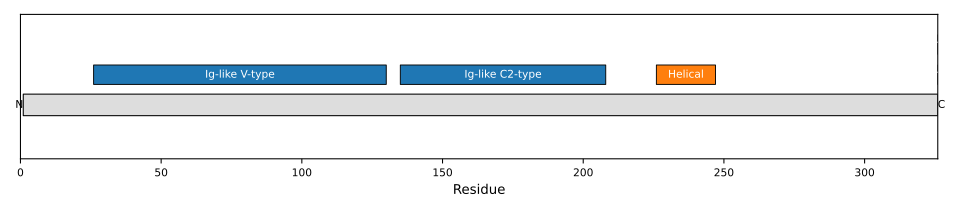
1: Self-ligand receptor of the signaling lymphocytic activation molecule (SLAM) family. SLAM receptors triggered by homo- or heterotypic cell-cell interactions are modulating the activation and differentiation of a wide variety of immune cells and thus are involved in the regulation and interconnection of both innate and adaptive immune response. Activities are controlled by presence or absence of small cytoplasmic adapter proteins, SH2D1A/SAP and/or SH2D1B/EAT-2. Can mediate natural killer (NK) cell cytotoxicity dependent on SH2D1A and SH2D1B (By similarity). Increases proliferative responses of activated T-cells and SH2D1A/SAP does not seem be required for this process. Homophilic interactions enhance interferon gamma/IFNG secretion in lymphocytes and induce platelet stimulation via a SH2D1A-dependent pathway. May serve as a marker for hematopoietic progenitor cells (PubMed:11564780, PubMed:12115647, PubMed:12928397, PubMed:12962726, PubMed:16037392) Required for a prolonged T-cell:B-cell contact, optimal T follicular helper function, and germinal center formation. In germinal centers involved in maintaining B-cell tolerance and in preventing autoimmunity (By similarity). In mast cells negatively regulates high affinity immunoglobulin epsilon receptor signaling; independent of SH2D1A and SH2D1B but implicating FES and PTPN6/SHP-1 (PubMed:22068234). In macrophages enhances LPS-induced MAPK phosphorylation and NF-kappaB activation and modulates LPS-induced cytokine secretion; involving ITSM 2 (By similarity). Positively regulates macroautophagy in primary dendritic cells via stabilization of IRF8; inhibits TRIM21-mediated proteasomal degradation of IRF8 (PubMed:29434592)