F-box/LRR-repeat protein 5 (F-box and leucine-rich repeat protein 5) (F-box protein FBL4/FBL5) (p45SKP2-like protein)
1_MAPFP 6_ EEVDV 11_ FTAPH 16_ WRMKQ 21_ LVGLY 26_ CDKLS 31_ KTNFS 36_ NNNDF 41_ RALLQ 46_ SLYAT 51_ FKEFK 56_ MHEQI 61_ ENEYI 66_ IGLLQ 71_ QRSQT 76_ IYNVH 81_ SDNKL 86_ SEMLS 91_ LFEKG 96_ LKNVK 101_ NEYEQ 106_ LNYAK 111_ QLKER 116_ LEAFT 121_ RDFLP 126_ HMKEE 131_ EEVFQ 136_ PMLME 141_ YFTYE 146_ ELKDI 151_ KKKVI 156_ AQHCS 161_ QKDTA 166_ ELLRG 171_ LSLWN 176_ HAEER 181_ QKFFK 186_ YSVDE 191_ KSDKE 196_ AEVSE 201_ HSTGI 206_ THLPP 211_ EVMLS 216_ IFSYL 221_ NPQEL 226_ CRCSQ 231_ VSMKW 236_ SQLTK 241_ TGSLW 246_ KHLYP 251_ VHWAR 256_ GDWYS 261_ GPATE 266_ LDTEP 271_ DDEWV 276_ KNRKD 281_ ESRAF 286_ HEWDE 291_ DADID 296_ ESEES 301_ AEESI 306_ AISIA 311_ QMEKR 316_ LLHGL 321_ IHNVL 326_ PYVGT 331_ SVKTL 336_ VLAYS 341_ SAVSS 346_ KMVRQ 351_ ILELC 356_ PNLEH 361_ LDLTQ 366_ TDISD 371_ SAFDS 376_ WSWLG 381_ CCQSL 386_ RHLDL 391_ SGCEK 396_ ITDVA 401_ LEKIS 406_ RALGI 411_ LTSHQ 416_ SGFLK 421_ TSTSK 426_ ITSTA 431_ WKNKD 436_ ITMQS 441_ TKQYA 446_ CLHDL 451_ TNKGI 456_ GEEID 461_ NEHPW 466_ TKPVS 471_ SENFT 476_ SPYVW 481_ MLDAE 486_ DLADI 491_ EDTVE 496_ WRHRN 501_ VESLC 506_ VMETA 511_ SNFSC 516_ STSGC 521_ FSKDI 526_ VGLRT 531_ SVCWQ 536_ QHCAS 541_ PAFAY 546_ CGHSF 551_ CCTGT 556_ ALRTM 561_ SSLPE 566_ SSAMC 571_ RKAAR 576_ TRLPR 581_ GKDLI 586_ YFGSE 591_ KSDQE 596_ TGRVL 601_ LFLSL 606_ SGCYQ 611_ ITDHG 616_ LRVLT 621_ LGGGL 626_ PYLEH 631_ LNLSG 636_ CLTIT 641_ GAGLQ 646_ DLVSA 651_ CPSLN 656_ DEYFY 661_ YCDNI 666_ NGPHA 671_ DTASG 676_ CQNLQ 681_ CGFRA 686_CCRSG
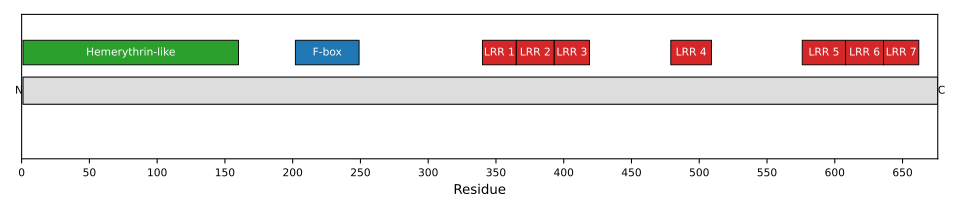
1: Component of some SCF (SKP1-cullin-F-box) protein ligase complex that plays a central role in iron homeostasis by promoting the ubiquitination and subsequent degradation of IREB2/IRP2 (PubMed:19762596, PubMed:19762597). The C-terminal domain of FBXL5 contains a redox-sensitive [2Fe-2S] cluster that, upon oxidation, promotes binding to IRP2 to effect its oxygen-dependent degradation (PubMed:32126207). Under iron deficiency conditions, the N-terminal hemerythrin-like (Hr) region, which contains a diiron metal center, cannot bind iron and undergoes conformational changes that destabilize the FBXL5 protein and cause its ubiquitination and degradation (PubMed:19762596, PubMed:19762597). When intracellular iron levels start rising, the Hr region is stabilized (PubMed:19762596, PubMed:19762597). Additional increases in iron levels facilitate the assembly and incorporation of a redox active [2Fe-2S] cluster in the C-terminal domain (PubMed:32126207). Only when oxygen level is high enough to maintain the cluster in its oxidized state can FBXL5 recruit IRP2 as a substrate for polyubiquination and degradation (PubMed:32126207). Promotes ubiquitination and subsequent degradation of the dynactin complex component DCTN1 (PubMed:17532294). Within the nucleus, promotes the ubiquitination of SNAI1; preventing its interaction with DNA and promoting its degradation (PubMed:24157836). Negatively regulates DNA damage response by mediating the ubiquitin-proteasome degradation of the DNA repair protein NABP2 (PubMed:25249620)