T-box transcription factor TBX21 (T-box protein 21) (T-cell-specific T-box transcription factor T-bet) (Transcription factor TBLYM)
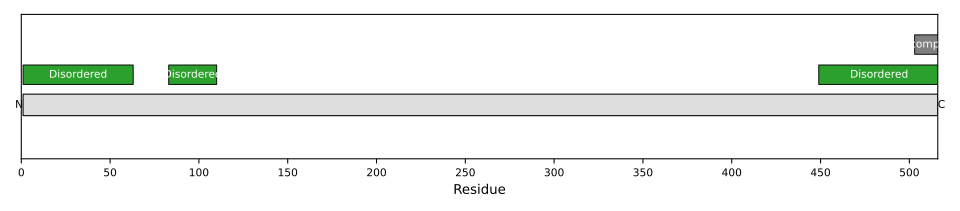
1_MGIVE 6_ PGCGD 11_ MLTGT 16_ EPMPG 21_ SDEGR 26_ APGAD 31_ PQHRY 36_ FYPEP 41_ GAQDA 46_ DERRG 51_ GGSLG 56_ SPYPG 61_ GALVP 66_ APPSR 71_ FLGAY 76_ AYPPR 81_ PQAAG 86_ FPGAG 91_ ESFPP 96_ PADAE 101_ GYQPG 106_ EGYAA 111_ PDPRA 116_ GLYPG 121_ PREDY 126_ ALPAG 131_ LEVSG 136_ KLRVA 141_ LNNHL 146_ LWSKF 151_ NQHQT 156_ EMIIT 161_ KQGRR 166_ MFPFL 171_ SFTVA 176_ GLEPT 181_ SHYRM 186_ FVDVV 191_ LVDQH 196_ HWRYQ 201_ SGKWV 206_ QCGKA 211_ EGSMP 216_ GNRLY 221_ VHPDS 226_ PNTGA 231_ HWMRQ 236_ EVSFG 241_ KLKLT 246_ NNKGA 251_ SNNVT 256_ QMIVL 261_ QSLHK 266_ YQPRL 271_ HIVEV 276_ NDGEP 281_ EAACN 286_ ASNTH 291_ IFTFQ 296_ ETQFI 301_ AVTAY 306_ QNAEI 311_ TQLKI 316_ DNNPF 321_ AKGFR 326_ ENFES 331_ MYTSV 336_ DTSIP 341_ SPPGP 346_ NCQFL 351_ GGDHY 356_ SPLLP 361_ NQYPV 366_ PSRFY 371_ PDLPG 376_ QAKDV 381_ VPQAY 386_ WLGAP 391_ RDHSY 396_ EAEFR 401_ AVSMK 406_ PAFLP 411_ SAPGP 416_ TMSYY 421_ RGQEV 426_ LAPGA 431_ GWPVA 436_ PQYPP 441_ KMGPA 446_ SWFRP 451_ MRTLP 456_ MEPGP 461_ GGSEG 466_ RGPED 471_ QGPPL 476_ VWTEI 481_ APIRP 486_ ESSDS 491_ GLGEG 496_ DSKRR 501_ RVSPY 506_ PSSGD 511_ SSSPA 516_ GAPSP 521_ FDKEA 526_EGQFY
1: Lineage-defining transcription factor which initiates Th1 lineage development from naive Th precursor cells both by activating Th1 genetic programs and by repressing the opposing Th2 and Th17 genetic programs (PubMed:10761931). Activates transcription of a set of genes important for Th1 cell function, including those encoding IFN-gamma and the chemokine receptor CXCR3. Induces permissive chromatin accessibilty and CpG methylation in IFNG (PubMed:33296702). Activates IFNG and CXCR3 genes in part by recruiting chromatin remodeling complexes including KDM6B, a SMARCA4-containing SWI/SNF-complex, and an H3K4me2-methyltransferase complex to their promoters and all of these complexes serve to establish a more permissive chromatin state conducive with transcriptional activation (By similarity). Can activate Th1 genes also via recruitment of Mediator complex and P-TEFb (composed of CDK9 and CCNT1/cyclin-T1) in the form of the super elongation complex (SEC) to super-enhancers and associated genes in activated Th1 cells (PubMed:27292648). Inhibits the Th17 cell lineage commitment by blocking RUNX1-mediated transactivation of Th17 cell-specific transcriptinal regulator RORC. Inhibits the Th2 cell lineage commitment by suppressing the production of Th2 cytokines, such as IL-4, IL-5, and IL- 13, via repression of transcriptional regulators GATA3 and NFATC2. Protects Th1 cells from amplifying aberrant type-I IFN response in an IFN-gamma abundant microenvironment by acting as a repressor of type-I IFN transcription factors and type-I IFN-stimulated genes. Acts as a regulator of antiviral B-cell responses; controls chronic viral infection by promoting the antiviral antibody IgG2a isotype switching and via regulation of a broad antiviral gene expression program (By similarity). Required for the correct development of natural killer (NK) and mucosal-associated invariant T (MAIT) cells (PubMed:33296702)