ALK tyrosine kinase receptor (EC 2.7.10.1) (Anaplastic lymphoma kinase) (CD antigen CD246)
1_MGAIG 6_ LLWLL 11_ PLLLS 16_ TAAVG 21_ SGMGT 26_ GQRAG 31_ SPAAG 36_ PPLQP 41_ REPLS 46_ YSRLQ 51_ RKSLA 56_ VDFVV 61_ PSLFR 66_ VYARD 71_ LLLPP 76_ SSSEL 81_ KAGRP 86_ EARGS 91_ LALDC 96_ APLLR 101_ LLGPA 106_ PGVSW 111_ TAGSP 116_ APAEA 121_ RTLSR 126_ VLKGG 131_ SVRKL 136_ RRAKQ 141_ LVLEL 146_ GEEAI 151_ LEGCV 156_ GPPGE 161_ AAVGL 166_ LQFNL 171_ SELFS 176_ WWIRQ 181_ GEGRL 186_ RIRLM 191_ PEKKA 196_ SEVGR 201_ EGRLS 206_ AAIRA 211_ SQPRL 216_ LFQIF 221_ GTGHS 226_ SLESP 231_ TNMPS 236_ PSPDY 241_ FTWNL 246_ TWIMK 251_ DSFPF 256_ LSHRS 261_ RYGLE 266_ CSFDF 271_ PCELE 276_ YSPPL 281_ HDLRN 286_ QSWSW 291_ RRIPS 296_ EEASQ 301_ MDLLD 306_ GPGAE 311_ RSKEM 316_ PRGSF 321_ LLLNT 326_ SADSK 331_ HTILS 336_ PWMRS 341_ SSEHC 346_ TLAVS 351_ VHRHL 356_ QPSGR 361_ YIAQL 366_ LPHNE 371_ AAREI 376_ LLMPT 381_ PGKHG 386_ WTVLQ 391_ GRIGR 396_ PDNPF 401_ RVALE 406_ YISSG 411_ NRSLS 416_ AVDFF 421_ ALKNC 426_ SEGTS 431_ PGSKM 436_ ALQSS 441_ FTCWN 446_ GTVLQ 451_ LGQAC 456_ DFHQD 461_ CAQGE 466_ DESQM 471_ CRKLP 476_ VGFYC 481_ NFEDG 486_ FCGWT 491_ QGTLS 496_ PHTPQ 501_ WQVRT 506_ LKDAR 511_ FQDHQ 516_ DHALL 521_ LSTTD 526_ VPASE 531_ SATVT 536_ SATFP 541_ APIKS 546_ SPCEL 551_ RMSWL 556_ IRGVL 561_ RGNVS 566_ LVLVE 571_ NKTGK 576_ EQGRM 581_ VWHVA 586_ AYEGL 591_ SLWQW 596_ MVLPL 601_ LDVSD 606_ RFWLQ 611_ MVAWW 616_ GQGSR 621_ AIVAF 626_ DNISI 631_ SLDCY 636_ LTISG 641_ EDKIL 646_ QNTAP 651_ KSRNL 656_ FERNP 661_ NKELK 666_ PGENS 671_ PRQTP 676_ IFDPT 681_ VHWLF 686_ TTCGA 691_ SGPHG 696_ PTQAQ 701_ CNNAY 706_ QNSNL 711_ SVEVG 716_ SEGPL 721_ KGIQI 726_ WKVPA 731_ TDTYS 736_ ISGYG 741_ AAGGK 746_ GGKNT 751_ MMRSH 756_ GVSVL 761_ GIFNL 766_ EKDDM 771_ LYILV 776_ GQQGE 781_ DACPS 786_ TNQLI 791_ QKVCI 796_ GENNV 801_ IEEEI 806_ RVNRS 811_ VHEWA 816_ GGGGG 821_ GGGAT 826_ YVFKM 831_ KDGVP 836_ VPLII 841_ AAGGG 846_ GRAYG 851_ AKTDT 856_ FHPER 861_ LENNS 866_ SVLGL 871_ NGNSG 876_ AAGGG 881_ GGWND 886_ NTSLL 891_ WAGKS 896_ LQEGA 901_ TGGHS 906_ CPQAM 911_ KKWGW 916_ ETRGG 921_ FGGGG 926_ GGCSS 931_ GGGGG 936_ GYIGG 941_ NAASN 946_ NDPEM 951_ DGEDG 956_ VSFIS 961_ PLGIL 966_ YTPAL 971_ KVMEG 976_ HGEVN 981_ IKHYL 986_ NCSHC 991_ EVDEC 996_ HMDPE 1001_ SHKVI 1006_ CFCDH 1011_ GTVLA 1016_ EDGVS 1021_ CIVSP 1026_ TPEPH 1031_ LPLSL 1036_ ILSVV 1041_ TSALV 1046_ AALVL 1051_ AFSGI 1056_ MIVYR 1061_ RKHQE 1066_ LQAMQ 1071_ MELQS 1076_ PEYKL 1081_ SKLRT 1086_ STIMT 1091_ DYNPN 1096_ YCFAG 1101_ KTSSI 1106_ SDLKE 1111_ VPRKN 1116_ ITLIR 1121_ GLGHG 1126_ AFGEV 1131_ YEGQV 1136_ SGMPN 1141_ DPSPL 1146_ QVAVK 1151_ TLPEV 1156_ CSEQD 1161_ ELDFL 1166_ MEALI 1171_ ISKFN 1176_ HQNIV 1181_ RCIGV 1186_ SLQSL 1191_ PRFIL 1196_ LELMA 1201_ GGDLK 1206_ SFLRE 1211_ TRPRP 1216_ SQPSS 1221_ LAMLD 1226_ LLHVA 1231_ RDIAC 1236_ GCQYL 1241_ EENHF 1246_ IHRDI 1251_ AARNC 1256_ LLTCP 1261_ GPGRV 1266_ AKIGD 1271_ FGMAR 1276_ DIYRA 1281_ SYYRK 1286_ GGCAM 1291_ LPVKW 1296_ MPPEA 1301_ FMEGI 1306_ FTSKT 1311_ DTWSF 1316_ GVLLW 1321_ EIFSL 1326_ GYMPY 1331_ PSKSN 1336_ QEVLE 1341_ FVTSG 1346_ GRMDP 1351_ PKNCP 1356_ GPVYR 1361_ IMTQC 1366_ WQHQP 1371_ EDRPN 1376_ FAIIL 1381_ ERIEY 1386_ CTQDP 1391_ DVINT 1396_ ALPIE 1401_ YGPLV 1406_ EEEEK 1411_ VPVRP 1416_ KDPEG 1421_ VPPLL 1426_ VSQQA 1431_ KREEE 1436_ RSPAA 1441_ PPPLP 1446_ TTSSG 1451_ KAAKK 1456_ PTAAE 1461_ ISVRV 1466_ PRGPA 1471_ VEGGH 1476_ VNMAF 1481_ SQSNP 1486_ PSELH 1491_ KVHGS 1496_ RNKPT 1501_ SLWNP 1506_ TYGSW 1511_ FTEKP 1516_ TKKNN 1521_ PIAKK 1526_ EPHDR 1531_ GNLGL 1536_ EGSCT 1541_ VPPNV 1546_ ATGRL 1551_ PGASL 1556_ LLEPS 1561_ SLTAN 1566_ MKEVP 1571_ LFRLR 1576_ HFPCG 1581_ NVNYG 1586_ YQQQG 1591_ LPLEA 1596_ ATAPG 1601_ AGHYE 1606_ DTILK 1611_SKNSM
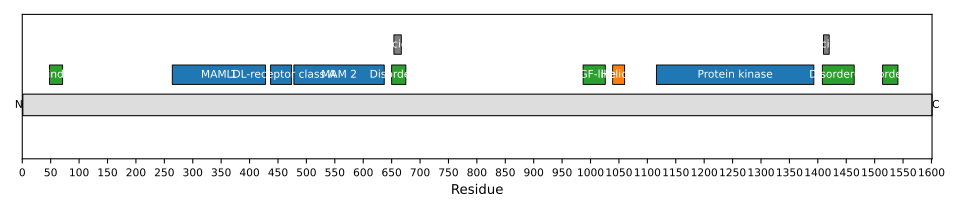
1: Neuronal receptor tyrosine kinase that is essentially and transiently expressed in specific regions of the central and peripheral nervous systems and plays an important role in the genesis and differentiation of the nervous system (PubMed:11121404, PubMed:11387242, PubMed:16317043, PubMed:17274988, PubMed:30061385, PubMed:34646012, PubMed:34819673). Also acts as a key thinness protein involved in the resistance to weight gain: in hypothalamic neurons, controls energy expenditure acting as a negative regulator of white adipose tissue lipolysis and sympathetic tone to fine-tune energy homeostasis (By similarity). Following activation by ALKAL2 ligand at the cell surface, transduces an extracellular signal into an intracellular response (PubMed:30061385, PubMed:33411331, PubMed:34646012, PubMed:34819673). In contrast, ALKAL1 is not a potent physiological ligand for ALK (PubMed:34646012). Ligand-binding to the extracellular domain induces tyrosine kinase activation, leading to activation of the mitogen-activated protein kinase (MAPK) pathway (PubMed:34819673). Phosphorylates almost exclusively at the first tyrosine of the Y-x-x-x-Y-Y motif (PubMed:15226403, PubMed:16878150). Induces tyrosine phosphorylation of CBL, FRS2, IRS1 and SHC1, as well as of the MAP kinases MAPK1/ERK2 and MAPK3/ERK1 (PubMed:15226403, PubMed:16878150). ALK activation may also be regulated by pleiotrophin (PTN) and midkine (MDK) (PubMed:11278720, PubMed:11809760, PubMed:12107166, PubMed:12122009). PTN-binding induces MAPK pathway activation, which is important for the anti-apoptotic signaling of PTN and regulation of cell proliferation (PubMed:11278720, PubMed:11809760, PubMed:12107166). MDK-binding induces phosphorylation of the ALK target insulin receptor substrate (IRS1), activates mitogen-activated protein kinases (MAPKs) and PI3-kinase, resulting also in cell proliferation induction (PubMed:12122009). Drives NF-kappa-B activation, probably through IRS1 and the activation of the AKT serine/threonine kinase (PubMed:15226403, PubMed:16878150). Recruitment of IRS1 to activated ALK and the activation of NF-kappa-B are essential for the autocrine growth and survival signaling of MDK (PubMed:15226403, PubMed:16878150)