C-type lectin domain family 4 member A (C-type lectin DDB27) (C-type lectin superfamily member 6) (Dendritic cell immunoreceptor) (Lectin-like immunoreceptor) (CD antigen CD367)
1_MTSEI 6_ TYAEV 11_ RFKNE 16_ FKSSG 21_ INTAS 26_ SAASK 31_ ERTAP 36_ HKSNT 41_ GFPKL 46_ LCASL 51_ LIFFL 56_ LLAIS 61_ FFIAF 66_ VIFFQ 71_ KYSQL 76_ LEKKT 81_ TKELV 86_ HTTLE 91_ CVKKN 96_ MPVEE 101_ TAWSC 106_ CPKNW 111_ KSFSS 116_ NCYFI 121_ STESA 126_ SWQDS 131_ EKDCA 136_ RMEAH 141_ LLVIN 146_ TQEEQ 151_ DFIFQ 156_ NLQEE 161_ SAYFV 166_ GLSDP 171_ EGQRH 176_ WQWVD 181_ QTPYN 186_ ESSTF 191_ WHPRE 196_ PSDPN 201_ ERCVV 206_ LNFRK 211_ SPKRW 216_ GWNDV 221_ NCLGP 226_ QRSVC 231_EMMKI
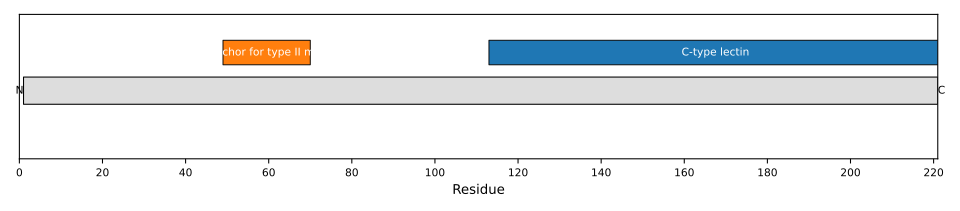
1: C-type lectin receptor that binds carbohydrates mannose and fucose but also weakly interacts with N-acetylglucosamine (GlcNAc) in a Ca(2+)-dependent manner (PubMed:27015765). Involved in regulating immune reactivity (PubMed:10438934, PubMed:18258799). Once triggered by antigen, it is internalized by clathrin-dependent endocytosis and delivers its antigenic cargo into the antigen presentation pathway resulting in cross-priming of CD8(+) T cells. This cross-presentation and cross-priming are enhanced by TLR7 and TLR8 agonists with increased expansion of the CD8(+) T cells, high production of IFNG and TNF with reduced levels of IL4, IL5 and IL13 (PubMed:18258799, PubMed:20530286). In plasmacytoid dendritic cells, inhibits TLR9-mediated IFNA and TNF production (PubMed:18258799). May be involved via its ITIM motif (immunoreceptor tyrosine-based inhibitory motifs) in the inhibition of B-cell-receptor-mediated calcium mobilization and protein tyrosine phosphorylation (PubMed:10438934)
2: (Microbial infection) Involved in the interaction between HIV-1 virus and dendritic cells. Enhances HIV-1 binding/entry and virus infection. Requires ITIM motif-associated signal transduction pathway involving phosphatases PTPN6 and PTPN11, SYK, Src kinases and MAP kinases