Frizzled-1 (Fz-1) (hFz1) (FzE1)
1_MAEEE 6_ APKKS 11_ RAAGG 16_ GASWE 21_ LCAGA 26_ LSARL 31_ AEEGS 36_ GDAGG 41_ RRRPP 46_ VDPRR 51_ LARQL 56_ LLLLW 61_ LLEAP 66_ LLLGV 71_ RAQAA 76_ GQGPG 81_ QGPGP 86_ GQQPP 91_ PPPQQ 96_ QQSGQ 101_ QYNGE 106_ RGISV 111_ PDHGY 116_ CQPIS 121_ IPLCT 126_ DIAYN 131_ QTIMP 136_ NLLGH 141_ TNQED 146_ AGLEV 151_ HQFYP 156_ LVKVQ 161_ CSAEL 166_ KFFLC 171_ SMYAP 176_ VCTVL 181_ EQALP 186_ PCRSL 191_ CERAR 196_ QGCEA 201_ LMNKF 206_ GFQWP 211_ DTLKC 216_ EKFPV 221_ HGAGE 226_ LCVGQ 231_ NTSDK 236_ GTPTP 241_ SLLPE 246_ FWTSN 251_ PQHGG 256_ GGHRG 261_ GFPGG 266_ AGASE 271_ RGKFS 276_ CPRAL 281_ KVPSY 286_ LNYHF 291_ LGEKD 296_ CGAPC 301_ EPTKV 306_ YGLMY 311_ FGPEE 316_ LRFSR 321_ TWIGI 326_ WSVLC 331_ CASTL 336_ FTVLT 341_ YLVDM 346_ RRFSY 351_ PERPI 356_ IFLSG 361_ CYTAV 366_ AVAYI 371_ AGFLL 376_ EDRVV 381_ CNDKF 386_ AEDGA 391_ RTVAQ 396_ GTKKE 401_ GCTIL 406_ FMMLY 411_ FFSMA 416_ SSIWW 421_ VILSL 426_ TWFLA 431_ AGMKW 436_ GHEAI 441_ EANSQ 446_ YFHLA 451_ AWAVP 456_ AIKTI 461_ TILAL 466_ GQVDG 471_ DVLSG 476_ VCFVG 481_ LNNVD 486_ ALRGF 491_ VLAPL 496_ FVYLF 501_ IGTSF 506_ LLAGF 511_ VSLFR 516_ IRTIM 521_ KHDGT 526_ KTEKL 531_ EKLMV 536_ RIGVF 541_ SVLYT 546_ VPATI 551_ VIACY 556_ FYEQA 561_ FRDQW 566_ ERSWV 571_ AQSCK 576_ SYAIP 581_ CPHLQ 586_ AGGGA 591_ PPHPP 596_ MSPDF 601_ TVFMI 606_ KYLMT 611_ LIVGI 616_ TSGFW 621_ IWSGK 626_ TLNSW 631_ RKFYT 636_ RLTNS 641_KQGET
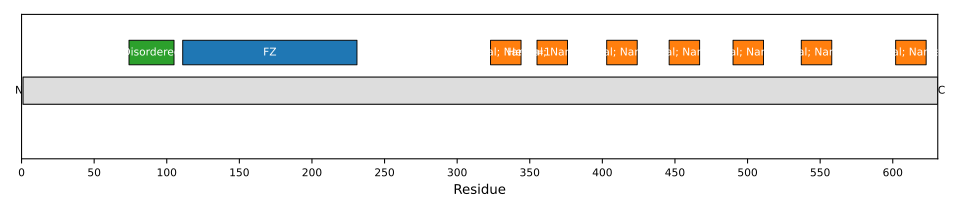
1: Receptor for Wnt proteins (PubMed:10557084). Activated by WNT3A, WNT3, WNT1 and to a lesser extent WNT2, but apparently not by WNT4, WNT5A, WNT5B, WNT6, WNT7A or WNT7B (PubMed:10557084). Contradictory results showing activation by WNT7B have been described for mouse (By similarity). Functions in the canonical Wnt/beta-catenin signaling pathway (PubMed:10557084). The canonical Wnt/beta-catenin signaling pathway leads to the activation of disheveled proteins, inhibition of GSK-3 kinase, nuclear accumulation of beta-catenin and activation of Wnt target genes (PubMed:10557084). A second signaling pathway involving PKC and calcium fluxes has been seen for some family members, but it is not yet clear if it represents a distinct pathway or if it can be integrated in the canonical pathway, as PKC seems to be required for Wnt-mediated inactivation of GSK-3 kinase. Both pathways seem to involve interactions with G-proteins. May be involved in transduction and intercellular transmission of polarity information during tissue morphogenesis and/or in differentiated tissues (Probable)
2: (Microbial infection) Acts as a receptor for C.difficile toxin TcdB in the colonic epithelium