Syncytin-1 (Endogenous retrovirus group W member 1) (Env-W) (Envelope polyprotein gPr73) (Enverin) (HERV-7q Envelope protein) (HERV-W envelope protein) (HERV-W_7q21.2 provirus ancestral Env polyprotein) (Syncytin) [Cleaved into: Surface protein (SU) (gp50); Transmembrane protein (TM) (gp24)]
1_MALPY 6_ HIFLF 11_ TVLLP 16_ SFTLT 21_ APPPC 26_ RCMTS 31_ SSPYQ 36_ EFLWR 41_ MQRPG 46_ NIDAP 51_ SYRSL 56_ SKGTP 61_ TFTAH 66_ THMPR 71_ NCYHS 76_ ATLCM 81_ HANTH 86_ YWTGK 91_ MINPS 96_ CPGGL 101_ GVTVC 106_ WTYFT 111_ QTGMS 116_ DGGGV 121_ QDQAR 126_ EKHVK 131_ EVISQ 136_ LTRVH 141_ GTSSP 146_ YKGLD 151_ LSKLH 156_ ETLRT 161_ HTRLV 166_ SLFNT 171_ TLTGL 176_ HEVSA 181_ QNPTN 186_ CWICL 191_ PLNFR 196_ PYVSI 201_ PVPEQ 206_ WNNFS 211_ TEINT 216_ TSVLV 221_ GPLVS 226_ NLEIT 231_ HTSNL 236_ TCVKF 241_ SNTTY 246_ TTNSQ 251_ CIRWV 256_ TPPTQ 261_ IVCLP 266_ SGIFF 271_ VCGTS 276_ AYRCL 281_ NGSSE 286_ SMCFL 291_ SFLVP 296_ PMTIY 301_ TEQDL 306_ YSYVI 311_ SKPRN 316_ KRVPI 321_ LPFVI 326_ GAGVL 331_ GALGT 336_ GIGGI 341_ TTSTQ 346_ FYYKL 351_ SQELN 356_ GDMER 361_ VADSL 366_ VTLQD 371_ QLNSL 376_ AAVVL 381_ QNRRA 386_ LDLLT 391_ AERGG 396_ TCLFL 401_ GEECC 406_ YYVNQ 411_ SGIVT 416_ EKVKE 421_ IRDRI 426_ QRRAE 431_ ELRNT 436_ GPWGL 441_ LSQWM 446_ PWILP 451_ FLGPL 456_ AAIIL 461_ LLLFG 466_ PCIFN 471_ LLVNF 476_ VSSRI 481_ EAVKL 486_ QMEPK 491_ MQSKT 496_ KIYRR 501_ PLDRP 506_ ASPRS 511_ DVNDI 516_ KGTPP 521_ EEISA 526_ AQPLL 531_RPNSA
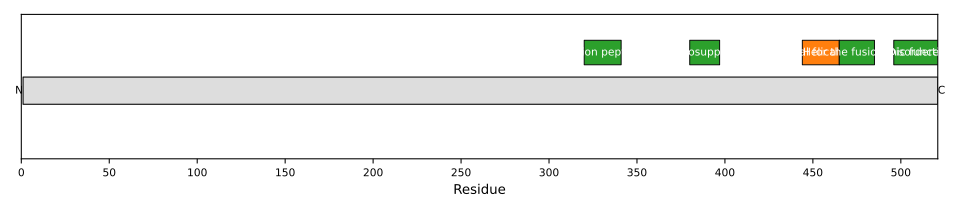
1: This endogenous retroviral envelope protein has retained its original fusogenic properties and participates in trophoblast fusion and the formation of a syncytium during placenta morphogenesis. May induce fusion through binding of SLC1A4 and SLC1A5 (PubMed:10708449, PubMed:12050356, PubMed:23492904)
2: Endogenous envelope proteins may have kept, lost or modified their original function during evolution. Retroviral envelope proteins mediate receptor recognition and membrane fusion during early infection. The surface protein (SU) mediates receptor recognition, while the transmembrane protein (TM) acts as a class I viral fusion protein. The protein may have at least 3 conformational states: pre-fusion native state, pre-hairpin intermediate state, and post-fusion hairpin state. During viral and target cell membrane fusion, the coiled coil regions (heptad repeats) assume a trimer-of-hairpins structure, positioning the fusion peptide in close proximity to the C-terminal region of the ectodomain. The formation of this structure appears to drive apposition and subsequent fusion of membranes