Nucleotide-binding oligomerization domain-containing protein 1 (Caspase recruitment domain-containing protein 4)
1_MEEQG 6_ HSEME 11_ IIPSE 16_ SHPHI 21_ QLLKS 26_ NRELL 31_ VTHIR 36_ NTQCL 41_ VDNLL 46_ KNDYF 51_ SAEDA 56_ EIVCA 61_ CPTQP 66_ DKVRK 71_ ILDLV 76_ QSKGE 81_ EVSEF 86_ FLYLL 91_ QQLAD 96_ AYVDL 101_ RPWLL 106_ EIGFS 111_ PSLLT 116_ QSKVV 121_ VNTDP 126_ VSRYT 131_ QQLRH 136_ HLGRD 141_ SKFVL 146_ CYAQK 151_ EELLL 156_ EEIYM 161_ DTIME 166_ LVGFS 171_ NESLG 176_ SLNSL 181_ ACLLD 186_ HTTGI 191_ LNEQG 196_ ETIFI 201_ LGDAG 206_ VGKSM 211_ LLQRL 216_ QSLWA 221_ TGRLD 226_ AGVKF 231_ FFHFR 236_ CRMFS 241_ CFKES 246_ DRLCL 251_ QDLLF 256_ KHYCY 261_ PERDP 266_ EEVFA 271_ FLLRF 276_ PHVAL 281_ FTFDG 286_ LDELH 291_ SDLDL 296_ SRVPD 301_ SSCPW 306_ EPAHP 311_ LVLLA 316_ NLLSG 321_ KLLKG 326_ ASKLL 331_ TARTG 336_ IEVPR 341_ QFLRK 346_ KVLLR 351_ GFSPS 356_ HLRAY 361_ ARRMF 366_ PERAL 371_ QDRLL 376_ SQLEA 381_ NPNLC 386_ SLCSV 391_ PLFCW 396_ IIFRC 401_ FQHFR 406_ AAFEG 411_ SPQLP 416_ DCTMT 421_ LTDVF 426_ LLVTE 431_ VHLNR 436_ MQPSS 441_ LVQRN 446_ TRSPV 451_ ETLHA 456_ GRDTL 461_ CSLGQ 466_ VAHRG 471_ MEKSL 476_ FVFTQ 481_ EEVQA 486_ SGLQE 491_ RDMQL 496_ GFLRA 501_ LPELG 506_ PGGDQ 511_ QSYEF 516_ FHLTL 521_ QAFFT 526_ AFFLV 531_ LDDRV 536_ GTQEL 541_ LRFFQ 546_ EWMPP 551_ AGAAT 556_ TSCYP 561_ PFLPF 566_ QCLQG 571_ SGPAR 576_ EDLFK 581_ NKDHF 586_ QFTNL 591_ FLCGL 596_ LSKAK 601_ QKLLR 606_ HLVPA 611_ AALRR 616_ KRKAL 621_ WAHLF 626_ SSLRG 631_ YLKSL 636_ PRVQV 641_ ESFNQ 646_ VQAMP 651_ TFIWM 656_ LRCIY 661_ ETQSQ 666_ KVGQL 671_ AARGI 676_ CANYL 681_ KLTYC 686_ NACSA 691_ DCSAL 696_ SFVLH 701_ HFPKR 706_ LALDL 711_ DNNNL 716_ NDYGV 721_ RELQP 726_ CFSRL 731_ TVLRL 736_ SVNQI 741_ TDGGV 746_ KVLSE 751_ ELTKY 756_ KIVTY 761_ LGLYN 766_ NQITD 771_ VGARY 776_ VTKIL 781_ DECKG 786_ LTHLK 791_ LGKNK 796_ ITSEG 801_ GKYLA 806_ LAVKN 811_ SKSIS 816_ EVGMW 821_ GNQVG 826_ DEGAK 831_ AFAEA 836_ LRNHP 841_ SLTTL 846_ SLASN 851_ GISTE 856_ GGKSL 861_ ARALQ 866_ QNTSL 871_ EILWL 876_ TQNEL 881_ NDEVA 886_ ESLAE 891_ MLKVN 896_ QTLKH 901_ LWLIQ 906_ NQITA 911_ KGTAQ 916_ LADAL 921_ QSNTG 926_ ITEIC 931_ LNGNL 936_ IKPEE 941_ AKVYE 946_DEKRI
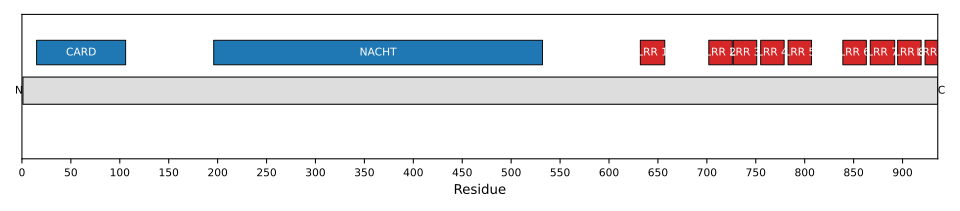
1: Pattern recognition receptor (PRR) that detects bacterial peptidoglycan fragments and other danger signals and thus participates in both innate and adaptive immune responses (PubMed:11058605, PubMed:12791997, PubMed:12796777, PubMed:15044951, PubMed:16172124, PubMed:19043560, PubMed:22672233, PubMed:27099311). Specifically recognizes and binds gamma-D-glutamyl-meso-diaminopimelic acid (iE-DAP), a dipeptide present in peptidoglycan of Gram-negative bacteria (PubMed:12791997, PubMed:12796777, PubMed:12871942, PubMed:16172124, PubMed:16211083). Preferentially binds iE-DAP in tripeptide-containing muropeptides (MurNAc-TriDAP or TriDAP) (PubMed:16211083). Ligand binding triggers oligomerization that facilitates the binding and subsequent activation of the proximal adapter receptor-interacting RIPK2 (PubMed:12791997, PubMed:12796777, PubMed:17054981). Following recruitment, RIPK2 undergoes 'Met-1'- (linear) and 'Lys-63'-linked polyubiquitination by E3 ubiquitin-protein ligases XIAP, BIRC2, BIRC3 and the LUBAC complex, becoming a scaffolding protein for downstream effectors, triggering activation of the NF-kappa-B and MAP kinases signaling (PubMed:10880512, PubMed:12791997, PubMed:19043560). This in turn leads to the transcriptional activation of hundreds of genes involved in immune response (PubMed:10880512, PubMed:19043560). Also acts as a regulator of antiviral response elicited by dsRNA and the expression of RLR pathway members by targeting IFIH1 and TRAF3 to modulate the formation of IFIH1-MAVS and TRAF3-MAVS complexes leading to increased transcription of type I IFNs (PubMed:32169843). Also acts as a regulator of autophagy via its interaction with ATG16L1, possibly by recruiting ATG16L1 at the site of bacterial entry (By similarity). Besides recognizing pathogens, also involved in the endoplasmic reticulum stress response: acts by sensing and binding to the cytosolic metabolite sphingosine-1-phosphate generated in response to endoplasmic reticulum stress, initiating an inflammation process that leads to activation of the NF-kappa-B and MAP kinases signaling (PubMed:27007849, PubMed:33942347). In addition, plays a role in insulin trafficking in beta cells in a cell-autonomous manner (By similarity). Mechanistically, upon recognizing cognate ligands, NOD1 and RIPK2 localize to insulin vesicles where they recruit RAB1A to direct insulin trafficking through the cytoplasm (By similarity)
2: In contrast to isoform 1, does not efficiently recognize and bind gamma-D-glutamyl-meso-diaminopimelic acid (iE-DAP) ligand