DNA polymerase eta (EC 2.7.7.7) (RAD30 homolog A) (Xeroderma pigmentosum variant type protein)
1_MATGQ 6_ DRVVA 11_ LVDMD 16_ CFFVQ 21_ VEQRQ 26_ NPHLR 31_ NKPCA 36_ VVQYK 41_ SWKGG 46_ GIIAV 51_ SYEAR 56_ AFGVT 61_ RSMWA 66_ DDAKK 71_ LCPDL 76_ LLAQV 81_ RESRG 86_ KANLT 91_ KYREA 96_ SVEVM 101_ EIMSR 106_ FAVIE 111_ RASID 116_ EAYVD 121_ LTSAV 126_ QERLQ 131_ KLQGQ 136_ PISAD 141_ LLPST 146_ YIEGL 151_ PQGPT 156_ TAEET 161_ VQKEG 166_ MRKQG 171_ LFQWL 176_ DSLQI 181_ DNLTS 186_ PDLQL 191_ TVGAV 196_ IVEEM 201_ RAAIE 206_ RETGF 211_ QCSAG 216_ ISHNK 221_ VLAKL 226_ ACGLN 231_ KPNRQ 236_ TLVSH 241_ GSVPQ 246_ LFSQM 251_ PIRKI 256_ RSLGG 261_ KLGAS 266_ VIEIL 271_ GIEYM 276_ GELTQ 281_ FTESQ 286_ LQSHF 291_ GEKNG 296_ SWLYA 301_ MCRGI 306_ EHDPV 311_ KPRQL 316_ PKTIG 321_ CSKNF 326_ PGKTA 331_ LATRE 336_ QVQWW 341_ LLQLA 346_ QELEE 351_ RLTKD 356_ RNDND 361_ RVATQ 366_ LVVSI 371_ RVQGD 376_ KRLSS 381_ LRRCC 386_ ALTRY 391_ DAHKM 396_ SHDAF 401_ TVIKN 406_ CNTSG 411_ IQTEW 416_ SPPLT 421_ MLFLC 426_ ATKFS 431_ ASAPS 436_ SSTDI 441_ TSFLS 446_ SDPSS 451_ LPKVP 456_ VTSSE 461_ AKTQG 466_ SGPAV 471_ TATKK 476_ ATTSL 481_ ESFFQ 486_ KAAER 491_ QKVKE 496_ ASLSS 501_ LTAPT 506_ QAPMS 511_ NSPSK 516_ PSLPF 521_ QTSQS 526_ TGTEP 531_ FFKQK 536_ SLLLK 541_ QKQLN 546_ NSSVS 551_ SPQQN 556_ PWSNC 561_ KALPN 566_ SLPTE 571_ YPGCV 576_ PVCEG 581_ VSKLE 586_ ESSKA 591_ TPAEM 596_ DLAHN 601_ SQSMH 606_ ASSAS 611_ KSVLE 616_ VTQKA 621_ TPNPS 626_ LLAAE 631_ DQVPC 636_ EKCGS 641_ LVPVW 646_ DMPEH 651_ MDYHF 656_ ALELQ 661_ KSFLQ 666_ PHSSN 671_ PQVVS 676_ AVSHQ 681_ GKRNP 686_ KSPLA 691_ CTNKR 696_ PRPEG 701_ MQTLE 706_SFFKP
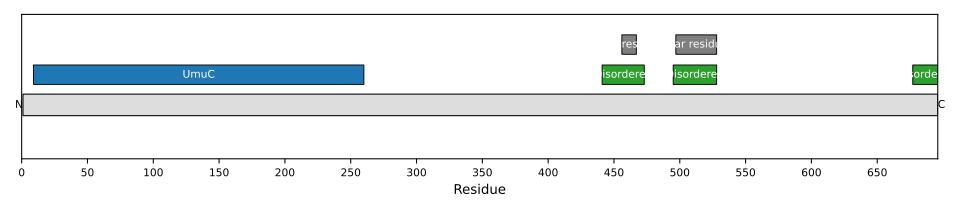
1: DNA polymerase specifically involved in the DNA repair by translesion synthesis (TLS) (PubMed:10385124, PubMed:11743006, PubMed:16357261, PubMed:24449906, PubMed:24553286, PubMed:38212351). Due to low processivity on both damaged and normal DNA, cooperates with the heterotetrameric (REV3L, REV7, POLD2 and POLD3) POLZ complex for complete bypass of DNA lesions. Inserts one or 2 nucleotide(s) opposite the lesion, the primer is further extended by the tetrameric POLZ complex. In the case of 1,2-intrastrand d(GpG)-cisplatin cross-link, inserts dCTP opposite the 3' guanine (PubMed:24449906). Particularly important for the repair of UV-induced pyrimidine dimers (PubMed:10385124, PubMed:11743006). Although inserts the correct base, may cause base transitions and transversions depending upon the context. May play a role in hypermutation at immunoglobulin genes (PubMed:11376341, PubMed:14734526). Forms a Schiff base with 5'-deoxyribose phosphate at abasic sites, but does not have any lyase activity, preventing the release of the 5'-deoxyribose phosphate (5'-dRP) residue. This covalent trapping of the enzyme by the 5'-dRP residue inhibits its DNA synthetic activity during base excision repair, thereby avoiding high incidence of mutagenesis (PubMed:14630940). Targets POLI to replication foci (PubMed:12606586)