Cyclic AMP-dependent transcription factor ATF-5 (cAMP-dependent transcription factor ATF-5) (Activating transcription factor 5) (Transcription factor ATFx)
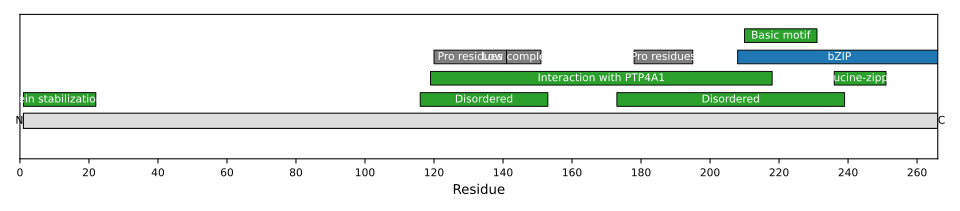
1_MSLLA 6_ TLGLE 11_ LDRAL 16_ LPASG 21_ LGWLV 26_ DYGKL 31_ PPAPA 36_ PLAPY 41_ EVLGG 46_ ALEGG 51_ LPVGG 56_ EPLAG 61_ DGFSD 66_ WMTER 71_ VDFTA 76_ LLPLE 81_ PPLPP 86_ GTLPQ 91_ PSPTP 96_ PDLEA 101_ MASLL 106_ KKELE 111_ QMEDF 116_ FLDAP 121_ PLPPP 126_ SPPPL 131_ PPPPL 136_ PPAPS 141_ LPLSL 146_ PSFDL 151_ PQPPV 156_ LDTLD 161_ LLAIY 166_ CRNEA 171_ GQEEV 176_ GMPPL 181_ PPPQQ 186_ PPPPS 191_ PPQPS 196_ RLAPY 201_ PHPAT 206_ TRGDR 211_ KQKKR 216_ DQNKS 221_ AALRY 226_ RQRKR 231_ AEGEA 236_ LEGEC 241_ QGLEA 246_ RNREL 251_ KERAE 256_ SVERE 261_ IQYVK 266_ DLLIE 271_ VYKAR 276_SQRTR
1: Transcription factor that either stimulates or represses gene transcription through binding of different DNA regulatory elements such as cAMP response element (CRE) (consensus: 5'-GTGACGT[AC][AG]-3'), ATF5-specific response element (ARE) (consensus: 5'-C[CT]TCT[CT]CCTT[AT]-3') but also the amino acid response element (AARE), present in many viral and cellular promoters. Critically involved, often in a cell type-dependent manner, in cell survival, proliferation, and differentiation (PubMed:10373550, PubMed:15358120, PubMed:20654631, PubMed:21212266). Its transcriptional activity is enhanced by CCND3 and slightly inhibited by CDK4 (PubMed:15358120). Important regulator of the cerebral cortex formation, functions in cerebral cortical neuroprogenitor cells to maintain proliferation and to block differentiation into neurons. Must be down-regulated in order for such cells to exit the cycle and differentiate (By similarity). Participates in the pathways by which SHH promotes cerebellar granule neuron progenitor cells proliferation (By similarity). Critical for survival of mature olfactory sensory neurons (OSN), directs expression of OSN-specific genes (By similarity). May be involved in osteogenic differentiation (PubMed:22442021). Promotes cell proliferation and survival by inducing the expression of EGR1 sinergistically with ELK1. Once acetylated by EP300, binds to ARE sequences on target genes promoters, such as BCL2 and EGR1 (PubMed:21791614). Plays an anti-apoptotic role through the transcriptional regulation of BCL2, this function seems to be cell type-dependent (By similarity). Cooperates with NR1I3/CAR in the transcriptional activation of CYP2B6 in liver (PubMed:18332083). In hepatic cells, represses CRE-dependent transcription and inhibits proliferation by blocking at G2/M phase (PubMed:18701499, PubMed:22528486). May act as a negative regulator of IL1B transduction pathway in liver (PubMed:24379400). Upon IL1B stimulus, cooperates with NLK to activate the transactivation activity of C/EBP subfamily members (PubMed:25512613). Besides its function of transcription factor, acts as a cofactor of CEBPB to activate CEBPA and promote adipocyte differentiation (PubMed:24216764). Regulates centrosome dynamics in a cell-cycle- and centriole-age-dependent manner. Forms 9-foci symmetrical ring scaffold around the mother centriole to control centrosome function and the interaction between centrioles and pericentriolar material (PubMed:26213385)