Caspase recruitment domain-containing protein 8 (EC 3.4.-.-) (CARD-inhibitor of NF-kappa-B-activating ligand) (CARDINAL) (Tumor up-regulated CARD-containing antagonist of CASP9) (TUCAN) [Cleaved into: Caspase recruitment domain-containing protein 8, C-terminus (CARD8-CT); Caspase recruitment domain-containing protein 8, N-terminus (CARD8-NT)]
1_MEKKE 6_ CPEKS 11_ SSSEE 16_ ELPRR 21_ DSGSS 26_ RNIDA 31_ SKLIR 36_ LQGSR 41_ KLLVD 46_ NSIRE 51_ LQYTK 56_ TGIFF 61_ QAEAC 66_ VTNDT 71_ VYREL 76_ PCVSE 81_ TLCDI 86_ SHFFQ 91_ EDDET 96_ EAEPL 101_ LFRAV 106_ PECQL 111_ SGGDI 116_ PSVSE 121_ EQESS 126_ EGQDS 131_ GDICS 136_ EENQI 141_ VSSYA 146_ SKVCF 151_ EIEED 156_ YKNRQ 161_ FLGPE 166_ GNVDV 171_ ELIDK 176_ STNRY 181_ SVWFP 186_ TAGWY 191_ LWSAT 196_ GLGFL 201_ VRDEV 206_ TVTIA 211_ FGSWS 216_ QHLAL 221_ DLQHH 226_ EQWLV 231_ GGPLF 236_ DVTAE 241_ PEEAV 246_ AEIHL 251_ PHFIS 256_ LQAGE 261_ VDVSW 266_ FLVAH 271_ FKNEG 276_ MVLEH 281_ PARVE 286_ PFYAV 291_ LESPS 296_ FSLMG 301_ ILLRI 306_ ASGTR 311_ LSIPI 316_ TSNTL 321_ IYYHP 326_ HPEDI 331_ KFHLY 336_ LVPSD 341_ ALLTK 346_ AIDDE 351_ EDRFH 356_ GVRLQ 361_ TSPPM 366_ EPLNF 371_ GSSYI 376_ VSNSA 381_ NLKVM 386_ PKELK 391_ LSYRS 396_ PGEIQ 401_ HFSKF 406_ YAGQM 411_ KEPIQ 416_ LEITE 421_ KRHGT 426_ LVWDT 431_ EVKPV 436_ DLQLV 441_ AASAP 446_ PPFSG 451_ AAFVK 456_ ENHRQ 461_ LQARM 466_ GDLKG 471_ VLDDL 476_ QDNEV 481_ LTENE 486_ KELVE 491_ QEKTR 496_ QSKNE 501_ ALLSM 506_ VEKKG 511_ DLALD 516_ VLFRS 521_ ISERD 526_ PYLVS 531_YLRQQ
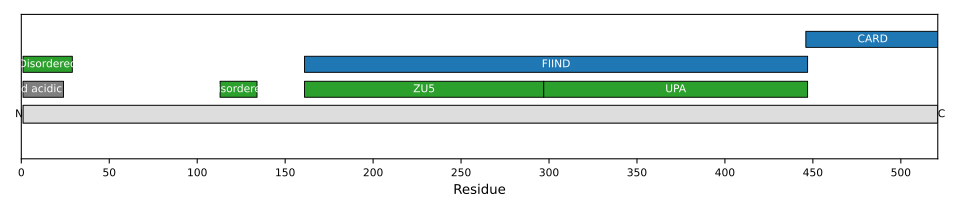
1: Inflammasome sensor, which mediates inflammasome activation in response to various pathogen-associated signals, leading to subsequent pyroptosis of CD4(+) T-cells and macrophages (PubMed:11408476, PubMed:11821383, PubMed:15030775, PubMed:32051255, PubMed:32840892, PubMed:33542150, PubMed:34019797, PubMed:36357533). Inflammasomes are supramolecular complexes that assemble in the cytosol in response to pathogens and other damage-associated signals and play critical roles in innate immunity and inflammation (PubMed:11408476, PubMed:11821383, PubMed:15030775, PubMed:36357533). Acts as a recognition receptor (PRR): recognizes specific pathogens and other damage-associated signals, such as HIV-1 protease activity or Val-boroPro inhibitor, and mediates CARD8 inflammasome activation (PubMed:32840892, PubMed:33542150, PubMed:36357533). In response to pathogen-associated signals, the N-terminal part of CARD8 is degraded by the proteasome, releasing the cleaved C-terminal part of the protein (Caspase recruitment domain-containing protein 8, C-terminus), which polymerizes to initiate the formation of the inflammasome complex: the CARD8 inflammasome directly recruits pro-caspase-1 (proCASP1) independently of PYCARD/ASC and promotes caspase-1 (CASP1) activation, which subsequently cleaves and activates inflammatory cytokines IL1B and IL18 and gasdermin-D (GSDMD), leading to pyroptosis (PubMed:32051255, PubMed:32840892, PubMed:33053349, PubMed:33542150, PubMed:36357533). Ability to sense HIV-1 protease activity leads to the clearance of latent HIV-1 in patient CD4(+) T-cells after viral reactivation; in contrast, HIV-1 can evade CARD8-sensing when its protease remains inactive in infected cells prior to viral budding (PubMed:33542150). Also acts as a negative regulator of the NLRP3 inflammasome (PubMed:24517500). May also act as an inhibitor of NF-kappa-B activation (PubMed:11551959, PubMed:12067710)
2: Constitutes the precursor of the CARD8 inflammasome, which mediates autoproteolytic processing within the FIIND domain to generate the N-terminal and C-terminal parts, which are associated non-covalently in absence of pathogens and other damage-associated signals
3: Regulatory part that prevents formation of the CARD8 inflammasome: in absence of pathogens and other damage-associated signals, interacts with the C-terminal part of CARD8 (Caspase recruitment domain-containing protein 8, C-terminus), preventing activation of the CARD8 inflammasome (PubMed:33542150). In response to pathogen-associated signals, this part is ubiquitinated by the N-end rule pathway and degraded by the proteasome, releasing the cleaved C-terminal part of the protein, which polymerizes and forms the CARD8 inflammasome (Probable) (PubMed:32558991)
4: Constitutes the active part of the CARD8 inflammasome (PubMed:32840892, PubMed:34019797). In absence of pathogens and other damage-associated signals, interacts with the N-terminal part of CARD8 (Caspase recruitment domain-containing protein 8, N-terminus), preventing activation of the CARD8 inflammasome (PubMed:33542150). In response to pathogen-associated signals, the N-terminal part of CARD8 is degraded by the proteasome, releasing this form, which polymerizes to form the CARD8 inflammasome complex: the CARD8 inflammasome complex then directly recruits pro-caspase-1 (proCASP1) and promotes caspase-1 (CASP1) activation, leading to gasdermin-D (GSDMD) cleavage and subsequent pyroptosis (PubMed:32840892, PubMed:33542150)