DDB1- and CUL4-associated factor 1 (HIV-1 Vpr-binding protein) (VprBP) (Serine/threonine-protein kinase VPRBP) (EC 2.7.11.1) (Vpr-interacting protein)
1_MTTVV 6_ VHVDS 11_ KAELT 16_ TLLEQ 21_ WEKEH 26_ GSGQD 31_ MVPIL 36_ TRMSQ 41_ LIEKE 46_ TEEYR 51_ KGDPD 56_ PFDDR 61_ HPGRA 66_ DPECM 71_ LGHLL 76_ RILFK 81_ NDDFM 86_ NALVN 91_ AYVMT 96_ SREPP 101_ LNTAA 106_ CRLLL 111_ DIMPG 116_ LETAV 121_ VFQEK 126_ EGIVE 131_ NLFKW 136_ AREAD 141_ QPLRT 146_ YSTGL 151_ LGGAM 156_ ENQDI 161_ AANYR 166_ DENSQ 171_ LVAIV 176_ LRRLR 181_ ELQLQ 186_ EVALR 191_ QENKR 196_ PSPRK 201_ LSSEP 206_ LLPLD 211_ EEAVD 216_ MDYGD 221_ MAVDV 226_ VDGDQ 231_ EEASG 236_ DMEIS 241_ FHLDS 246_ GHKTS 251_ SRVNS 256_ TTKPE 261_ DGGLK 266_ KNKSA 271_ KQGDR 276_ ENFRK 281_ AKQKL 286_ GFSSS 291_ DPDRM 296_ FVELS 301_ NSSWS 306_ EMSPW 311_ VIGTN 316_ YTLYP 321_ MTPAI 326_ EQRLI 331_ LQYLT 336_ PLGEY 341_ QELLP 346_ IFMQL 351_ GSREL 356_ MMFYI 361_ DLKQT 366_ NDVLL 371_ TFEAL 376_ KHLAS 381_ LLLHN 386_ KFATE 391_ FVAHG 396_ GVQKL 401_ LEIPR 406_ PSMAA 411_ TGVSM 416_ CLYYL 421_ SYNQD 426_ AMERV 431_ CMHPH 436_ NVLSD 441_ VVNYT 446_ LWLME 451_ CSHAS 456_ GCCHA 461_ TMFFS 466_ ICFSF 471_ RAVLE 476_ LFDRY 481_ DGLRR 486_ LVNLI 491_ STLEI 496_ LNLED 501_ QGALL 506_ SDDEI 511_ FASRQ 516_ TGKHT 521_ CMALR 526_ KYFEA 531_ HLAIK 536_ LEQVK 541_ QSLQR 546_ TEGGI 551_ LVHPQ 556_ PPYKA 561_ CSYTH 566_ EQIVE 571_ MMEFL 576_ IEYGP 581_ AQLYW 586_ EPAEV 591_ FLKLS 596_ CVQLL 601_ LQLIS 606_ IACNW 611_ KTYYA 616_ RNDTV 621_ RFALD 626_ VLAIL 631_ TVVPK 636_ IQLQL 641_ AESVD 646_ VLDEA 651_ GSTVS 656_ TVGIS 661_ IILGV 666_ AEGEF 671_ FIHDA 676_ EIQKS 681_ ALQII 686_ INCVC 691_ GPDNR 696_ ISSIG 701_ KFISG 706_ TPRRK 711_ LPQNP 716_ KSSEH 721_ TLAKM 726_ WNVVQ 731_ SNNGI 736_ KVLLS 741_ LLSIK 746_ MPITD 751_ ADQIR 756_ ALACK 761_ ALVGL 766_ SRSST 771_ VRQII 776_ SKLPL 781_ FSSCQ 786_ IQQLM 791_ KEPVL 796_ QDKRS 801_ DHVKF 806_ CKYAA 811_ ELIER 816_ VSGKP 821_ LLIGT 826_ DVSLA 831_ RLQKA 836_ DVVAQ 841_ SRISF 846_ PEKEL 851_ LLLIR 856_ NHLIS 861_ KGLGE 866_ TATVL 871_ TKEAD 876_ LPMTA 881_ ASHSS 886_ AFTPV 891_ TAAAS 896_ PVSLP 901_ RTPRI 906_ ANGIA 911_ TRLGS 916_ HAAVG 921_ ASAPS 926_ APTAH 931_ PQPRP 936_ PQGPL 941_ ALPGP 946_ SYAGN 951_ SPLIG 956_ RISFI 961_ RERPS 966_ PCNGR 971_ KIRVL 976_ RQKSD 981_ HGAYS 986_ QSPAI 991_ KKQLD 996_ RHLPS 1001_ PPTLD 1006_ SIITE 1011_ YLREQ 1016_ HARCK 1021_ NPVAT 1026_ CPPFS 1031_ LFTPH 1036_ QCPEP 1041_ KQRRQ 1046_ APINF 1051_ TSRLN 1056_ RRASF 1061_ PKYGG 1066_ VDGGC 1071_ FDRHL 1076_ IFSRF 1081_ RPISV 1086_ FREAN 1091_ EDESG 1096_ FTCCA 1101_ FSARE 1106_ RFLML 1111_ GTCTG 1116_ QLKLY 1121_ NVFSG 1126_ QEEAS 1131_ YNCHN 1136_ SAITH 1141_ LEPSR 1146_ DGSLL 1151_ LTSAT 1156_ WSQPL 1161_ SALWG 1166_ MKSVF 1171_ DMKHS 1176_ FTEDH 1181_ YVEFS 1186_ KHSQD 1191_ RVIGT 1196_ KGDIA 1201_ HIYDI 1206_ QTGNK 1211_ LLTLF 1216_ NPDLA 1221_ NNYKR 1226_ NCATF 1231_ NPTDD 1236_ LVLND 1241_ GVLWD 1246_ VRSAQ 1251_ AIHKF 1256_ DKFNM 1261_ NISGV 1266_ FHPNG 1271_ LEVII 1276_ NTEIW 1281_ DLRTF 1286_ HLLHT 1291_ VPALD 1296_ QCRVV 1301_ FNHTG 1306_ TVMYG 1311_ AMLQA 1316_ DDEDD 1321_ LMEER 1326_ MKSPF 1331_ GSSFR 1336_ TFNAT 1341_ DYKPI 1346_ ATIDV 1351_ KRNIF 1356_ DLCTD 1361_ TKDCY 1366_ LAVIE 1371_ NQGSM 1376_ DALNM 1381_ DTVCR 1386_ LYEVG 1391_ RQRLA 1396_ EDEDE 1401_ EEDQE 1406_ EEEQE 1411_ EEDDD 1416_ EDDDD 1421_ TDDLD 1426_ ELDTD 1431_ QLLEA 1436_ ELEED 1441_ DNNEN 1446_ AGEDG 1451_ DNDFS 1456_ PSDEE 1461_ LANLL 1466_ EEGED 1471_ GEDED 1476_ SDADE 1481_ EVELI 1486_ LGDTD 1491_ SSDNS 1496_ DLEDD 1501_IILSL
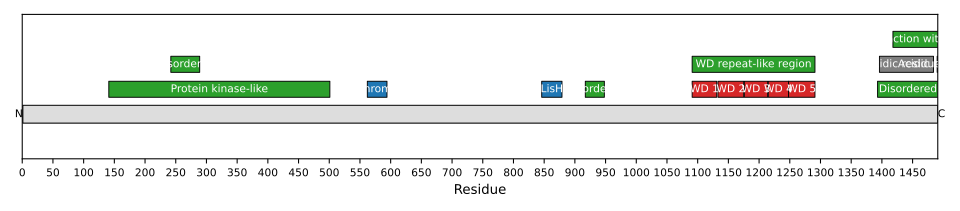
1: Acts both as a substrate recognition component of E3 ubiquitin-protein ligase complexes and as an atypical serine/threonine-protein kinase, playing key roles in various processes such as cell cycle, telomerase regulation and histone modification. Probable substrate-specific adapter of a DCX (DDB1-CUL4-X-box) E3 ubiquitin-protein ligase complex, named CUL4A-RBX1-DDB1-DCAF1/VPRBP complex, which mediates ubiquitination and proteasome-dependent degradation of proteins such as NF2 (PubMed:23063525). Involved in the turnover of methylated proteins: recognizes and binds methylated proteins via its chromo domain, leading to ubiquitination of target proteins by the RBX1-DDB1-DCAF1/VPRBP complex (PubMed:23063525). The CUL4A-RBX1-DDB1-DCAF1/VPRBP complex is also involved in B-cell development: DCAF1 is recruited by RAG1 to ubiquitinate proteins, leading to limit error-prone repair during V(D)J recombination (By similarity). Also part of the EDVP complex, an E3 ligase complex that mediates ubiquitination of proteins such as TERT, leading to TERT degradation and telomerase inhibition (PubMed:19287380, PubMed:23362280). The EDVP complex also mediates ubiquitination and degradation of CCP110 (PubMed:28242748, PubMed:34259627). Also acts as an atypical serine/threonine-protein kinase that specifically mediates phosphorylation of 'Thr-120' of histone H2A (H2AT120ph) in a nucleosomal context, thereby repressing transcription (PubMed:24140421). H2AT120ph is present in the regulatory region of many tumor suppresor genes, down-regulates their transcription and is present at high level in a number of tumors (PubMed:24140421). Involved in JNK-mediated apoptosis during cell competition process via its interaction with LLGL1 and LLGL2 (PubMed:20644714). By acting on TET dioxygenses, essential for oocyte maintenance at the primordial follicle stage, hence essential for female fertility (By similarity)
2: (Microbial infection) In case of infection by HIV-1 virus, it is recruited by HIV-1 Vpr in order to hijack the CUL4A-RBX1-DDB1-DCAF1/VPRBP function leading to arrest the cell cycle in G2 phase, and also to protect the viral protein from proteasomal degradation by another E3 ubiquitin ligase. The HIV-1 Vpr protein hijacks the CUL4A-RBX1-DDB1-DCAF1/VPRBP complex to promote ubiquitination and degradation of proteins such as TERT and ZIP/ZGPAT
3: (Microbial infection) In case of infection by HIV-2 virus, it is recruited by HIV-2 Vpx in order to hijack the CUL4A-RBX1-DDB1-DCAF1/VPRBP function leading to enhanced efficiency of macrophage infection and promotion of the replication of cognate primate lentiviruses in cells of monocyte/macrophage lineage