Malignant fibrous histiocytoma-amplified sequence 1 (Malignant fibrous histiocytoma-amplified sequence with leucine-rich tandem repeats 1)
1_MAGMD 6_ SGNLK 11_ TARLW 16_ RDAAL 21_ RARKL 26_ RSNLR 31_ QLTLT 36_ AAGAC 41_ PGAGA 46_ DALES 51_ PASPQ 56_ LVLPA 61_ NLGDI 66_ EALNL 71_ GNNGL 76_ EEVPE 81_ GLGSA 86_ LGSLR 91_ VLVLR 96_ RNRFA 101_ RLPPA 106_ VAELG 111_ HHLTE 116_ LDVSH 121_ NRLTA 126_ LGAEV 131_ VSALR 136_ ELRKL 141_ NLSHN 146_ QLPAL 151_ PAQLG 156_ ALAHL 161_ EELDV 166_ SFNRL 171_ AHLPD 176_ SLSCL 181_ SRLRT 186_ LDVDH 191_ NQLTA 196_ FPRQL 201_ LQLVA 206_ LEELD 211_ VSSNR 216_ LRGLP 221_ EDISA 226_ LRALK 231_ ILWLS 236_ GAELG 241_ TLPAG 246_ FCELA 251_ SLESL 256_ MLDNN 261_ GLQAL 266_ PAQFS 271_ CLQRL 276_ KMLNL 281_ SSNLF 286_ EEFPA 291_ ALLPL 296_ AGLEE 301_ LYLSR 306_ NQLTS 311_ VPSLI 316_ SGLGR 321_ LLTLW 326_ LDNNR 331_ IRYLP 336_ DSIVE 341_ LTGLE 346_ ELVLQ 351_ GNQIA 356_ VLPDH 361_ FGQLS 366_ RVGLW 371_ KIKDN 376_ PLIQP 381_ PYEVC 386_ MKGIP 391_ YIAAY 396_ QKELA 401_ HSQPA 406_ VQPRL 411_ KLLLM 416_ GHKAA 421_ GKTLL 426_ RHCLT 431_ EERVE 436_ GCPGG 441_ GDKEK 446_ CYPPS 451_ PPPVS 456_ KGIEV 461_ TSWTA 466_ DASRG 471_ LRFIV 476_ YDLAG 481_ DESYE 486_ VIQPF 491_ FLSPG 496_ ALYVL 501_ VVNLA 506_ TYEPR 511_ HFPTT 516_ VGSFL 521_ HRVGA 526_ RVPHA 531_ VVCIV 536_ GTHAD 541_ LCGER 546_ ELEEK 551_ CLDIH 556_ RQIAL 561_ QEKHD 566_ AEGLS 571_ RLAKV 576_ VDEAL 581_ ARDFE 586_ LRSAS 591_ PHAAY 596_ YGVSD 601_ KNLRR 606_ RKAHF 611_ QYLLN 616_ HRLQI 621_ LSPVL 626_ PVSCR 631_ DPRHL 636_ RRLRD 641_ KLLSV 646_ AEHRE 651_ IFPNL 656_ HRVLP 661_ RSWQV 666_ LEELH 671_ FQPPQ 676_ AQRLW 681_ LSWWD 686_ SARLG 691_ LQAGL 696_ TEDRL 701_ QSALS 706_ YLHES 711_ GKLLY 716_ FEDSP 721_ ALKEH 726_ VFHNL 731_ TRLID 736_ ILNVF 741_ FQRDP 746_ SLLLH 751_ KLLLG 756_ TSGEG 761_ KAEGE 766_ SSPPM 771_ ARSTP 776_ SQELL 781_ RATQL 786_ HQYVE 791_ GFLLH 796_ GLLPA 801_ HVIRL 806_ LLKPH 811_ VQAQQ 816_ DLQLL 821_ LELLE 826_ KMGLC 831_ YCLNK 836_ PKGKP 841_ LNGST 846_ AWYKF 851_ PCYVQ 856_ NEVPH 861_ AEAWI 866_ NGTNL 871_ AGQSF 876_ VAEQL 881_ QIEYS 886_ FPFTF 891_ PLGLF 896_ ARYSV 901_ QINSH 906_ VVHRS 911_ DGKFQ 916_ IFAYR 921_ GKVPV 926_ VVSYR 931_ PARGV 936_ LQPDT 941_ LSIAS 946_ HASLP 951_ NIWTA 956_ WQAIT 961_ PLVEE 966_ LNVLL 971_ QEWPG 976_ LHYTV 981_ HILCS 986_ KCLKR 991_ GSPNP 996_ HAFPG 1001_ ELLSQ 1006_ PRPEG 1011_ VAEII 1016_ CPKNG 1021_ SERVN 1026_ VALVY 1031_ PPTPT 1036_ VISPC 1041_ SKKNV 1046_GEKHR
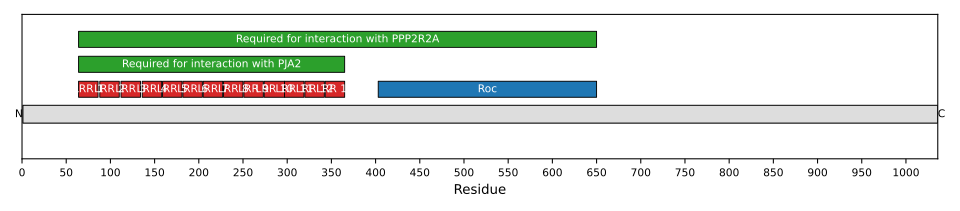
1: Probable GTP-binding protein (PubMed:24286120). Functions in innate immunity and more specifically the inflammatory response as a regulator of the Toll-like receptor TLR2 and TLR4 signaling pathways (PubMed:26599367, PubMed:28471450, PubMed:28609714). Negatively regulates the part of the TLR4 signaling pathway that leads to the activation of the transcription factor AP-1. By retaining the phosphatase complex PP2A into the cytoplasm, prevents the dephosphorylation of the AP-1 subunit JUN which is required for proper activation of the transcription factor (PubMed:28609714). Both inhibits and activates the TLR2-dependent signaling pathway (PubMed:26599367). Positively regulates the TLR2 signaling pathway to activate specifically the downstream p38 and JNK MAP kinases and promote the polarization of macrophages toward the pro-inflammatory M1 phenotype (PubMed:28471450). It may also play a role in the regulation of inflammation induced by high glucose through the PKB/AKT signaling pathway (PubMed:29168081). Also involved in erythrocyte differentiation through activation of the ERK1/ERK2 signaling pathway (PubMed:23327923)