Lysyl oxidase homolog 2 (EC 1.4.3.13) (Lysyl oxidase-like protein 2) (Lysyl oxidase-related protein 2) (Lysyl oxidase-related protein WS9-14)
1_MERPL 6_ CSHLC 11_ SCLAM 16_ LALLS 21_ PLSLA 26_ QYDSW 31_ PHYPE 36_ YFQQP 41_ APEYH 46_ QPQAP 51_ ANVAK 56_ IQLRL 61_ AGQKR 66_ KHSEG 71_ RVEVY 76_ YDGQW 81_ GTVCD 86_ DDFSI 91_ HAAHV 96_ VCREL 101_ GYVEA 106_ KSWTA 111_ SSSYG 116_ KGEGP 121_ IWLDN 126_ LHCTG 131_ NEATL 136_ AACTS 141_ NGWGV 146_ TDCKH 151_ TEDVG 156_ VVCSD 161_ KRIPG 166_ FKFDN 171_ SLINQ 176_ IENLN 181_ IQVED 186_ IRIRA 191_ ILSTY 196_ RKRTP 201_ VMEGY 206_ VEVKE 211_ GKTWK 216_ QICDK 221_ HWTAK 226_ NSRVV 231_ CGMFG 236_ FPGER 241_ TYNTK 246_ VYKMF 251_ ASRRK 256_ QRYWP 261_ FSMDC 266_ TGTEA 271_ HISSC 276_ KLGPQ 281_ VSLDP 286_ MKNVT 291_ CENGL 296_ PAVVS 301_ CVPGQ 306_ VFSPD 311_ GPSRF 316_ RKAYK 321_ PEQPL 326_ VRLRG 331_ GAYIG 336_ EGRVE 341_ VLKNG 346_ EWGTV 351_ CDDKW 356_ DLVSA 361_ SVVCR 366_ ELGFG 371_ SAKEA 376_ VTGSR 381_ LGQGI 386_ GPIHL 391_ NEIQC 396_ TGNEK 401_ SIIDC 406_ KFNAE 411_ SQGCN 416_ HEEDA 421_ GVRCN 426_ TPAMG 431_ LQKKL 436_ RLNGG 441_ RNPYE 446_ GRVEV 451_ LVERN 456_ GSLVW 461_ GMVCG 466_ QNWGI 471_ VEAMV 476_ VCRQL 481_ GLGFA 486_ SNAFQ 491_ ETWYW 496_ HGDVN 501_ SNKVV 506_ MSGVK 511_ CSGTE 516_ LSLAH 521_ CRHDG 526_ EDVAC 531_ PQGGV 536_ QYGAG 541_ VACSE 546_ TAPDL 551_ VLNAE 556_ MVQQT 561_ TYLED 566_ RPMFM 571_ LQCAM 576_ EENCL 581_ SASAA 586_ QTDPT 591_ TGYRR 596_ LLRFS 601_ SQIHN 606_ NGQSD 611_ FRPKN 616_ GRHAW 621_ IWHDC 626_ HRHYH 631_ SMEVF 636_ THYDL 641_ LNLNG 646_ TKVAE 651_ GHKAS 656_ FCLED 661_ TECEG 666_ DIQKN 671_ YECAN 676_ FGDQG 681_ ITMGC 686_ WDMYR 691_ HDIDC 696_ QWVDI 701_ TDVPP 706_ GDYLF 711_ QVVIN 716_ PNFEV 721_ AESDY 726_ SNNIM 731_ KCRSR 736_ YDGHR 741_ IWMYN 746_ CHIGG 751_ SFSEE 756_ TEKKF 761_ EHFSG 766_LLNNQ
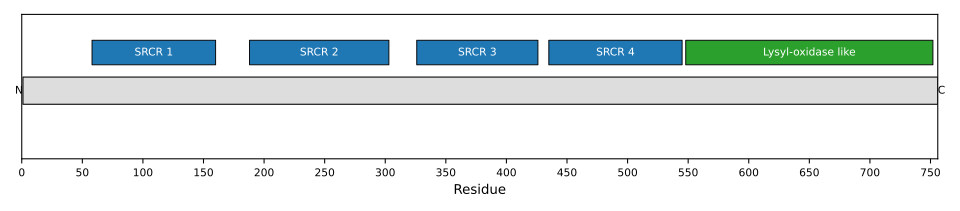
1: Mediates the post-translational oxidative deamination of lysine residues on target proteins leading to the formation of deaminated lysine (allysine) (PubMed:27735137). Acts as a transcription corepressor and specifically mediates deamination of trimethylated 'Lys-4' of histone H3 (H3K4me3), a specific tag for epigenetic transcriptional activation (PubMed:27735137). Shows no activity against histone H3 when it is trimethylated on 'Lys-9' (H3K9me3) or 'Lys-27' (H3K27me3) or when 'Lys-4' is monomethylated (H3K4me1) or dimethylated (H3K4me2) (PubMed:27735137). Also mediates deamination of methylated TAF10, a member of the transcription factor IID (TFIID) complex, which induces release of TAF10 from promoters, leading to inhibition of TFIID-dependent transcription (PubMed:25959397). LOXL2-mediated deamination of TAF10 results in transcriptional repression of genes required for embryonic stem cell pluripotency including POU5F1/OCT4, NANOG, KLF4 and SOX2 (By similarity). Involved in epithelial to mesenchymal transition (EMT) via interaction with SNAI1 and participates in repression of E-cadherin CDH1, probably by mediating deamination of histone H3 (PubMed:16096638, PubMed:24414204, PubMed:27735137). During EMT, involved with SNAI1 in negatively regulating pericentromeric heterochromatin transcription (PubMed:24239292). SNAI1 recruits LOXL2 to pericentromeric regions to oxidize histone H3 and repress transcription which leads to release of heterochromatin component CBX5/HP1A, enabling chromatin reorganization and acquisition of mesenchymal traits (PubMed:24239292). Interacts with the endoplasmic reticulum protein HSPA5 which activates the IRE1-XBP1 pathway of the unfolded protein response, leading to expression of several transcription factors involved in EMT and subsequent EMT induction (PubMed:28332555). Involved in E-cadherin repression following hypoxia, a hallmark of EMT believed to amplify tumor aggressiveness, suggesting that it may play a role in tumor progression (PubMed:20026874). When secreted into the extracellular matrix, promotes cross-linking of extracellular matrix proteins by mediating oxidative deamination of peptidyl lysine residues in precursors to fibrous collagen and elastin (PubMed:20306300). Acts as a regulator of sprouting angiogenesis, probably via collagen IV scaffolding (PubMed:21835952). Acts as a regulator of chondrocyte differentiation, probably by regulating expression of factors that control chondrocyte differentiation (By similarity)