Receptor-interacting serine/threonine-protein kinase 3 (EC 2.7.11.1) (RIP-like protein kinase 3) (Receptor-interacting protein 3) (RIP-3)
1_MSCVK 6_ LWPSG 11_ APAPL 16_ VSIEE 21_ LENQE 26_ LVGKG 31_ GFGTV 36_ FRAQH 41_ RKWGY 46_ DVAVK 51_ IVNSK 56_ AISRE 61_ VKAMA 66_ SLDNE 71_ FVLRL 76_ EGVIE 81_ KVNWD 86_ QDPKP 91_ ALVTK 96_ FMENG 101_ SLSGL 106_ LQSQC 111_ PRPWP 116_ LLCRL 121_ LKEVV 126_ LGMFY 131_ LHDQN 136_ PVLLH 141_ RDLKP 146_ SNVLL 151_ DPELH 156_ VKLAD 161_ FGLST 166_ FQGGS 171_ QSGTG 176_ SGEPG 181_ GTLGY 186_ LAPEL 191_ FVNVN 196_ RKAST 201_ ASDVY 206_ SFGIL 211_ MWAVL 216_ AGREV 221_ ELPTE 226_ PSLVY 231_ EAVCN 236_ RQNRP 241_ SLAEL 246_ PQAGP 251_ ETPGL 256_ EGLKE 261_ LMQLC 266_ WSSEP 271_ KDRPS 276_ FQECL 281_ PKTDE 286_ VFQMV 291_ ENNMN 296_ AAVST 301_ VKDFL 306_ SQLRS 311_ SNRRF 316_ SIPES 321_ GQGGT 326_ EMDGF 331_ RRTIE 336_ NQHSR 341_ NDVMV 346_ SEWLN 351_ KLNLE 356_ EPPSS 361_ VPKKC 366_ PSLTK 371_ RSRAQ 376_ EEQVP 381_ QAWTA 386_ GTSSD 391_ SMAQP 396_ PQTPE 401_ TSTFR 406_ NQMPS 411_ PTSTG 416_ TPSPG 421_ PRGNQ 426_ GAERQ 431_ GMNWS 436_ CRTPE 441_ PNPVT 446_ GRPLV 451_ NIYNC 456_ SGVQV 461_ GDNNY 466_ LTMQQ 471_ TTALP 476_ TWGLA 481_ PSGKG 486_ RGLQH 491_ PPPVG 496_ SQEGP 501_ KDPEA 506_ WSRPQ 511_GWYNH
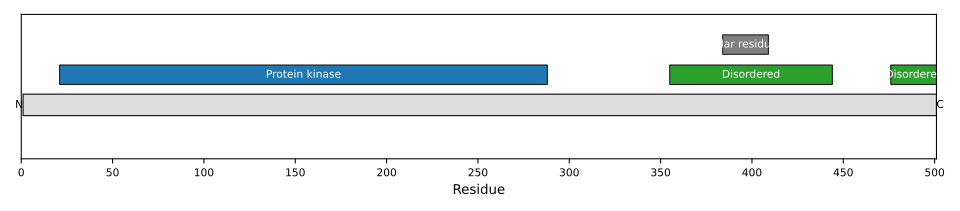
1: Serine/threonine-protein kinase that activates necroptosis and apoptosis, two parallel forms of cell death (PubMed:19524512, PubMed:19524513, PubMed:22265413, PubMed:22265414, PubMed:22421439, PubMed:29883609, PubMed:32657447). Necroptosis, a programmed cell death process in response to death-inducing TNF-alpha family members, is triggered by RIPK3 following activation by ZBP1 (PubMed:19524512, PubMed:19524513, PubMed:22265413, PubMed:22265414, PubMed:22421439, PubMed:29883609, PubMed:32298652). Activated RIPK3 forms a necrosis-inducing complex and mediates phosphorylation of MLKL, promoting MLKL localization to the plasma membrane and execution of programmed necrosis characterized by calcium influx and plasma membrane damage (PubMed:19524512, PubMed:19524513, PubMed:22265413, PubMed:22265414, PubMed:22421439, PubMed:25316792, PubMed:29883609). In addition to TNF-induced necroptosis, necroptosis can also take place in the nucleus in response to orthomyxoviruses infection: following ZBP1 activation, which senses double-stranded Z-RNA structures, nuclear RIPK3 catalyzes phosphorylation and activation of MLKL, promoting disruption of the nuclear envelope and leakage of cellular DNA into the cytosol (By similarity). Also regulates apoptosis: apoptosis depends on RIPK1, FADD and CASP8, and is independent of MLKL and RIPK3 kinase activity (By similarity). Phosphorylates RIPK1: RIPK1 and RIPK3 undergo reciprocal auto- and trans-phosphorylation (PubMed:19524513). In some cell types, also able to restrict viral replication by promoting cell death-independent responses (By similarity). In response to Zika virus infection in neurons, promotes a cell death-independent pathway that restricts viral replication: together with ZBP1, promotes a death-independent transcriptional program that modifies the cellular metabolism via up-regulation expression of the enzyme ACOD1/IRG1 and production of the metabolite itaconate (By similarity). Itaconate inhibits the activity of succinate dehydrogenase, generating a metabolic state in neurons that suppresses replication of viral genomes (By similarity). RIPK3 binds to and enhances the activity of three metabolic enzymes: GLUL, GLUD1, and PYGL (PubMed:19498109). These metabolic enzymes may eventually stimulate the tricarboxylic acid cycle and oxidative phosphorylation, which could result in enhanced ROS production (PubMed:19498109)
2: (Microbial infection) In case of herpes simplex virus 1/HHV-1 infection, forms heteromeric amyloid structures with HHV-1 protein RIR1/ICP6 which may inhibit RIPK3-mediated necroptosis, thereby preventing host cell death pathway and allowing viral evasion