RNA-binding protein 7 (RNA-binding motif protein 7)
1_MGAAA 6_ AEADR 11_ TLFVG 16_ NLETK 21_ VTEEL 26_ LFELF 31_ HQAGP 36_ VIKVK 41_ IPKDK 46_ DGKPK 51_ QFAFV 56_ NFKHE 61_ VSVPY 66_ AMNLL 71_ NGIKL 76_ YGRPI 81_ KIQFR 86_ SGSSH 91_ APQDV 96_ SLSYP 101_ QHHVG 106_ NSSPT 111_ STSPS 116_ RYERT 121_ MDNMT 126_ SSAQI 131_ IQRSF 136_ SSPEN 141_ FQRQA 146_ VMNSA 151_ LRQMS 156_ YGGKF 161_ GSSPL 166_ DQSGF 171_ SPSVQ 176_ SHSHS 181_ FNQSS 186_ SSQWR 191_ QGTPS 196_ SQRKV 201_ RMNSY 206_ PYLAD 211_ RHYSR 216_ EQRYT 221_ DHGSD 226_ HHYRG 231_ KRDDF 236_ FYEDR 241_ NHDDW 246_ SHDYD 251_ NRRDS 256_ SRDGK 261_WRSSR
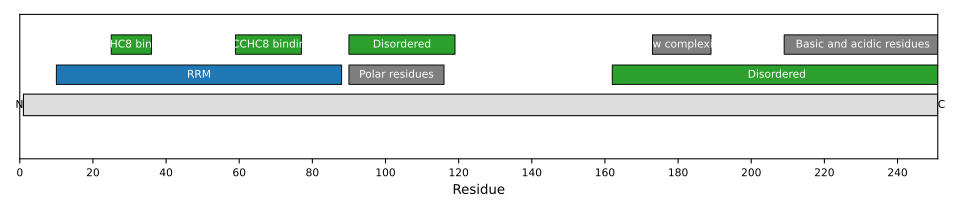
1: RNA-binding subunit of the trimeric nuclear exosome targeting (NEXT) complex, a complex that functions as an RNA exosome cofactor that directs a subset of non-coding short-lived RNAs for exosomal degradation (PubMed:25189701, PubMed:25525152, PubMed:25578728, PubMed:25852104, PubMed:27871484). NEXT is involved in surveillance and turnover of aberrant transcripts and non-coding RNAs (PubMed:25189701, PubMed:25852104, PubMed:27871484). Binds preferentially polyuridine sequences and associates with newly synthesized RNAs, including pre-mRNAs and short-lived exosome substrates such as promoter upstream transcripts (PROMPTs), enhancer RNAs (eRNAs), and 3'-extended products from small nuclear RNAs (snRNAs) (PubMed:25189701, PubMed:25525152, PubMed:25578728, PubMed:25852104). Participates in several biological processes including DNA damage response (DDR) and stress response (PubMed:25525152, PubMed:30824372). During stress response, activation of the p38MAPK-MK2 pathway decreases RBM7-RNA-binding and subsequently the RNA exosome degradation activities, thereby modulating the turnover of non-coding transcriptome (PubMed:25525152). Participates in DNA damage response (DDR), through its interaction with MEPCE and LARP7, the core subunits of 7SK snRNP complex, that release the positive transcription elongation factor b (P-TEFb) complex from the 7SK snRNP. In turn, activation of P-TEFb complex induces the transcription of P-TEFb-dependent DDR genes to promote cell viability (PubMed:30824372)