YTH domain-containing family protein 2 (DF2) (CLL-associated antigen KW-14) (High-glucose-regulated protein 8) (Renal carcinoma antigen NY-REN-2)
1_MSASS 6_ LLEQR 11_ PKGQG 16_ NKVQN 21_ GSVHQ 26_ KDGLN 31_ DDDFE 36_ PYLSP 41_ QARPN 46_ NAYTA 51_ MSDSY 56_ LPSYY 61_ SPSIG 66_ FSYSL 71_ GEAAW 76_ STGGD 81_ TAMPY 86_ LTSYG 91_ QLSNG 96_ EPHFL 101_ PDAMF 106_ GQPGA 111_ LGSTP 116_ FLGQH 121_ GFNFF 126_ PSGID 131_ FSAWG 136_ NNSSQ 141_ GQSTQ 146_ SSGYS 151_ SNYAY 156_ APSSL 161_ GGAMI 166_ DGQSA 171_ FANET 176_ LNKAP 181_ GMNTI 186_ DQGMA 191_ ALKLG 196_ STEVA 201_ SNVPK 206_ VVGSA 211_ VGSGS 216_ ITSNI 221_ VASNS 226_ LPPAT 231_ IAPPK 236_ PASWA 241_ DIASK 246_ PAKQQ 251_ PKLKT 256_ KNGIA 261_ GSSLP 266_ PPPIK 271_ HNMDI 276_ GTWDN 281_ KGPVA 286_ KAPSQ 291_ ALVQN 296_ IGQPT 301_ QGSPQ 306_ PVGQQ 311_ ANNSP 316_ PVAQA 321_ SVGQQ 326_ TQPLP 331_ PPPPQ 336_ PAQLS 341_ VQQQA 346_ AQPTR 351_ WVAPR 356_ NRGSG 361_ FGHNG 366_ VDGNG 371_ VGQSQ 376_ AGSGS 381_ TPSEP 386_ HPVLE 391_ KLRSI 396_ NNYNP 401_ KDFDW 406_ NLKHG 411_ RVFII 416_ KSYSE 421_ DDIHR 426_ SIKYN 431_ IWCST 436_ EHGNK 441_ RLDAA 446_ YRSMN 451_ GKGPV 456_ YLLFS 461_ VNGSG 466_ HFCGV 471_ AEMKS 476_ AVDYN 481_ TCAGV 486_ WSQDK 491_ WKGRF 496_ DVRWI 501_ FVKDV 506_ PNSQL 511_ RHIRL 516_ ENNEN 521_ KPVTN 526_ SRDTQ 531_ EVPLE 536_ KAKQV 541_ LKIIA 546_ SYKHT 551_ TSIFD 556_ DFSHY 561_ EKRQE 566_ EEESV 571_KKERQ
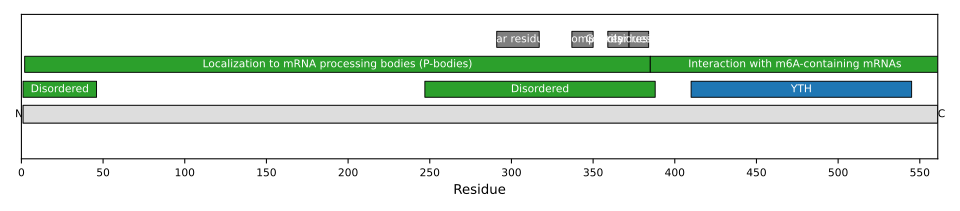
1: Specifically recognizes and binds N6-methyladenosine (m6A)-containing RNAs, and regulates their stability (PubMed:24284625, PubMed:26046440, PubMed:26318451, PubMed:32492408). M6A is a modification present at internal sites of mRNAs and some non-coding RNAs and plays a role in mRNA stability and processing (PubMed:22575960, PubMed:24284625, PubMed:25412658, PubMed:25412661, PubMed:32492408). Acts as a regulator of mRNA stability by promoting degradation of m6A-containing mRNAs via interaction with the CCR4-NOT and ribonuclease P/MRP complexes, depending on the context (PubMed:24284625, PubMed:26046440, PubMed:27558897, PubMed:30930054, PubMed:32492408). The YTHDF paralogs (YTHDF1, YTHDF2 and YTHDF3) share m6A-containing mRNAs targets and act redundantly to mediate mRNA degradation and cellular differentiation (PubMed:28106072, PubMed:32492408). M6A-containing mRNAs containing a binding site for RIDA/HRSP12 (5'-GGUUC-3') are preferentially degraded by endoribonucleolytic cleavage: cooperative binding of RIDA/HRSP12 and YTHDF2 to transcripts leads to recruitment of the ribonuclease P/MRP complex (PubMed:30930054). Other m6A-containing mRNAs undergo deadenylation via direct interaction between YTHDF2 and CNOT1, leading to recruitment of the CCR4-NOT and subsequent deadenylation of m6A-containing mRNAs (PubMed:27558897). Required maternally to regulate oocyte maturation: probably acts by binding to m6A-containing mRNAs, thereby regulating maternal transcript dosage during oocyte maturation, which is essential for the competence of oocytes to sustain early zygotic development (By similarity). Also required during spermatogenesis: regulates spermagonial adhesion by promoting degradation of m6A-containing transcripts coding for matrix metallopeptidases (By similarity). Also involved in hematopoietic stem cells specification by binding to m6A-containing mRNAs, leading to promote their degradation (PubMed:30065315). Also acts as a regulator of neural development by promoting m6A-dependent degradation of neural development-related mRNA targets (By similarity). Inhibits neural specification of induced pluripotent stem cells by binding to methylated neural-specific mRNAs and promoting their degradation, thereby restraining neural differentiation (PubMed:32169943). Regulates circadian regulation of hepatic lipid metabolism: acts by promoting m6A-dependent degradation of PPARA transcripts (PubMed:30428350). Regulates the innate immune response to infection by inhibiting the type I interferon response: acts by binding to m6A-containing IFNB transcripts and promoting their degradation (PubMed:30559377). May also act as a promoter of cap-independent mRNA translation following heat shock stress: upon stress, relocalizes to the nucleus and specifically binds mRNAs with some m6A methylation mark at their 5'-UTR, protecting demethylation of mRNAs by FTO, thereby promoting cap-independent mRNA translation (PubMed:26458103). Regulates mitotic entry by promoting the phase-specific m6A-dependent degradation of WEE1 transcripts (PubMed:32267835). Promotes formation of phase-separated membraneless compartments, such as P-bodies or stress granules, by undergoing liquid-liquid phase separation upon binding to mRNAs containing multiple m6A-modified residues: polymethylated mRNAs act as a multivalent scaffold for the binding of YTHDF proteins, juxtaposing their disordered regions and thereby leading to phase separation (PubMed:31292544, PubMed:31388144, PubMed:31642031, PubMed:32451507). The resulting mRNA-YTHDF complexes then partition into different endogenous phase-separated membraneless compartments, such as P-bodies, stress granules or neuronal RNA granules (PubMed:31292544). May also recognize and bind RNAs modified by C5-methylcytosine (m5C) and act as a regulator of rRNA processing (PubMed:31815440)
2: (Microbial infection) Promotes viral gene expression and replication of polyomavirus SV40: acts by binding to N6-methyladenosine (m6A)-containing viral RNAs (PubMed:29447282)
3: (Microbial infection) Promotes viral gene expression and virion production of kaposis sarcoma-associated herpesvirus (KSHV) at some stage of the KSHV life cycle (in iSLK.219 and iSLK.BAC16 cells) (PubMed:29659627). Acts by binding to N6-methyladenosine (m6A)-containing viral RNAs (PubMed:29659627)