Fatty acid desaturase 3 (EC 1.14.19.-) (Delta(13) fatty acid desaturase) (Delta(13) desaturase)
1_MGGVG 6_ EPGPR 11_ EGPAQ 16_ PGAPL 21_ PTFCW 26_ EQIRA 31_ HDQPG 36_ DKWLV 41_ IERRV 46_ YDISR 51_ WAQRH 56_ PGGSR 61_ LIGHH 66_ GAEDA 71_ TDAFR 76_ AFHQD 81_ LNFVR 86_ KFLQP 91_ LLIGE 96_ LAPEE 101_ PSQDG 106_ PLNAQ 111_ LVEDF 116_ RALHQ 121_ AAEDM 126_ KLFDA 131_ SPTFF 136_ AFLLG 141_ HILAM 146_ EVLAW 151_ LLIYL 156_ LGPGW 161_ VPSAL 166_ AAFIL 171_ AISQA 176_ QSWCL 181_ QHDLG 186_ HASIF 191_ KKSWW 196_ NHVAQ 201_ KFVMG 206_ QLKGF 211_ SAHWW 216_ NFRHF 221_ QHHAK 226_ PNIFH 231_ KDPDV 236_ TVAPV 241_ FLLGE 246_ SSVEY 251_ GKKKR 256_ RYLPY 261_ NQQHL 266_ YFFLI 271_ GPPLL 276_ TLVNF 281_ EVENL 286_ AYMLV 291_ CMQWA 296_ DLLWA 301_ ASFYA 306_ RFFLS 311_ YLPFY 316_ GVPGV 321_ LLFFV 326_ AVRVL 331_ ESHWF 336_ VWITQ 341_ MNHIP 346_ KEIGH 351_ EKHRD 356_ WVSSQ 361_ LAATC 366_ NVEPS 371_ LFTNW 376_ FSGHL 381_ NFQIE 386_ HHLFP 391_ RMPRH 396_ NYSRV 401_ APLVK 406_ SLCAK 411_ HGLSY 416_ EVKPF 421_ LTALV 426_ DIVRS 431_ LKKSG 436_DIWLD
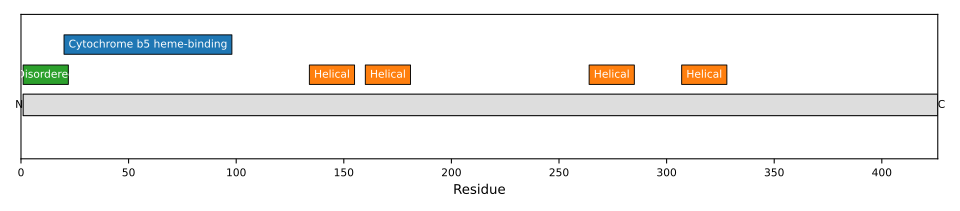
1: Mammals have different sphingoid bases that differ in their length and/or pattern of desaturation and hydroxyl groups. The predominant sphingoid base that comprises mammalian ceramides is sphing-4-enine (sphingosine or SPH) which has a trans (E) desaturation at carbon 4 (PubMed:31862735, PubMed:31916624). FADS3 is a desaturase that introduces a cis (Z) double bond between carbon 14 and carbon 15 of the sphingoid base (also known as long chain base, LCB), producing LCBs such as sphinga-4,14-dienine (SPD, d18:2(4E,14Z)) from SPH (PubMed:31862735, PubMed:31916624, PubMed:37209771). Prefers SPH-containing ceramides (N-acylsphing-4-enines) as substrates (PubMed:31862735, PubMed:31916624, PubMed:37209771). Capable of metabolizing also the SPH in its free form (PubMed:31862735). SPD ceramides occur widely in mammalian tissues and cells (PubMed:31916624). Due to their unusual structure containing a cis double bond, SPD ceramides may have an opposite, negative role in lipid microdomain formation relative to conventional ceramides (PubMed:31916624). Could be involved in the detoxification of 1-deoxy sphingolipids, by desaturating the cytotoxic 1-deoxysphinganine (1-deoxySA, m18:0), produced under pathological conditions, to 1-deoxysphingenine (1-deoxysphingosine, 1-deoxySO, m18:1) (Probable). Although prefers SPH-containing ceramides (N-acylsphing-4-enines) as substrates, it also exhibits activity toward dihydrosphingosine-containing CERs (N-acylsphinganines) and produces 14Z-SPH-containing sphingolipids,which can be found in patients with DEGS1 mutations (PubMed:37209771). Its desaturase mechanism involves an electron transfer facilitated by cytochrome b5 (PubMed:37209771). FADS3 also acts as a methyl-end fatty acyl coenzyme A (CoA) desaturase that introduces a cis double bond between the preexisting double bond and the terminal methyl group of the fatty acyl chain (By similarity). Desaturates (11E)-octadecenoate (trans-vaccenoate, the predominant trans fatty acid in human milk) at carbon 13 to generate (11E,13Z)-octadecadienoate (also known as conjugated linoleic acid 11E,13Z-CLA) (By similarity)